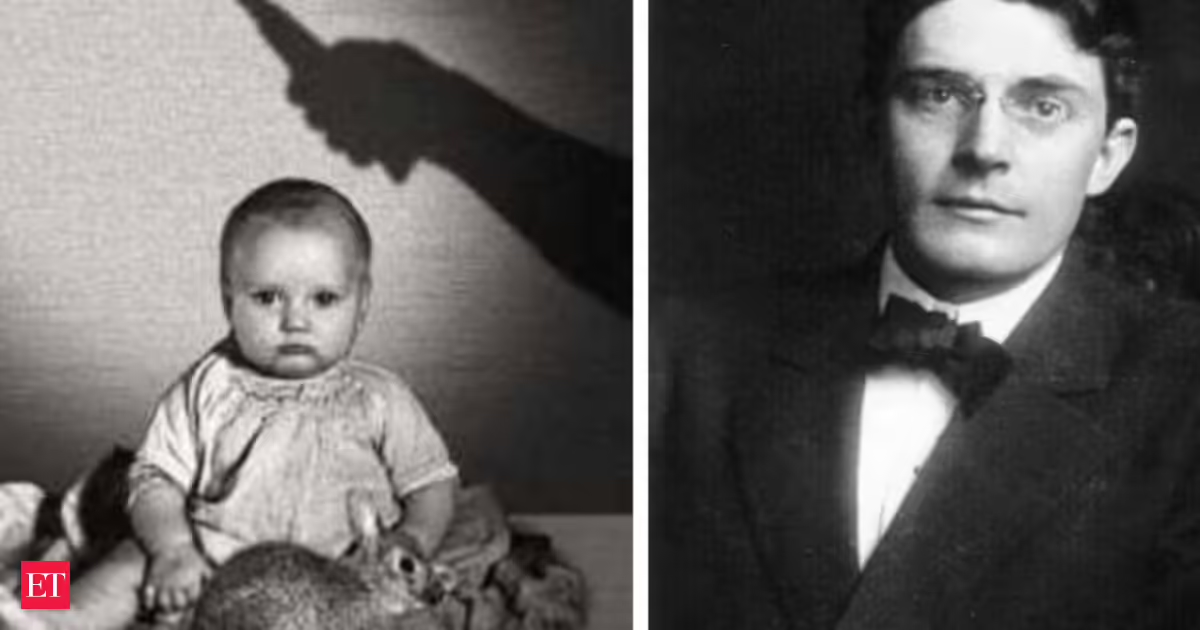
Few psychology experiments have become as famous, or as controversial, as the study known as Little Albert. Conducted by psychologist John B. Watson and his graduate student Rosalie Rayner, the experiment appeared to show that fear could be learned through experience rather than emerging entirely from instinct. It was published in the Journal of Experimental Psychology in 1920, and the study involved pairing a white rat with a loud, frightening noise and observing how an infant responded over time.More than a century later, researchers still discuss the experiment because it helped launch decades of work on fear learning, anxiety, and emotional conditioning, even as modern scholars continue to debate its methods and conclusions.One of a series of published stills taken from film of the experiment | Wikimedia CommonsA simple experiment asked a surprisingly big questionBehaviorism was becoming one of the dominant movements in psychology at the time Watson conducted the study. Behaviorists argued that much of human behavior could be understood through learning and environmental influences rather than through hidden mental processes.To test whether emotions could be conditioned, Watson and Rayner worked with an infant later known as Little Albert. Initially, the child showed no fear of a white laboratory rat. Researchers then paired the rat’s appearance with a loud noise created by striking a steel bar behind the child. According to the original report published in the Journal of Experimental Psychology, Albert eventually began showing signs of distress when the rat appeared, even when the noise was absent. The study quickly became one of psychology’s most cited demonstrations of classical conditioning in humans.The experiment suggested that fear could spreadOne reason the study became so influential is that the reported fear response did not remain limited to the rat itself. Watson and Rayner claimed that Albert also reacted negatively to other furry objects, including a rabbit and a fur coat.Modern reviews of fear conditioning, including work published in Neuroscience & Biobehavioral Reviews and Behavior Research and Therapy, describe this process as fear generalization. In everyday life, people rarely react only to the exact source of an unpleasant experience. Instead, fear often spreads to similar objects, situations, or environments. The Little Albert experiment appeared to provide an early illustration of how that process might occur, helping researchers think about the development of phobias and anxiety disorders.Later researchers questioned the storyAlthough the experiment became a staple of psychology textbooks, the story grew more complicated over time. Historians and psychologists who reexamined the original records discovered important uncertainties about the case, including questions about Albert’s identity, health, and the strength of the reported fear responses.A detailed historical review published in History of Psychology argued that the experiment’s popular retelling often goes beyond what the available evidence can confidently support. More recently, researchers publishing in American Psychologist analyzed surviving film footage and suggested that some textbook descriptions may exaggerate the intensity of Albert’s reactions. These debates do not erase the experiment’s historical importance, but they have encouraged a more cautious interpretation of what the study actually demonstrated.The study helped shape modern anxiety researchThe broader idea behind the experiment continued to influence psychological science despite the criticisms. Research on fear conditioning remains central to understanding anxiety disorders, trauma responses, and phobias.Reviews published in journals such as Nature Reviews Neuroscience and Current Opinion in Behavioral Sciences continue to describe conditioned fear as a key mechanism in emotional learning. Scientists now study these processes using far more sophisticated methods than Watson could have imagined, examining how the brain predicts threats, stores fear memories, and gradually reduces fear through extinction learning. In many ways, those modern investigations can be traced back to the same question that motivated the Little Albert experiment more than a century ago: how do people learn what to fear?John B. Watson | Wikimedia CommonsThe ethical questions became just as importantToday, the Little Albert experiment is remembered not only for its scientific influence but also for its ethical problems. Modern research standards require protections that did not exist when Watson conducted the study, particularly when children are involved.Articles published in Science and Engineering Ethics and teaching materials used in modern psychology programs often present the case as an example of why informed consent, participant welfare, and independent ethical review became so important. The study therefore occupies a unique place in psychology’s history because it helped shape conversations about both scientific knowledge and scientific responsibility.More than one hundred years later, Little Albert remains one of psychology’s most enduring stories because it sits at the intersection of discovery, controversy, and ethics. The experiment helped popularize the idea that fear can be learned through experience, a concept that continues to influence research on anxiety and emotional development. At the same time, later investigations have shown that the famous story is more complicated than many textbooks once suggested. Its lasting significance lies not only in what it revealed about fear, but also in the questions it raised about how psychological research should be conducted and remembered.
In 1920, a psychologist watched a toddler learn fear from a white rat and revealed that fear could be learned
A famous psychology study from 1920, the Little Albert experiment, showed fear can be learned. Conducted by John B. Watson and Rosalie Rayner, it paired a rat with loud noises. This influenced decades of research on anxiety and emotional conditioning. However, later reviews questioned its methods and conclusions. The study also highlighted crucial ethical considerations in psychological research.
827 words~4 min read