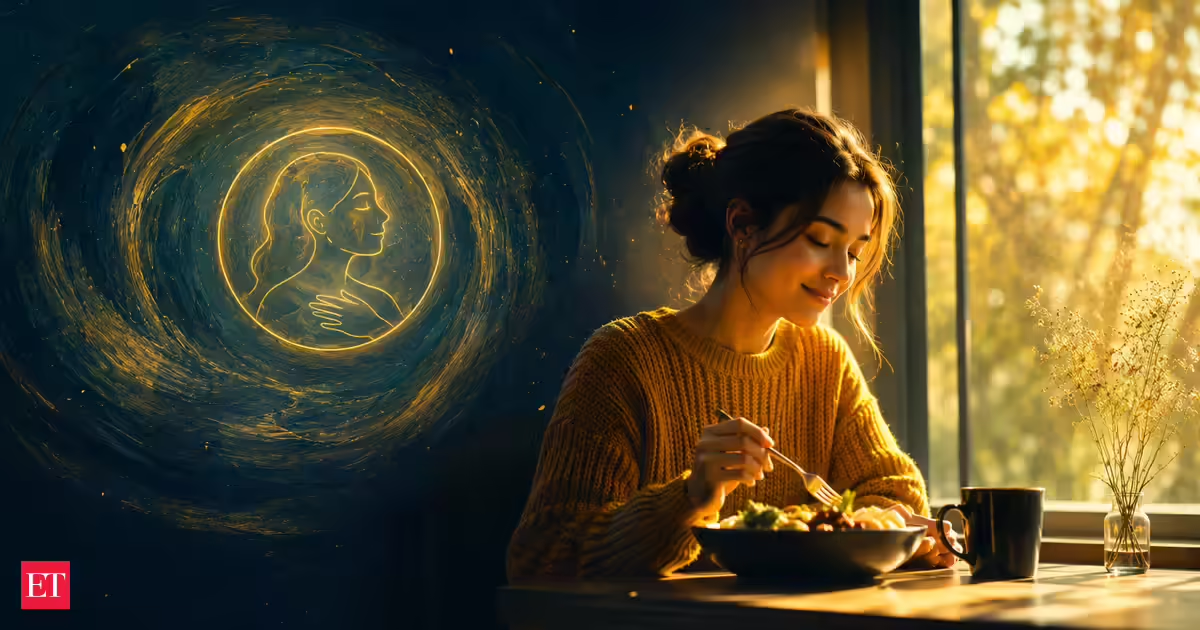
Picture this: you are at a dinner party, and someone asks the question that everyone dreads: “So, are you seeing anyone?” You smile, lay down your fork, and say, “No. And honestly, I'm not looking.” The table goes silent for two seconds until someone changes the subject to rent prices.That silence speaks volumes. Not about the person, but about how little room American culture allows for people who have deliberately, thoughtfully chosen to stay alone. Not because they’ve given up on connection. But because it matters so much to them that a hollow version of it is worse than none at all.More Americans are making that choice. According to the Pew Research Center, as of 2021, 25% of 40-year-olds in the United States had never been married, compared to 20% just a decade earlier. Being single is not a temporary detour for millennials in particular. For many, it's probably the whole point.The story we tell about single people is wrongThere is a deeply embedded cultural script in America. You date, you commit, and you build a life with someone. Being single is the waiting room. If you are single for too long, it’s often assumed there must be something wrong.But that script doesn’t hold up when you look at the data.Rather than suffering through it, single people who really enjoy life on their own are thriving. This is according to Dr Bella DePaulo, a Harvard PhD and the leading US researcher on singlehood, who draws on survey data from more than 20,000 people across more than 100 countries. DePaulo’s research shows that the people she calls the “single at heart” lead joyful, meaningful, and psychologically rich lives. Contrary to popular assumptions, these people also become happier as they get older and are better able to navigate later life on their own than those who have built everything around a romantic partnership, DePaulo said.That calls into question everything we assume about people who aren't coupled up.She's not avoiding connection. She's protecting the real thing. Image Credits: ChatGPTFeeling too much, not too littleHere’s the part most people miss: a lot of long-term single people aren’t avoiding relationships because they don’t want connection. More often it’s the exact opposite. They want it so much that its shallowness becomes corrosive, like being in a room with another person and feeling the space between you as a weight on your chest.Research on sensory processing sensitivity helps explain why. In 1997, Elaine Aron and Arthur Aron published a seminal study in the Journal of Personality and Social Psychology suggesting that around 15 to 20% of people process emotional and social stimuli on a much deeper level than the average person. According to Aron and Aron, these highly sensitive people have heightened emotional reactivity, greater empathy, and heightened sensitivity to subtle interpersonal dynamics, such as micro-moments of dismissal or disconnection that others may not even notice.For someone wired like that, a lukewarm relationship is not neutral. It's exhausting. They know when someone is performing presence without really being present, and they can’t pretend they don’t.So they remain single. Not because they don’t believe in connection, but because they know exactly what it’s supposed to feel like and they’re not willing to settle for anything less.The double standard no one talks aboutWe cheer for the person who walks away from a soul-crushing job or toxic relationship. We call it growth, self-awareness, courage. But when you bring that same clarity to romantic relationships, when you say "I'd rather be alone than with someone who doesn't really see me," suddenly there's something wrong with you.According to DePaulo, this is a form of "singlism": the low-level but steady stigmatization and stereotyping that single people experience, baked into everything from casual assumptions to workplace policies that favor partnered employees. Single people, says DePaulo, are routinely treated as incomplete, as works in progress, as people who have simply not yet found the right person, not as people who have made a fully considered choice.This pressure is especially acute for millennials, who grew up with traditional milestone expectations but came of age in an economy that made hitting those milestones harder and, for many, less desirable on schedule.Clarity is its own form of connectionOne of the more quietly radical shifts among single millennials in the US is a redefinition of what connection actually is.Choosing yourself isn't a consolation prize. For many, it's the whole plan. Image Credits: ChatGPTIn a 2025 study published in Personal Relationships, Kredl et al. found that single young adults with a clear sense of what they wanted from relationships reported lower loneliness and greater life satisfaction, regardless of whether they were actively dating. According to Kredl et al. , the key was not relationship status but how much self-knowledge the person had when making their choices.That changes the whole conversation. The people most comfortable being single aren’t the ones who have walled themselves off. They are the ones who know themselves well enough to know what real connection is and where to find it. For many, it’s in deep friendships, chosen family, and conversations that leave you feeling more known than any relationship ever did.Choosing yourself is not a plan BMillennials have been more willing than any generation before them to look at what they actually want from life, not what they were told to want. For a growing number of them, single life isn't giving up on love. It’s refusing to perform a version of it that doesn’t feel real.The person at the dinner table who says, “I'm not looking for what most people seem to be offering,” isn't opting out. They are waiting. And in a culture where the empty chair next to you seems like a problem to be solved, it takes more courage than most people realize.
Psychology says people who've remained single by choice don't lack desire for connection; they feel it more intensely than most
Explore how those who choose to remain single experience deeper connections and a fulfilling life, challenging cultural expectations and stereotypes about being single.
961 words~4 min read