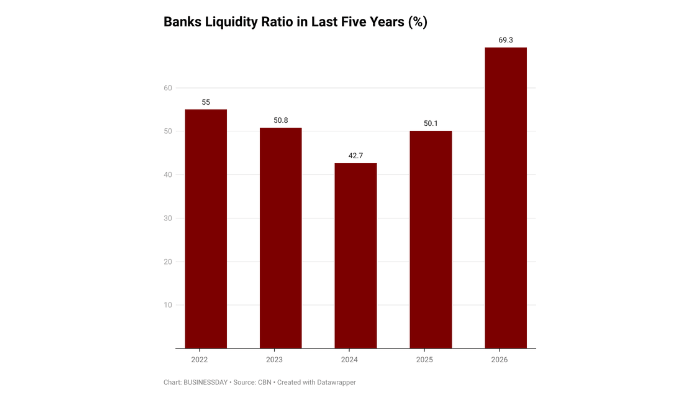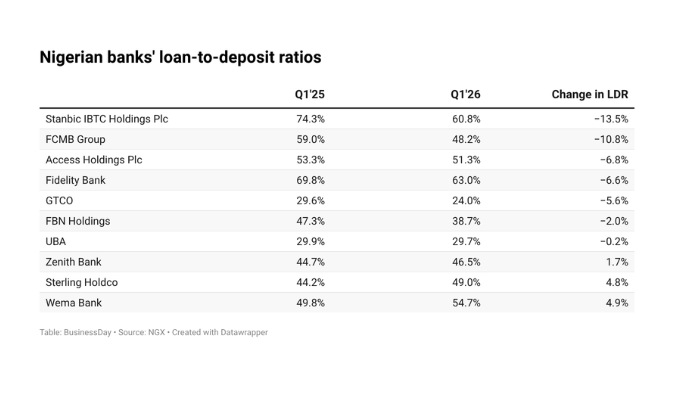
Nigerian banks became more cautious in deploying customer deposits into loans in the first half of 2026 (Q1), with Stanbic IBTC Holdings, FCMB Group, and Access Holdings recording the sharpest declines in lending appetite as deposit growth outpaced credit expansion across the sector.
An analysis of first-quarter 2026 financial statements of 10 listed banks shows that the industry’s average loan-to-deposit ratio (LDR) fell to 46.6 percent from 48.2 percent a year earlier, signalling a growing preference for liquidity preservation amid a high-interest-rate environment and persistent macroeconomic uncertainties.
The loan-to-deposit ratio, a key measure of how aggressively banks convert deposits into loans, compares a bank’s total loan book with customer deposits. A declining ratio generally indicates that deposits are growing faster than lending, reflecting a more conservative credit stance.
Stanbic IBTC recorded the steepest decline in lending appetite among the banks reviewed, with its LDR falling by 13.5 percentage points to 60.8 percent in the first quarter of 2026 from 74.3 percent a year earlier. Although the bank’s loan portfolio expanded to N2.48 trillion from N2.26 trillion, deposits grew much faster, rising to N4.08 trillion from N3.04 trillion.