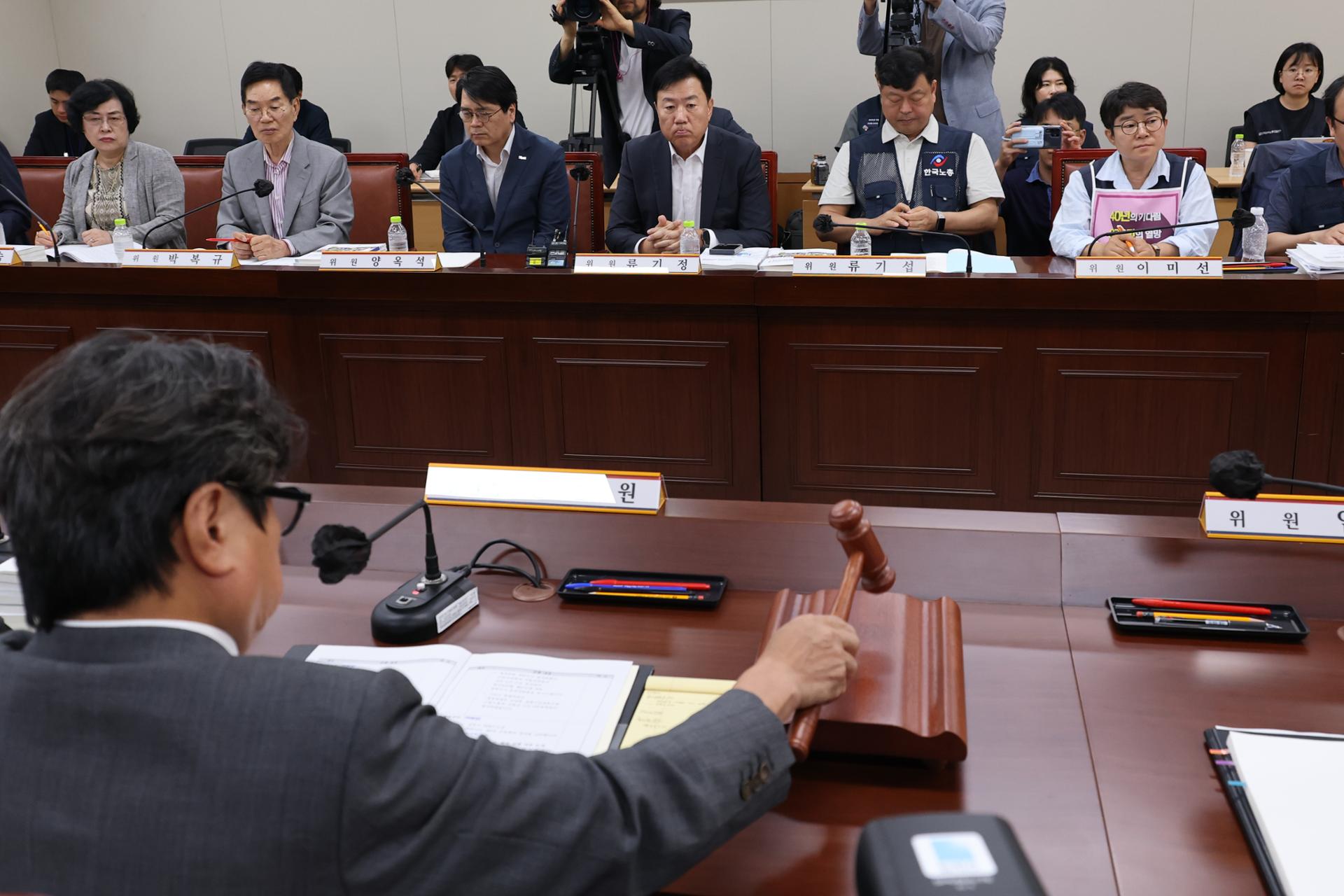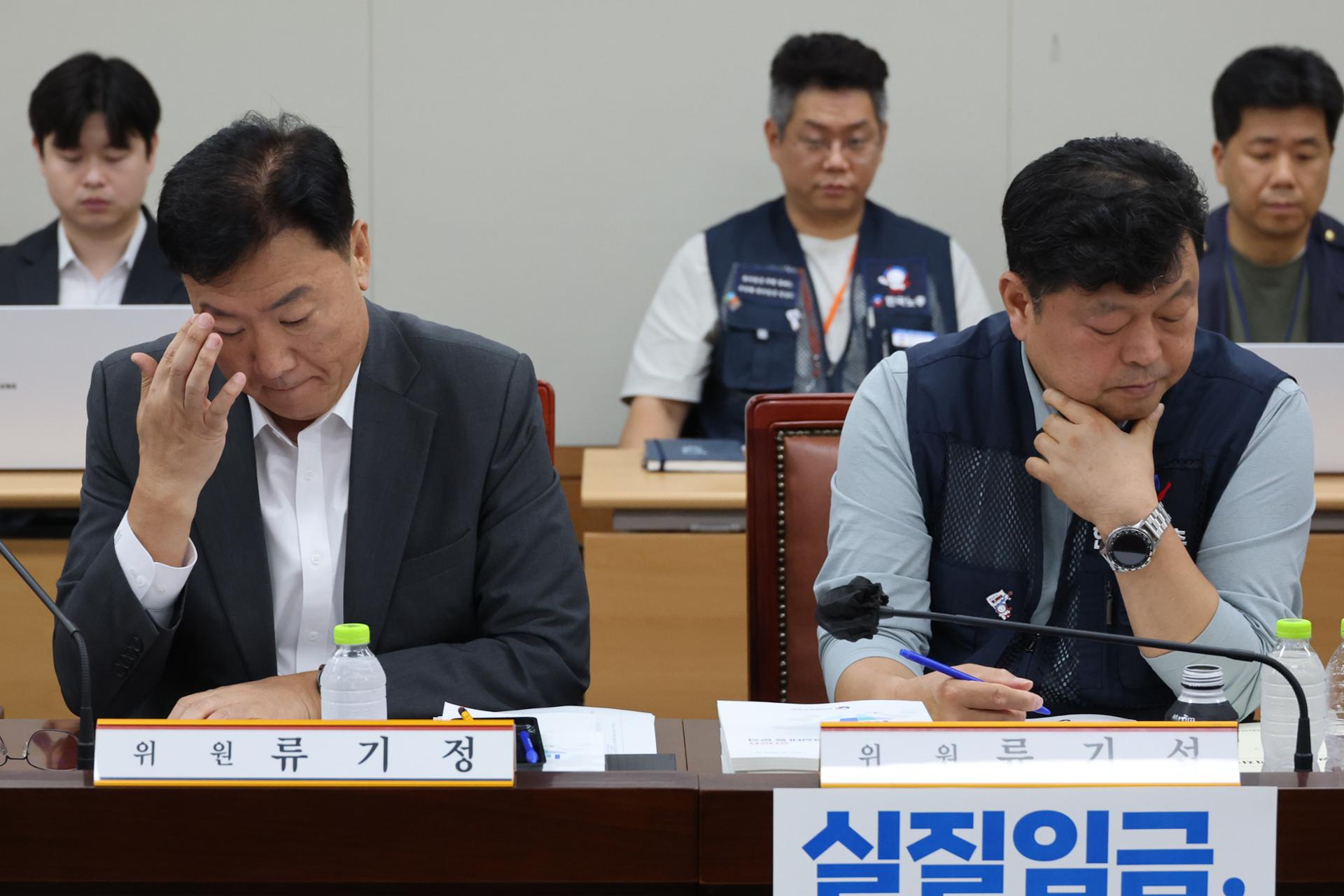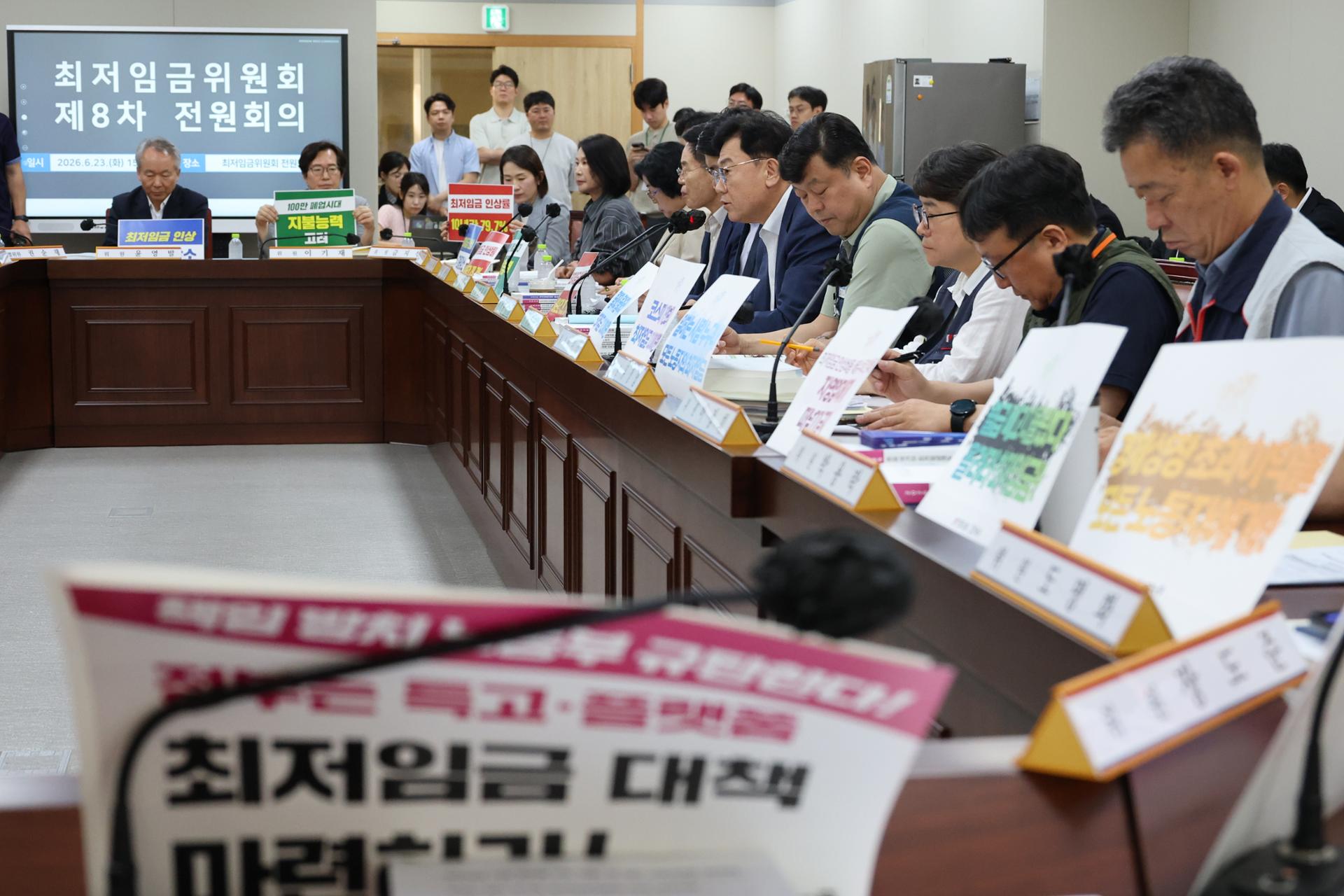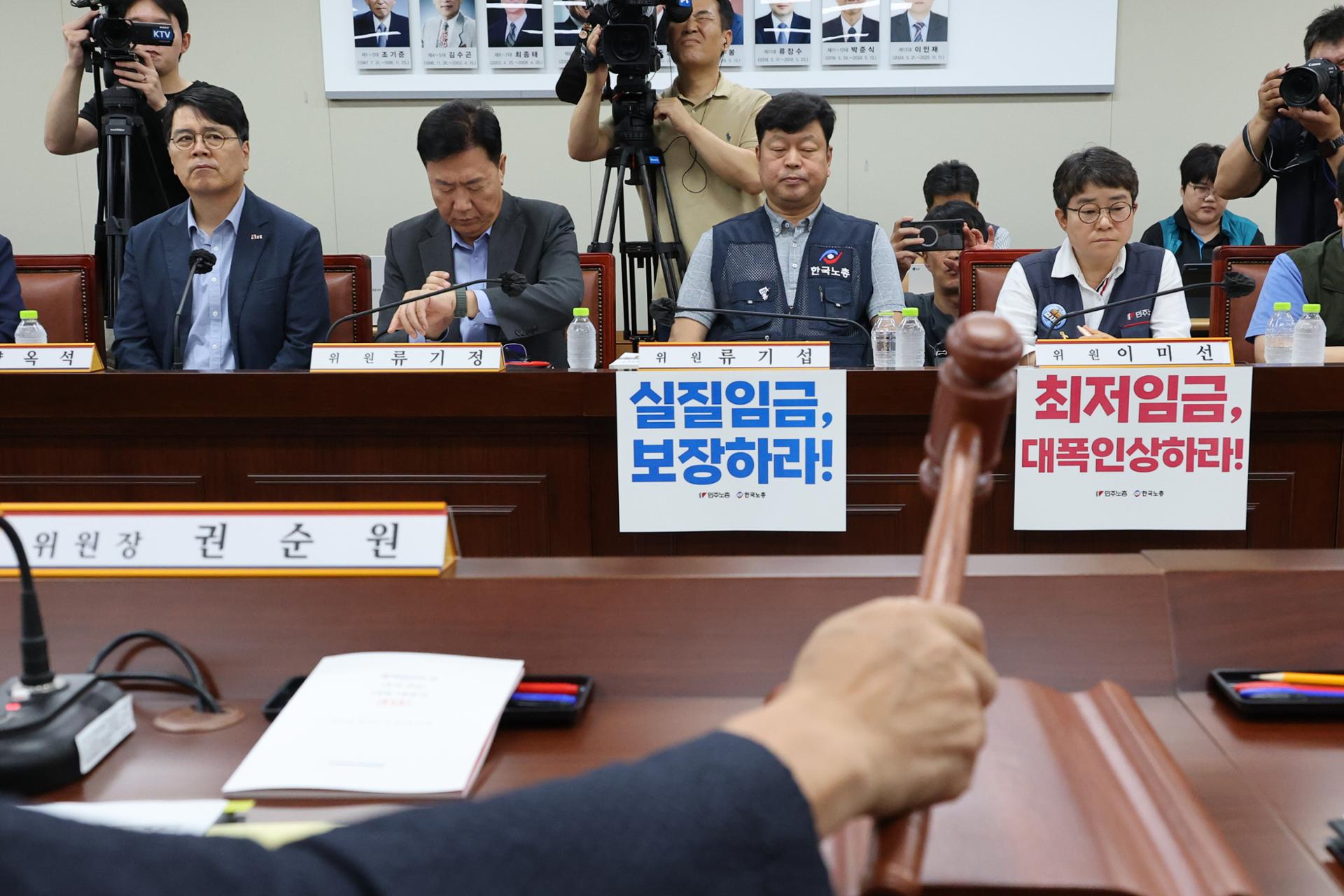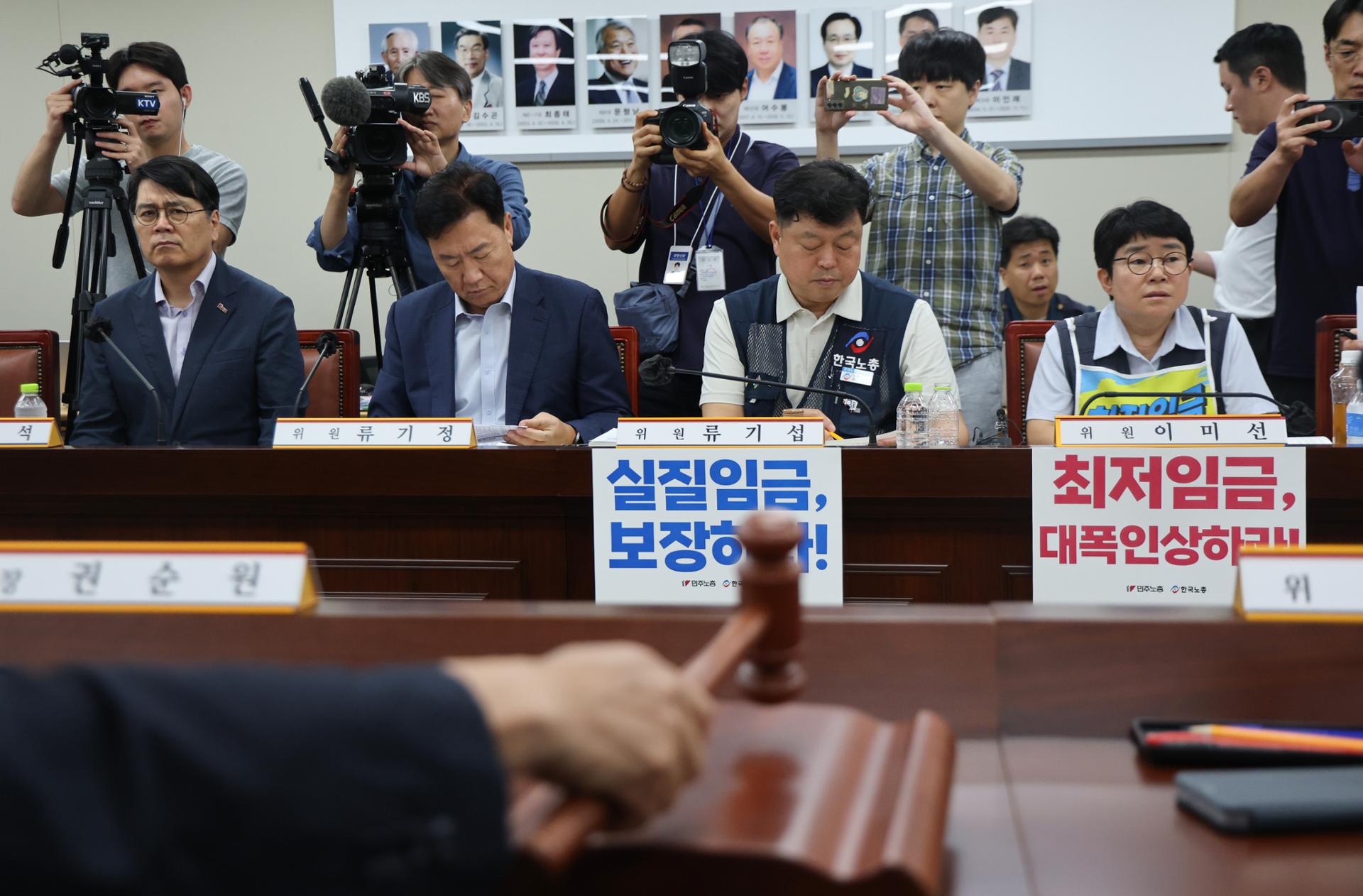
Unions seek 16.3% hike as employers call for lower pay floors in restaurants, hotels, taxi services Rhu Kee-jung (left), an employer representative and executive director of the Korea Enterprises Federation, listens to remarks by Lee Mi-sun (third from left), vice chair of the Korean Confederation of Trade Unions, during the sixth plenary session of the Minimum Wage Commission at the Government Complex Sejong on Tuesday. (Yonhap) South Korean labor and business groups clashed Tuesday as the state wage-setting panel opened talks on a variable minimum wage, a proposal backed by employers and fiercely opposed by unions.The talks came a day after labor groups proposed raising the 2027 minimum wage by 16.3 percent to 12,000 won ($7.93) an hour.The sixth plenary meeting of the Minimum Wage Commission in Sejong focused on proposals to have different minimum wages depending on industry, one of the most divisive issues in this year's negotiations.Rhu Kee-jung, executive director of the Korea Employers Federation, argued that businesses' ability to absorb labor costs varies significantly by sector.He noted that value added per worker in the accommodation and food-service sector stood at about 28 million won, roughly one-sixth of the 170 million won in manufacturing."There are fundamental differences among industries in their capacity to bear labor costs," Rhu said.He added that the minimum wage in the accommodation and food-service sector already amounts to 87.1 percent of the industry's median wage, making businesses in the sector particularly vulnerable to further increases.Employer organizations have repeatedly called for a lower minimum wage in sectors such as restaurants, hotels and taxi services, arguing that large gaps in productivity and profitability across industries make a single nationwide rate increasingly difficult to sustain.Yang Ok-seok, head of labor policy at the Korea Federation of SMEs, said differentiated minimum wages were necessary to protect small businesses struggling with weak demand and rising costs."For industries that have lost the ability to pay, differentiated minimum wages are a matter of survival for small merchants and microbusinesses," Yang said. "This is not discrimination but a last line of defense for economically vulnerable sectors."Labor representatives pushed back, accusing employers of seeking to institutionalize discrimination against workers in some sectors.Ryu Ki-seop, secretary-general of the Federation of Korean Trade Unions, said lower minimum wages for sectors such as restaurants would make it even harder to attract workers."If employers are allowed to pay less than the current minimum wage in industries like food service, the outcome is obvious," he said. "They will justify discrimination by attaching labels such as foreign worker, disabled worker or trainee worker in order to cut labor costs."The Minimum Wage Act currently allows different rates by industry. However, the provision has been used only once, when the system was first introduced in 1988. Since then, South Korea has maintained a single nationwide minimum wage.Lee Mi-sun, vice president of the Korean Confederation of Trade Unions, called the provision a "toxic clause" that should be abolished.The commission continued closed-door discussions Tuesday with eight labor representatives, nine employer representatives and nine public-interest members participating.Negotiations over the overall level of next year's minimum wage are expected to begin next week after the commission reaches a decision on whether industry-specific rates should be adopted.Labor groups have submitted an initial proposal of 12,000 won per hour, equivalent to about 2.51 million won a month based on a 40-hour week, while employers are expected to seek either a freeze or a substantially smaller increases.
Labor, businesses clash over industry-specific minimum wages
South Korean labor and business groups clashed Tuesday as the state wage-setting panel opened talks on a variable minimum wage, a proposal backed by employers a
568 words~3 min read