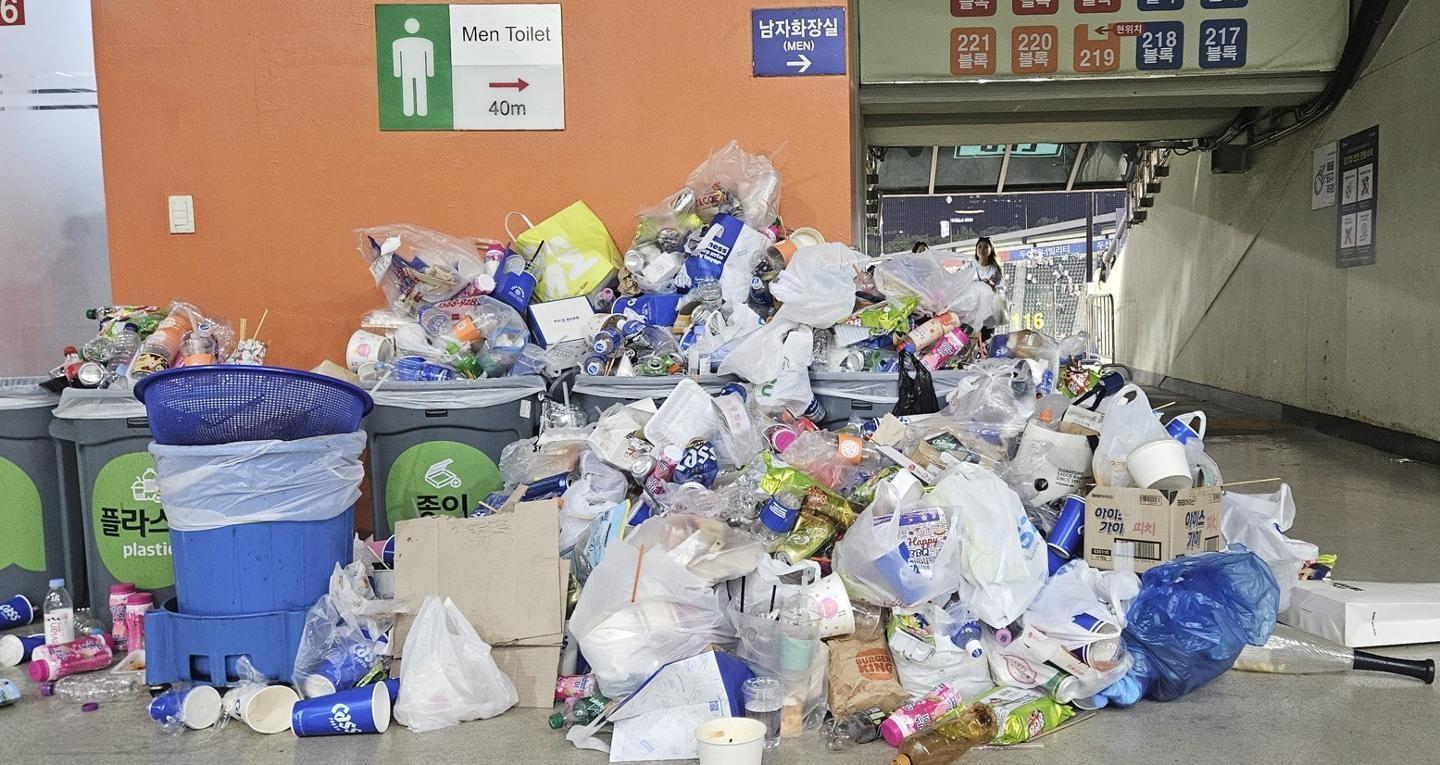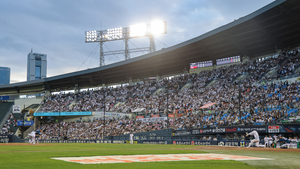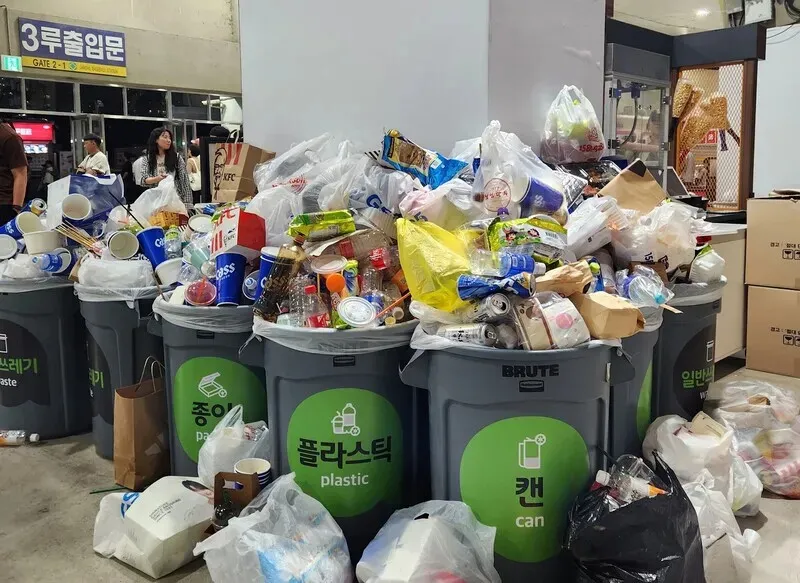
Trash and recyclables overflow from marked bins at Jamsil Baseball Stadium in Seoul on June 5, 2026. (courtesy KFEM)
Nearly all food and beverage vendors at South Korea’s professional baseball stadiums rely on disposable products, according to a new survey, with only one vendor nationwide operating exclusively with reusable items.The survey, conducted jointly by local chapters of the Korea Federation for Environmental Movements (KFEM) in eight cities that host professional baseball teams, found that 349 of 351 vendors (99.4%) across nine stadiums used single-use products. Just one vendor exclusively used reusable alternatives.The environmental groups announced the findings at a press conference held outside the headquarters of the Korea Baseball Organization (KBO) in Seoul’s Gangnam District on June 10. Among the stadiums surveyed, SSG Landers Field in Incheon received the highest rating for its efforts to reduce disposable waste, while Samsung Lions Park in Daegu and Sajik Baseball Stadium in Busan, home to the Lotte Giants, were ranked the worst.The survey found that at seven of the nine stadiums, all vendors used disposable products. Only Seoul’s Gocheok Sky Dome and Jamsil Baseball Stadium recorded usage rates below 100%, at 97.6% and 98.7%, respectively.The proportion of vendors using at least some reusable products varied significantly by stadium. Incheon’s SSG Landers Field led the rankings, with 50% of vendors using at least one type of reusable item. It was followed by KT Wiz Park in Suwon (38.2%), Jamsil Baseball Stadium (34.7%), Gocheok Sky Dome (29.3%), NC Park in Changwon (23.5%), Hanwha Life Ballpark in Daejeon (22.6%), Sajik Baseball Stadium in Busan (13.0%), and Kia Champions Field in Gwangju (9.7%). Daegu’s Samsung Lions Park ranked last at just 2.4%.Disposable chopsticks, forks and skewers were used by all 233 vendors that offered such utensils. None provided reusable alternatives. Disposable food containers were used by 228 vendors, plastic cups by 177 and paper cups by 108.By contrast, reusable cups were available at only 61 vendors, reusable food containers at 49, and reusable spoons at just one vendor.Based on the findings, the environmental groups rated SSG Landers Field as the only stadium to earn a “good” grade on efforts to reduce waste. Stadiums in Suwon, Seoul, Changwon, Daejeon and Gwangju received “average” ratings, while the stadiums in Busan and Daegu were deemed “poor.”The groups also identified shortcomings in stadium waste-management systems. Although most stadiums provided separate bins for general and recyclable waste, few had systems that allowed spectators to sort commonly generated stadium waste such as paper, plastic film (vinyl), PET bottles and food waste into separate categories.In addition, none of the nine stadiums surveyed had public drinking fountains. Without access to free drinking water, spectators are effectively forced to purchase bottled water, increasing plastic waste, the groups said.Based on the findings, the groups urged the KBO to implement a series of measures to reduce waste and improve recycling at stadiums. KFEM urged the league to publicly disclose data on waste generation and recycling rates, set targets for reducing stadium waste, expand the use of reusable containers and tableware, install sufficient drinking fountains at all stadiums, and improve waste-sorting facilities so that spectators can more easily separate recyclables.The groups said they plan to continue their campaign through petitions, monitoring efforts, inquiries to individual teams, policy proposals to lawmakers and public forums.