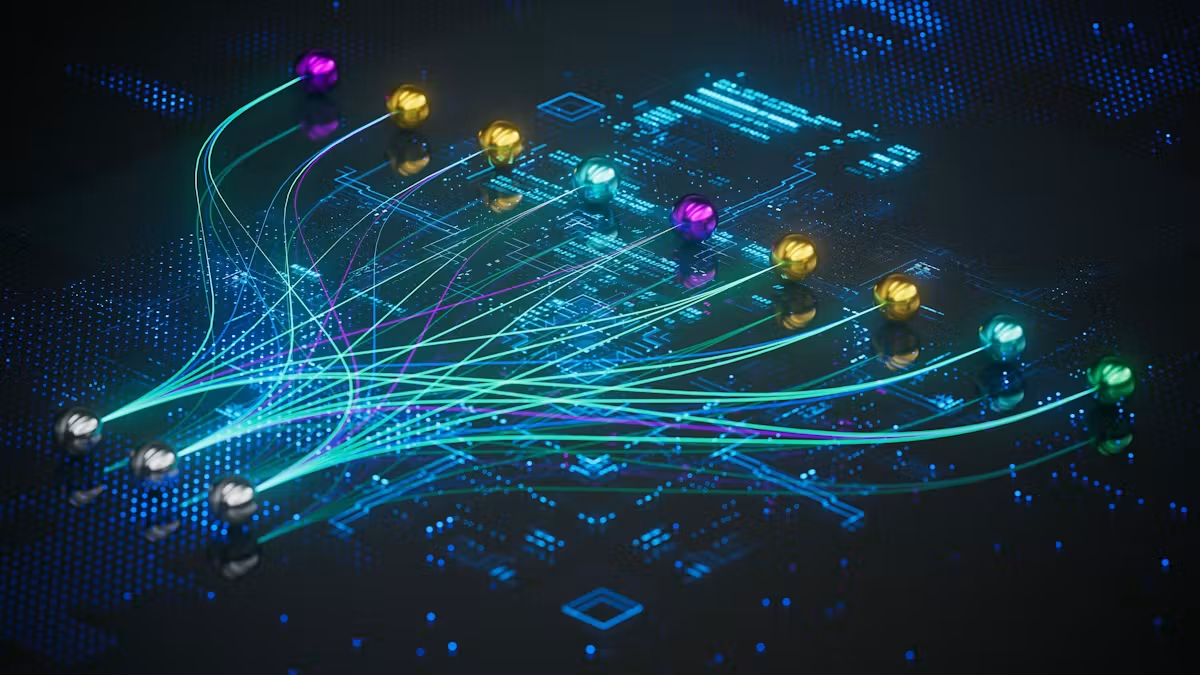
Hand the same research question to Claude Opus 4.8 twice. Then hand both answers to a third copy of Opus 4.8 and ask it to write one better reply. No second model walked into the room. No new knowledge arrived. The score climbed almost seven points.That single result, buried two-thirds of the way down OpenRouter's launch post for its new Fusion tool on 12 June 2026, is the most honest thing in it. Fusion's pitch is about diversity — many models, many perspectives, fused into something none could write alone. The self-versus-self test says the lift comes from somewhere quieter: the act of reading several drafts and combining them. The line-up matters less than the desk it gets mixed on.Key TakeawaysOpenRouter Fusion, launched 12 June 2026, sends a prompt to a panel of AI models in parallel, has a judge model map their agreements and contradictions, then writes one synthesised answer — through a single API call.On the DRACO deep-research benchmark, a budget panel (Gemini 3 Flash, Kimi K2. 6, DeepSeek V4 Pro) beat solo GPT-5.5 and Claude Opus 4.8 and came within 1 per cent of Claude Fable 5, at about half the cost.The gain is mostly the synthesis, not the variety: OpenRouter attributes roughly three-quarters of Fusion's lift to the combining step, and Opus 4.8 fused with a copy of itself jumped from 58.8 to 65.5 per cent.The benchmark is OpenRouter's own run, judged by a different model than the DRACO paper used, so the numbers signal a direction rather than settle a ranking.The cheap-panel maths is the real story; the premium panel buys small quality gains at roughly 3x the cost.What does Fusion actually do?Fusion runs a panel and a judge, then writes once. When a prompt arrives, OpenRouter fans it out to several models at the same time, each one armed with web search and fetch. A judge model reads every reply and marks up the session — where the models agree, where they clash, what each one caught and missed — and a final model writes the answer grounded in that markup. Picture a producer at the mixing desk with four takes of the same track in front of them, riding the faders, keeping the clean vocal from one and the bassline from another, bouncing it down to a single master. The whole chain runs server-side, called with one slug, openrouter/fusion, so an application reaches it the way it reaches any single model. The cost shows up as time: an invoked Fusion call runs two to three times longer than a normal one while the panel finishes and the desk does its work.The numbers OpenRouter published are striking on their face. Fable 5 paired with GPT-5.5 scored 69.0 per cent, above every solo model, including Fable 5 alone at 65.3 per cent. The budget trio — Gemini 3 Flash, Kimi K2. 6 and DeepSeek V4 Pro, none of them a frontier model — fused to 64.7 per cent, clearing solo GPT-5.5 at 60.0 and solo Opus 4.8 at 58.8, for roughly half the price of a frontier solo run. Three bedroom producers on cheap gear, mixed well, out-cutting the marquee name.The benchmark earns its asterisksDRACO is a serious test, which is why the caveats deserve daylight. Built by researchers at Perplexity and Harvard and published in February 2026, it draws 100 deep-research tasks from anonymised real Perplexity Deep Research queries across 10 domains and sources in 40 countries, each graded on about 39 weighted criteria spanning factual accuracy, breadth and depth, presentation and citation quality. Some criteria carry negative weight, so a model that states wrong things with confidence loses points, and padding earns nothing.Four things keep the scores directional rather than definitive. OpenRouter judged with Gemini 3.1 Pro Preview instead of the paper's Gemini 3 Pro, which places its figures outside a clean comparison with DRACO's published results. Absolute scores swing 10 to 25 points by judge choice, with only the relative order holding firm. Fable 5's content filters blocked 7 of the 100 tasks, so its 65.3 reflects 93 tasks against rivals that ran the full set — an uneven race. And the benchmark was run by the company selling the product, which is reason enough to wait for an outside replication before treating 69.0 as gospel.TypeConfigurationScoreFusionFable 5 + GPT-5.569.0%FusionOpus 4.8 + GPT-5.5 + Gemini 3.1 Pro68.3%FusionOpus 4.8 + GPT-5.567.6%FusionOpus 4.8 + Opus 4.8 (self)65.5%SoloClaude Fable 5 (93 tasks)65.3%FusionGemini 3 Flash + Kimi K2. 6 + DeepSeek V4 Pro64.7%SoloDeepSeek V4 Pro60.3%SoloGPT-5.560.0%SoloClaude Opus 4.858.8%SoloKimi K2. 653.7%SoloGemini 3.1 Pro45.4%SoloGemini 3 Flash43.1%The mix, not the musiciansBack to that self-versus-self result, because it reframes the whole product. OpenRouter says roughly three-quarters of Fusion's gain comes from the synthesis step and only a quarter from model diversity. Opus 4.8 partnered with a second copy of itself, judged by Opus 4.8, lifted 6.7 points over solo Opus. Run the same prompt twice and you get different reasoning paths, different searches, different sources; the desk has more to work with even when the players are the same. The value lives in mastering, not in the size of the band.The research record tells this two ways, and a careful reader should hold both. Together AI's original Mixture-of-Agents paper showed a panel of open-source models with an aggregator beating GPT-4o outright, proof that a panel needs no frontier member to win. A 2025 Princeton paper, "Rethinking Mixture-of-Agents," found the trap on the other side: throw mismatched models together and quality sinks, because the mix drags down to its weakest take. Diversity pays when the members are individually strong and genuinely complementary. It costs when they are noise. OpenRouter's slogan, model neurodiversity over single-model takeovers, is a good line that papers over that condition.The cost question most coverage skipsFusion has no subscription, and the meter is the catch. You pay the sum of every completion the pipeline calls — each panel model, plus the judge — billed at OpenRouter's pass-through rates with its roughly 5.5 per cent routing fee on top. The independent read from TokenMix is unsentimental: the premium Quality preset delivers about 3.7 DRACO points over the best single frontier model, at roughly 3.2 times the cost — paying 3. 2x for about 1. 06x relative quality. The budget panel tells the opposite story, reaching Fable-class research quality at around 0. 40x the cost of running Fable solo. So the defensible claim is narrow and real. Cheap models, judged well, can buy frontier-grade research for a fraction of frontier money; the top-end panel buys a thin edge at a fat premium.OpenRouter owns the gate, whoever wins the matchFusion makes complete sense once you see where OpenRouter sits. It is the model marketplace — one API call out to more than 400 models — founded in 2023 by Alex Atallah, who co-founded the NFT marketplace OpenSea, with Louis Vichy. On 26 May 2026 it closed a $113 million Series B led by CapitalG, Alphabet's growth fund, at roughly a $1.3 billion valuation, with cheques from NVIDIA's NVentures, ServiceNow, MongoDB, Snowflake and Databricks Ventures, Andreessen Horowitz and Menlo. Traffic runs near 100 trillion tokens a month, a fivefold rise in half a year, across 8 million users; Sacra pegs annualised revenue near $50 million, earned on roughly a 5 per cent cut of inference spend. "The era of picking a single model is over," Atallah said, casting OpenRouter as the Stripe of AI inference.Read it as cricket and the strategy clears up. The frontier labs are the star batsmen, each selling tickets on the promise of the highest individual score. OpenRouter runs the ground. It takes its gate cut on every ball bowled, regardless of which name is at the crease, and Fusion is the board pointing out that a well-drilled XI of journeymen can chase down a total the superstar set — using players the board also rents out. Every argument for Fusion is an argument for routing more spend through the house.Why this rattles the frontierThe deeper stake is where value settles. Frontier labs compete on raw model capability, the single highest score. Fusion's results, and Microsoft's before them, argue that the combination-and-synthesis layer is increasingly where the gaps close. Microsoft ran the same play on DRACO in March 2026 — its Researcher "Critique" splits an explorer model from a validator, its "Council" lines up several model answers with a note on where they agree and diverge — and reported a 7-point lift over the best system in the DRACO paper. Two large players, three months apart, landing on the same shape. That points value away from any one model and toward whoever owns the layer that combines them, which is a fine place for a neutral marketplace to stand and an uncomfortable one for a lab whose moat is a single best brain.The timing carried its own charge. Several outlets framed Fusion's arrival the same week Claude Fable 5 went offline — reporting a 12 June US Commerce Department directive that suspended Anthropic's Fable 5 and Mythos 5 — casting Fusion as the ready "near-Fable-5 at half the cost" substitute for developers who had built on Anthropic's top tier. Treat that as the coverage's reading of a fast-moving week rather than a settled account; what stands regardless is the convenience of a panel-of-cheaper-models pitch landing exactly when the most expensive single option blinked out.The India read sits in the cost columnFor an Indian developer or a Bengaluru AI startup watching token bills, the interesting line is not 69.0 per cent. It is 0. 40x. A small team that cannot justify frontier pricing per call can route a panel of cheaper models — several with strong reasoning and code performance — through one endpoint and reach research quality near the top tier for a fraction of the spend, which is the exact arithmetic that has made multi-model routing attractive to cost-watching teams everywhere. The premium configuration, with its 3x bill for a slim gain, will stay a rich-market indulgence. The budget panel is the version that travels to a market where every per-call rupee is counted.Strip away the launch-week drama and the benchmark sheen, and one shift sits underneath all of it: the answer is getting better in the combining, not the model. If that holds outside OpenRouter's own scorecard — and an independent run is the obvious next test — then the margin in AI starts migrating from the labs that build the smartest single model to whoever owns the desk where many models get mixed. OpenRouter has just volunteered to be that desk, and charged admission.Frequently asked questionsWhat is OpenRouter Fusion?OpenRouter Fusion is a tool, launched 12 June 2026, that sends one prompt to a panel of AI models at once, has a judge model analyse where they agree and differ, then writes a single synthesised answer. It runs through one API call using the slug openrouter/fusion. OpenRouter is a marketplace giving developers access to more than 400 models through a unified interface.Did budget AI models really beat frontier models?On the DRACO deep-research benchmark, a panel of three cheaper models (Gemini 3 Flash, Kimi K2. 6, DeepSeek V4 Pro) outscored solo GPT-5.5 and Claude Opus 4.8 and came within 1 per cent of Claude Fable 5, at about half the cost. The result was produced by OpenRouter on its own run of the benchmark, so it points to a real effect that still awaits independent replication.Where does Fusion's improvement actually come from?Mostly from the synthesis step. OpenRouter attributes roughly three-quarters of the gain to combining responses and a quarter to model diversity, and Claude Opus 4.8 fused with a copy of itself rose 6.7 points with no second model involved. Running a prompt more than once yields different reasoning the judge can merge.Is Fusion cheaper than using one frontier model?It depends on the panel. The budget panel reaches Fable-class research quality at around 0. 40x the cost of running Fable 5 alone. The premium panel costs roughly 3. 2x a single frontier model for about a 3.7-point quality gain, so it pays only where small accuracy gains carry high value.How does Fusion compare to Microsoft's approach?They share a design. Microsoft's Researcher "Critique" and "Council," shown on the same DRACO benchmark in March 2026, also run multiple models and synthesise their output, reporting a 7-point lift over the best system in the DRACO paper. Panel-plus-judge is a 2026 industry pattern rather than a single company's idea.end of article
OpenRouter Fusion Hits Near-Frontier AI Research Quality At Half The Cost
OpenRouter's Fusion fuses several models through one judge, and a cheap panel reached near-Fable-5 research quality at half the cost. The benchmark is the company's own, and most of the gain is the synthesis, not the diversity.
2,068 words~9 min read