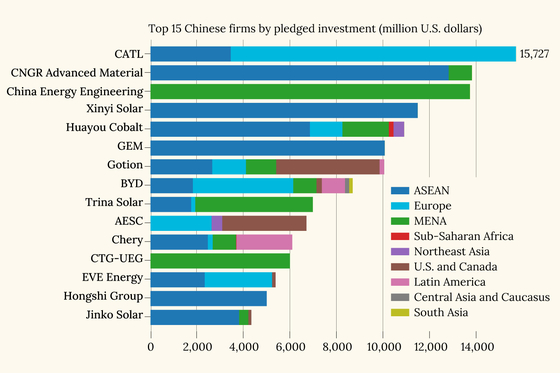
Contemporary Amperex Technology Co. Ltd. (CATL), the world’s largest electric vehicle (EV) battery manufacturer, has emerged as the leading investor among China’s clean technology companies in terms of overseas plant establishment since 2021, according to a report by the Net Zero Industrial Policy Lab at Johns Hopkins University. CATL has pledged a total of $15.7 billion to overseas ventures, outpacing competitors like CNGR Advanced Material Co. Ltd. ($13.84 billion) and the state-owned China Energy Engineering Corp. (CEEC), which committed $13.75 billion. [para. 1][para. 2][para. 17]Nearly 80% of CATL’s overseas investment—amounting to $12.3 billion—has been dedicated to Europe, with three major production hubs in the region. Its German facility is operational, while new plants are underway in Hungary and Spain. This strategic shift is largely driven by regulatory and economic factors. From 2027, battery manufacturers selling in the European Union will be required to report their batteries’ carbon footprints throughout their lifecycle, as mandated by new EU battery regulations. Additionally, the EU has imposed anti-subsidy tariffs on Chinese-made EVs, which further incentivizes local production. Transport costs are also significant; as batteries are heavy, shipping them from Asia is costly and logistically challenging. Therefore, producing closer to consumer markets in Europe is both practical and cost-effective. [para. 3][para. 4][para. 5][para. 6]Beyond Europe, CATL has invested $3.45 billion in Southeast Asia, especially within the Association of Southeast Asian Nations (ASEAN) region. A notable recent expansion includes the launch of a nearly $6 billion project in Indonesia as of July, focusing on leveraging Indonesia’s abundant nickel reserves. Indonesia mandates local nickel processing before export, encouraging significant battery and raw material investments from Chinese firms. The goal for CATL is to lead Southeast Asia’s battery supply chain, from raw materials to recycling, capitalizing on the region’s strategic resource advantages and goals to enhance its role in the global battery ecosystem. [para. 7][para. 8][para. 9][para. 10][para. 11][para. 12]Other major Chinese investors in overseas clean technology manufacturing include CNGR and CEEC. CNGR’s investments, amounting to $13.84 billion, are primarily concentrated in Indonesia for nickel cathode production and include a $1 billion battery plant in Morocco. Morocco is strategically selected for its free trade agreements with both the U.S. and EU, making it a favorable location to serve these key EV battery markets. [para. 13][para. 14][para. 15]CEEC’s investments, totaling $13.75 billion, are entirely focused on the Middle East and North Africa—specifically in Egypt and Morocco—with large-scale renewable hydrogen projects. These projects are highly capital-intensive, but they fit within a broader trend of Chinese investment in stable, strategically located countries with robust infrastructure and established industrial zones. The China-Egypt TEDA Suez Economic and Trade Cooperation Zone, set up in 2008, stands as an early example of Chinese industrial presence in Africa, and recent agreements aim to expand its role in new energy, new materials, and automotive sectors with additional infrastructure worth $100 million. [para. 16][para. 17][para. 18][para. 19][para. 20][para. 21][para. 22][para. 23][para. 24]All the leading companies on the Net Zero Industrial Policy Lab’s list have focused a large portion of their investments in specific global regions, dictated by supply chain concentration and industry-specific advantages. While geographic diversification is desirable, practical constraints related to supply chains and resource distribution largely determine these investment strategies. [para. 25][para. 26]AI generated, for reference only
Chart of the Day: CATL Leads Chinese Clean-Tech Firms in Overseas Investments
The battery-maker has pledged nearly $16 billion for European and Southeast Asian expansion, according to a new report
541 words~2 min read