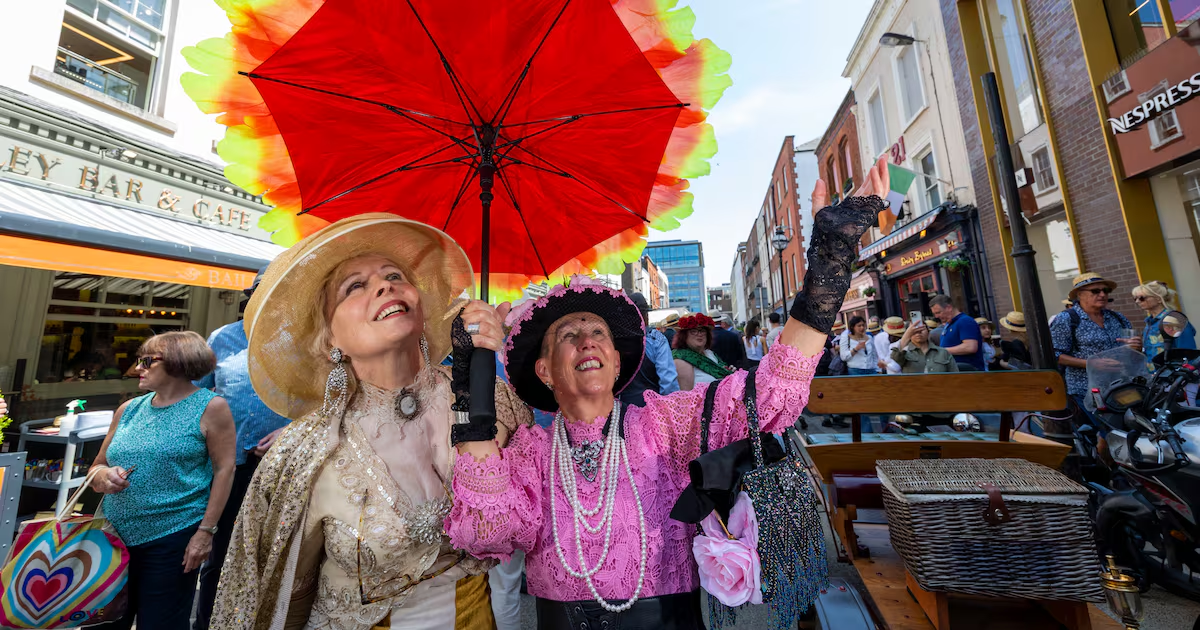
Journalists usually wait until December to write their end-of-year reviews. They needn’t bother this time around. Even if the next six months prove blissfully uneventful, 2026 will be remembered as a tumultuous one for the world. Frustrated by domestic divisions and global disorder, surveys suggest people’s faith in politics is rapidly receding. Those looking for a way through this turmoil could do worse than dive into James Joyce’s Ulysses. Few other works of modern literature provide greater sustenance in times of political strife. Although Joyce didn’t trade in false hope, he reminds us that political optimism, even if it appears foolish, is never wasted. Unless we believe that things can change for the better, they rarely will.Inspired by Homer’s Odyssey, Joyce’s novel tells the story of Leopold Bloom, a middle-aged Dubliner who struggles to find his way in a stagnant society. Set on a single day – June 16th, 1904 – 18 years before the establishment of the Irish Free State, Ulysses depicts a country in which progressives are mired in past defeats while imperial power is visibly decaying.The lord lieutenant, the British monarch’s representative in Ireland, circles the city in an ornate carriage, but locals neither know nor care who the viceroy is. Bar-stool nationalists dream of a “new Ireland”, but are still mourning the death of Charles Stewart Parnell after 13 years. An advertising man who once dabbled in politics, Bloom is no Homeric hero. Yet his political optimism permeates the book.Bloom, the son of a Jewish Hungarian immigrant, finds his identity and loyalty continuously questioned by fellow Dubliners. “What is your nation if I may ask?” a drunken patriot probes in Barney Kiernan’s pub, after Bloom rejects “national hatred among nations”. “Ireland. I was born here. Ireland,” replies the ad man, who deflects the insult by insisting he is “talking about injustice”. Although his appeal for tolerance and understanding sees Bloom chased out of the bar, his belief in a better society remains undimmed.Political violence casts a shadow over Ulysses, which Joyce began writing during the early months of the first World War and continued working on while he and his family fled Trieste in Italy for Zurich, Switzerland. Bloom, like his literary creator, is a pacifist who believes that differences should be settled through dialogue. “How can people aim guns at each other? Sometimes they go off,” Bloom wonders on Sandymount strand. Later in the novel, he denounces “violence or intolerance in any shape or form”. As he wanders around Dublin, lost in his own thoughts and desires, Bloom is drawn to ideas for improving the country. A hydroelectric power plant, restored waterways for passenger and freight use, and a new tramline are among his elaborate “schemes of wider scope”. The absurd pedantry of these plans is part of the book’s comic charm, but they convey Joyce’s belief that Irish independence was not an end in itself so much as an opportunity to recreate the country’s conscience after centuries of colonial neglect. Beneath this optimism lay the writer’s fear that Ireland would free itself from Britain, but fall under the spell of conservatives who would stifle creativity and self-expression.Despite his own troubles, Bloom continually thinks of others. An avid newspaper reader, he spares a thought for the victims of the “New York disaster”, a reference to a real-life steamboat that caught fire and sank in the East River on June 15th, 1904. Closer to home, he stops by a maternity ward to ask after a postmistress who is on her third day of labour. While at the hospital, Bloom spots Stephen Dedalus, a young poet who has fallen in with a crowd of drunken medical students. Sensing trouble, Bloom follows members of the party to the city’s red-light district and rescues Dedalus from a beating by British soldiers. Civic-mindedness, as Joyce reminds us, is an antidote to political cynicism. Taking his charge to a cabman’s shelter for a sobering cup of coffee, Bloom expounds on his political philosophy, championing “mutual equality” over “mutual superiority” and a revolution which can only come in “due instalments”. “Count me out,” the sceptical poet declares. “We can’t change the country. Let us change the subject.” But Bloom neither gives up on Dedalus nor his own “schemes of wider scope”, which preoccupy him from morning to night. From his conversations with Dedalus to his fiery encounter at Barney Kiernan’s pub, Bloom’s day is packed with politics. Reflecting on these experiences, the ad man is reminded of his youthful radicalism and old dreams of becoming a member of parliament. Political “propaganda and displays of mutual animosity” cause hurt, he concludes. Through his enduring curiosity, empathy and, above all, optimism, Bloom shows that another politics is possible.Joyce died in Switzerland in 1941 while Europe was engulfed by war once again. He never set foot in independent Ireland, which for decades remained the conservative state that the writer had so feared. Through due instalments, however, Irish progressives have fought one election and referendum at a time to create a more open and tolerant society much closer to the one of which Bloom dreamed. No matter how foolish political optimism might have seemed in 1904, it stood the test of time. On Bloomsday, literary enthusiasts will, as always, participate in readings, recitals and walking tours in honour of Joyce and his work. Those who are despondent about the state of the world might join in the celebrations and raise a glass of Bloom’s beloved burgundy to a better future, however distant it seems right now.Dermot Hodson is a professor of political economy at Loughborough University and the author of Circle of Stars: a History of the EU and the People who Made It
Opinion: On Bloomsday, if you take just one message from Ulysses then it should be this one
James Joyce didn’t trade in false hope, but he reminds us how political optimism, even if foolish, is never wasted
948 words~4 min read