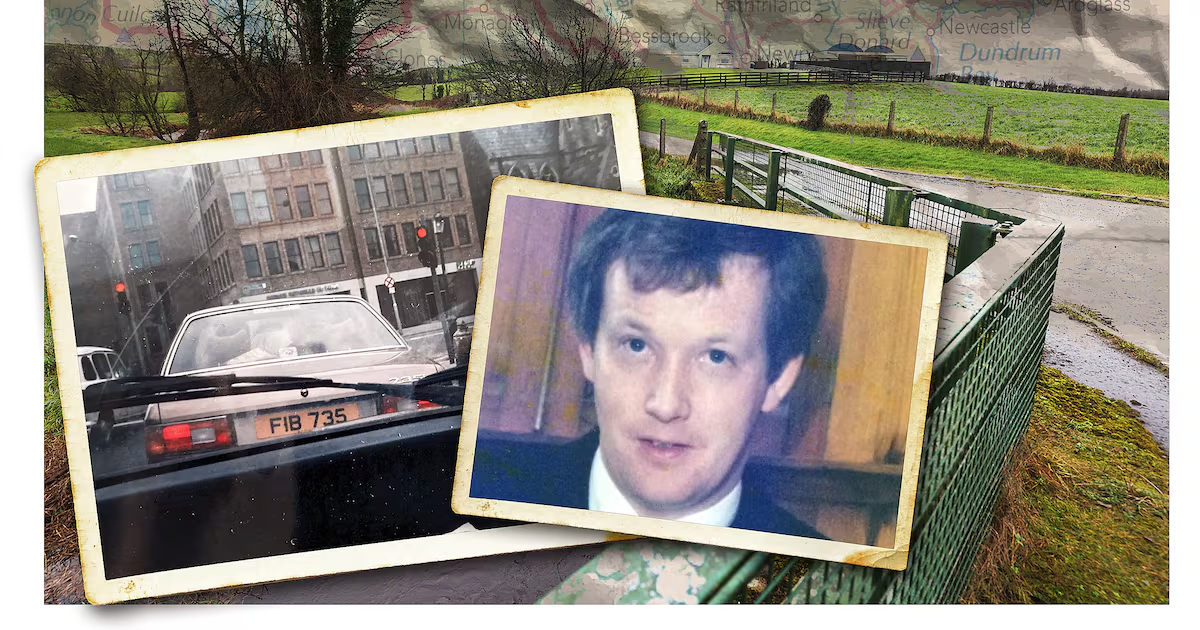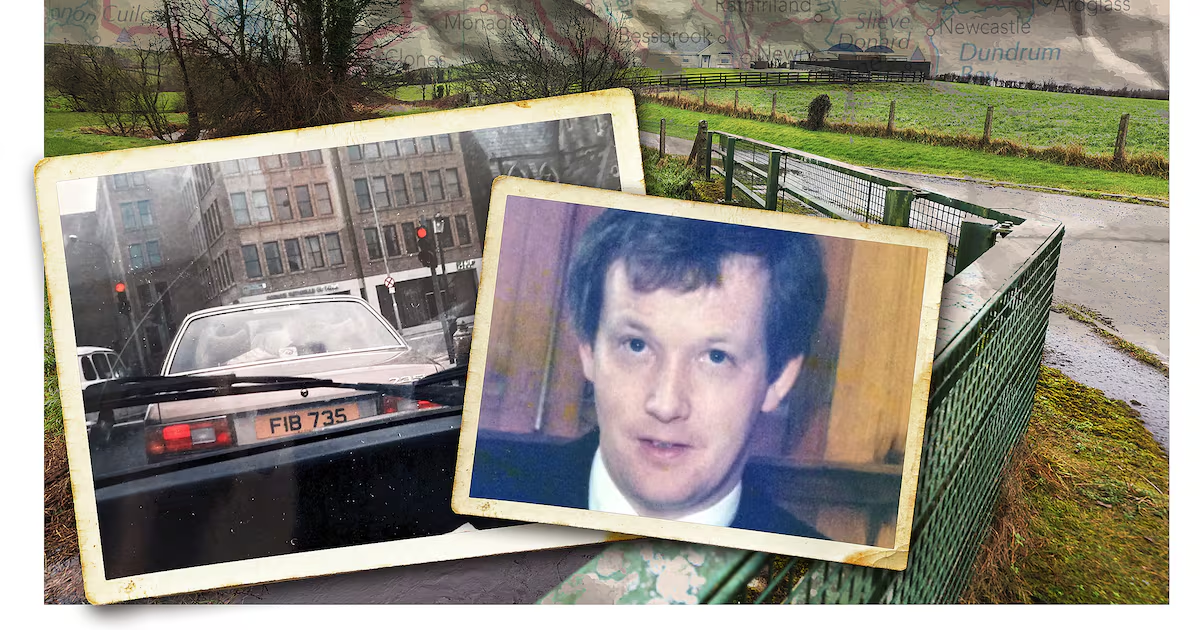
The photograph shows a BMW 735i on St Stephen’s Green, Dublin, in March 1986.The 40-year-old print is a prosaic image, but means much to a few. The car is carrying a newly married couple, Terence McKeever and his wife Rena, on the morning after their wedding.The image also tells a story that has darkened the decades since. McKeever, driving the bronze-coloured BMW, had just 77 days to live.It is one of scores of photographs laid out on the kitchen table in a farmhouse in Drumsollan, Killylea, north of Armagh city, by Karen McAnerney, the sister of McKeever.He was tortured, killed and dumped on a border bridge by the IRA 40 years ago on Tuesday.The last image of Terence McKeever's car, on St Stephen's Green, the morning after his wedding. It was just 11 weeks before he was tortured and killed by the IRA Four decades on, no one has been questioned or charged with his killing that occurred during Northern Ireland’s Troubles, the three-decade conflict. Forensics that could have led to prosecutions on the back of scientific advances have been lost on both sides of the Border.“For me, it’s like yesterday,” McAnerney tells The Irish Times.“The people that one would want to listen 40 years on, the ones who did this who are still alive, I think they’ll actually enjoy it more if they think you’re still suffering.”Despite the hurdles, McAnerney, with the help of the South-East Fermanagh Foundation led by Kenny Donaldson, has campaigned over the failures in the investigation led by the Royal Ulster Constabulary (RUC) and by An Garda Síochána south of the Border.Karen McAnerney at the family home with her German shepherd dogs, Roxy and Theo. Photograph: Alan Betson During hours of conversation, McAnerney’s anger comes though, often, about the loss of forensic exhibits in Dundalk Garda station, and the later Garda Síochána Ombudsman Commission (Gsoc) investigation into that, and missing exhibits in Northern Ireland.McKeever ran the family’s successful electrical contractors business in Armagh, but lived with his new wife in a Pembroke Road apartment in Ballsbridge, Dublin 4. He drove from Dublin to Armagh most days. On June 16th, 1986, he left home shortly after 6.30am in his BMW to meet a colleague at the Armagh offices who had travelled from England.Shortly after 10am, a worried colleague, Michael McLaughlin, rang the RUC and the Garda when McKeever did not arrive. Concerned his boss had been in an accident, McLaughlin borrowed an employee’s car to drive the route most likely taken by McKeever, but found nothing.An anonymous woman telephoned the RUC in Newtownhamilton in south Armagh at 10.45am, saying two balaclava-clad men had been seen acting suspiciously at Mullaghduff Bridge, Cullyhanna, not far from the Border.They had, she said, taken something from the back of a Toyota Liteace van 10 minutes before and left it by the bridge, before driving off towards Crossmaglen.Mullaghduff Bridge, near Cullyhanna, Co Armagh, where Terence McKeever was dumped by the IRA in June 1986 after he was killed in the Republic. Photograph: Alan Betson By 11.30am, a second caller told the RUC there was a body there.An hour later, a local priest in Cullyhanna went to the scene in an area considered among the most dangerous areas for British soldiers and police in Northern Ireland. He confirmed there was a body there. British soldiers cordoned off the district, holding RUC and emergency staff back until searches for hidden explosives were made.The caution was justified. Terence McKeever: the electrical contractor had been married for 11 weeks and hadn’t yet been on honeymoon The ground immediately around McKeever’s body was checked and declared safe. But searches over the next two days unearthed a 150lb bomb hidden in a stone wall 30 yards away, near where TV reporters, oblivious to the dangers, had finished their reports.A company employee identified McKeever’s body. His hands had been tied behind his back with blue twine, his head covered by a jacket. He had been shot three times in the head and neck. A pathologist’s report later said the bullets had been fired just inches away. There were signs of torture; the back of his left hand had been burned with cigarettes.McKeever’s BMW was found the following day near Carnagh Woods, not far from Keady, Co Armagh, 12 miles from the bridge. Later, a local witness said they had heard shouting and had noticed a blue Liteace van and a white Triumph car there early that day.Blue Toyota Liteace van - with the real registration number ‘7533 KI’ and fitted with false registration number ‘UZY 125’ - was stolen and used to transport businessman Terence McKeever to his death on June 16th, 1986. Photograph released by An Garda Síochána The RUC scene of crime officer, Noel Crawford, who found three spent cartridge cases and one bullet head on the road, believed McKeever had been shot where he was dumped. The bullet head was “a steel penetrator”, another description for an armour-piercing bullet, according to a report on the McKeever case that was later carried out by the Historical Enquiries Team (HET), which investigated legacy cases from 2006 to 2013.Recalling the aftermath of her brother’s killing, McAnerney remembers “a lot of people” congregated at the family home and her mother crying. “I was brutally told by a priest, ‘Terence was shot this morning’. That’s how it was put to me. Just as raw as that. I couldn’t comprehend. I blanked it from my mind,” she says.McAnerney stood at top of the long, rising entrance to the family home waiting for her father to come home. He had been out working on a job that day and could not be contacted.“I broke the news to him and he slumped over the steering wheel and his heart broke,” she says.Throughout years of campaigning, she is angry with many she has met, but grateful to Garda Superintendent James “Shay” O’Leary, appointed by former garda commissioner Drew Harris to be her Garda link.Sitting in his office in Roscommon, O’Leary talks openly about the case and about the investigation he has led – so far unsuccessfully – to track down forensics that went missing from Dundalk Garda station.Garda Supt James 'Shay' O’Leary, Roscommon. Photograph: Nick Bradshaw “We’ve searched all the obvious locations, including Garda headquarters and Dundalk,” he says.The blue Liteace was found in a farmyard in Ardee, Co Louth, three days after McKeever’s killing and searched by Garda Technical Bureau investigators once it was linked to the killing.“There were things like balaclavas, there was a face mask, there were cigarette butts taken from the ashtray in the van, one jumper. The floor mats were taken, all of that type of material,” O’Leary says.Everything was bagged and tagged properly at the scene, including a blue woollen cap, gloves and a green anorak coat – a substantial volume of material.The van, bearing the false registration plates, had been stolen in Dundalk in May, nearly a month before the killing. Soon afterwards, the exhibits were brought to the Forensic Science Laboratory, Dublin.“The difficulty, I suppose, is that there were no items to compare them with. We didn’t have a DNA database, even a fingerprint database. Checks for them had to be done manually,” O’Leary says.[ Families of Troubles victims killed along Border still await answers from State ]In time, following standard practice, the forensics were taken to Dundalk Garda station. In the years afterwards, they went missing, but nothing has been found to explain how and when that happened.The Smithwick Tribunal found, on the balance of probabilities, that a garda had leaked information that led to the 1989 killings of RUC Chief Superintendent Harry Breen and Supt Bob Buchanan, one of the most notorious IRA attacks of the Troubles.The finding has ever since provoked fury among gardaí.Knowing that questions about the missing forensics are being asked in the shadow of Smithwick’s findings and alleged collusion by individual gardaí, Supt O’Leary quickly gets to the nub.“So, we said, ‘Okay, those exhibits aren’t in the station. Are there any other exhibits from around that time that have a subversive connotation or connection? Are they there? Or did they go missing, too?’,” he tells The Irish Times.Exhibits from the 1980s linked to other IRA cases were found, however, “which led us more to the conclusion that the property and exhibit management system then was not as robust as it is now” rather than a more suspicious finding.Every Garda station in Co Louth and some in Co Meath were searched “over a long number of months, from attic to basement”, O’Leary says, while up to 80 retired gardaí were interviewed.Some retired officers had refused to deal with the Gsoc inquiry into McKeever’s death, but “they spoke to us”, O’Leary says.The bronze-coloured BMW 735i owned by Terence McKeever was subsequently found at Carnagh, Co Armagh, on June 17th, 1986, the day after he was murdered by the IRA. Photograph released by An Garda Síochána Sitting at McAnerney’s kitchen table in Armagh, the scale of the business built by her father, Dan, and grown by her brother, is laid out, with reams of old contracts and worklists spilling over the table’s edge.The family worked on both sides of the Border – “for everyone”, McAnerney says – hospitals, schools, businesses of all types, along with RUC and Garda stations, the Irish Defence Forces and the British Army.In a statement released after his death, the IRA said McKeever, a Catholic, had been killed because “he had ignored repeated warnings to firms who were carrying out work on security force premises” in the North.Later, McKeever’s father – who had handled the Northern security work, rather than his son – told the RUC that no threats had been made directly, according to RUC files.However, there were threats. “[They] got more aggressive closer to the time of Terence’s assassination, because he became very protective over me and told me to check the car and to not to travel across the border late at night and just be very careful,” McAnerney says.“So, I was aware that there was something going on in the background. Because he was brought up to be so respectful, respectful towards life, and to see life as precious, I suppose it never entered his head what would actually happen to him.”Illustrating the focus the IRA had placed on the man they targeted, it said McKeevers had worked at the Ulster Defence Regiment barracks in Portadown and British barracks in Armagh, Crossmaglen, Newtownhamilton, Keady and Omagh.Despite intimidation, every pew was filled in the Catholic St Patrick’s Cathedral in Armagh three days later when Cardinal Tomás Ó Fiaich railed against his murderers: “Let no one try, as the IRA have, to justify such an abominable crime under the cloak of war, or patriotism. This is murder, pure and simple.”It was, he said, a murder that had claimed the life of “an industrious, friendly, gentle and extremely hard-working” man who had built up the family firm to employ nearly 200 people in times when jobs were scarce.McKeever wasn’t the only one targeted by the IRA in its campaign against contractors. He was one of four to be killed that year. In August 1986, the IRA boasted it had even managed to stop milk deliveries to military and police bases. It warned that contractors would be considered “as part of the war machine” and “treated as collaborators” if they continued working for the security forces.The list of so-called “legitimate targets” was broad, including builders, telephone maintenance workers, even caterers, cleaners and those who supplied cigarette vending machines. The front page of An Phoblacht, August 7th, 1986 Page two of An Phoblacht, August 7th, 1986 “Terrorists ruled by the gun. There was a lot of fear in the community. So people never really spoke,” McAnerney says.“For us as industrial contractors and government contractors, it was like a stain in the family. You weren’t accepted within your own community and you weren’t accepted within the unionist community, either.”The RUC identified four suspects and their fingerprints were checked against those taken from the BMW. No matches were found.Intelligence linked several IRA men known to be “on the run” at the time. The name of Tyrone IRA man Jim Lynagh – killed a year later at Loughgall, Co Armagh, in a British army ambush – is repeatedly mentioned.The gun that killed McKeever was identified as a Colt .223 ArmaLite. It was used in 16 IRA attacks, causing 15 deaths between 1974 and 1989. It was ultimately found hidden in a wall in Sheetrim, Crossmaglen, in 1990 by Parachute Regiment soldiers “in a chance find”.A number of exhibits in McKeever case have been lost. The clothes he wore on the day of his murder, the twine used to bind his arms and forensics recovered from the Mullaghduff booby-trap bomb are among the items to have gone missing.Even if the missing exhibits are found, hopes that they could bring about convictions must “be tempered” because they would be admissible in court only if it could be shown they had been securely held throughout, the HET inquiry found.HET investigators tried to speak with one man who had “intimated” he had an idea about the killers’ identity, but efforts in 2008 to arrange a meeting failed as the man was due a major heart operation. The meeting never materialised.Today, everything reminds Karen McAnerney of her brother.“Driving through Dublin yesterday, I looked at all the buildings and all the construction work going on. And I thought, ‘Terence would have loved that’.” He had built up the family business to more than 200 employees during the 1980s recession. “To have so many employed, to be so progressive, it’s so sad to think that his life was cut short and that he never got time to bloom,” she says.Her brother “wasn’t money driven”, she says; he was “success-driven”.“He wanted to be successful. He wanted to be the best at what he did. He was very gentle, very kind and very generous. There was no greed in him, but there was ambition,” she says.She has grown frustrated with the authorities, especially in Dublin, but she calls Minister for Justice Jim O’Callaghan “very kind” and says PSNI Chief Constable Jon Boutcher is one of the few “who really genuinely cares and tries and is wanting to do the best for victims”.When McAnerney talks of her brother, her voice catches. He was a decade older than her; she was in college when he was killed. She took that photo on St Stephen’s Green; it is her last sight of him.Mother of Terence McKeever, Clare McKeever, right, in the years before her early death “Mom just died of a broken heart at 62, roughly 13 years after Terence. She was five-and-half stone when she died,” McAnerney says.Her father, Dan, “tried his best and kept his chin up. But we never discussed it at the kitchen table, never”, she says.Brother and sister Terence and Karen when they were children The McKeevers were, like many families of victims, expected to “get on with normal life” in a time where another neighbour could be a victim.“It was just one murder after another after another. Each would get two day’s coverage. Then the next one would happen,” she says.“People didn’t want to know. You were just left with your own pain. You carried on your own. “I had just started university. I’d say a lot of people throughout my time there never knew I had a brother that was murdered.”Terence McKeever, as a baby, with the family's pet dog The family business, one that had taken decades to build, died too. Some staff were afraid of further IRA attacks. Her father finished contracts “in an honourable way, but didn’t issue new ones”. Within six years, the business was gone.McAnerney believes the IRA dumped her brother’s body just north of the border and the Liteace van that carried him to his death in the south to complicate the investigation, but she considers the investigations “hollow” and loss of forensic evidence in Dundalk unforgivable.“Innocent victims’ murders don’t get investigated. We don’t have the aggressive voices that are so constantly heard,” she says. She describes her brother as “such a gorgeous person”. “Terence was going to do a day’s work that morning. What were his killers going out to do? They were heading out to murder. To torture somebody in such a brutal fashion,” she says.“We had a closed coffin. I wasn’t able to say goodbye to my brother. I couldn’t hug him, I could never let go of him because of that.” In her push to find those responsible for her brother’s murder, McAnerney met O’Leary.“She got very upset at one point. It was like, ‘You’re abandoning me now, as well’,” he recalls of their meeting.“She was incredibly frustrated. She’s a very, very resilient woman.”After their meeting, O’Leary “went upstairs” and sought authority to investigate a killing in Northern Ireland, though the superintendent makes little effort to hide the difficulties encountered so far.Mutual legal aid requests to the PSNI for information have been made, while Garda detectives have spoken to some of those in the RUC who were involved in the investigation 40 years ago north of the Border.He has sympathy for the challenges they faced.“They were saying that there was a body showing up a week on the Border at the time. I just get the impression that they were completely snowed under,” he says.Noting the repeated focus on Garda forensic losses, O’Leary says some evidence – clothes and other materials taken by the RUC – have disappeared north of the Border too.“They were kept, but they can’t be found now. There’s a couple of other items that can’t be found,” he says.He holds out hope that DNA advances could help with “one particular item” that he will not identify but which is at the Forensic Science Laboratory.“Fresh cases coming in take priority. So, we just have to wait our turn in the queue,” he says.O’Leary is optimistic that a prosecution in the Republic for McKeever’s killing is not an impossibility.“We can investigate and prosecute here,” says the superintendent, who used the legislation before to prosecute people arrested in a Donegal hotel for a robbery in Northern Ireland.New information has already been found.“We have identified a number of witnesses from the old case material [held by the PSNI] that have never been interviewed,” he says.A man who spotted McKeever’s car driving through Slane, Co Meath, that morning was “never interviewed by anybody” even though he rang an RUC station and gave his name and address.McKeever’s murder was never formally investigated in the Republic by the Garda at the time despite the van being found in Ardee.Some of those involved in McKeever’s killing are still alive. “The chances of probably getting a prosecution, if I’m being realistic, are slim. But they’re still there. There’s still that chance,” O’Leary says.“We still have a chance of DNA. We have unidentified finger marks.”Today, some will remember June 16th, 1986, differently to McAnerney – the ones still alive who were involved in his killing or planning it. O’Leary appeals to people to come forward with information, saying: “There are still people out there that have that information about what happened, who were responsible. All it takes is an anonymous phone call.”Given that it is the 40th anniversary of his killing this year,it will be especially painful for McAnerney.Ten years ago, she went to Mullaghduff Bridge to mark the 30th anniversary of her brother’s killing and to lay yellow roses where his body was dumped.Unsure of directions, she asked for guidance a few miles away. Within minutes of arriving at the bridge, two cars filled with men had parked on either side of the bridge, watching her. “Obviously the bongo drums, so to speak, had got going and said there’s a stranger in the area asking questions,” she says, with a shrug. The men said nothing, but the meaning was clear.For so many, The Troubles are not history, they are not even past.
Death at the bridge: The Troubles murder of Terence McKeever, 40 years on
The newly wed businessman was killed by the IRA, but key evidence has since gone missing on both sides of Border
3,329 words~15 min read