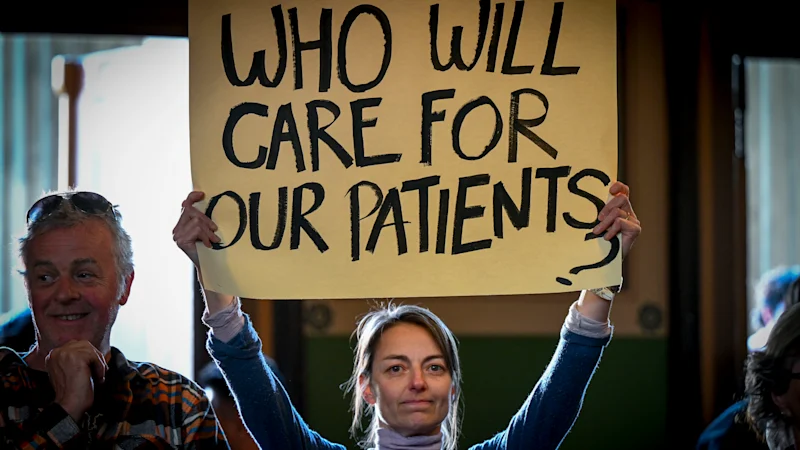
One cancer patient is advised to increase fluids, another sent an electronic script, and a third consoled. All have been saved from an emergency presentation by the timely intervention of a nurse – in just the first hour of the day.So, imagine my dismay when she warns me that her clinic will close for several weeks when she takes overdue leave. Thinking selfishly of my neediest patients, I ask why there’s no cover.“Because there is no money.”Considering the eye-watering price tag of many cancer therapies of limited, if not futile value, it seems incredible that there is no money to fund a cancer nurse who saves the healthcare system multiples of what she costs.I sympathise that manoeuvring healthcare budgets must be like managing a refractory migraine but still, who looks at this business case and says “it’s not worth it”? In the absence of said nurse, when patients are routed straight to emergency, who says, “that sounds like a good idea”?The catchphrase for every gap in healthcare delivery is that “there is no money” and clinicians are conditioned to believe it.But as a scathing report into the failings of one healthcare organisation shows, mismanagement may loom larger than money.First, some context.Melbourne’s Cohealth is one of Australia’s largest community health organisations. Funded to the tune of nearly $120m annually, it serves highly disadvantaged patients including those facing mental illness, homelessness, substance abuse, domestic violence and incarceration.Last year, the board announced that it had lost the good fight and was closing three GP clinics, citing – you guessed it – a lack of funding. This decision took clinicians, and more importantly, more than 12,000 patients, by surprise.The intense backlash triggered an inquiry. At its heart was the question: was inadequate Medicare funding to blame for the closure of the clinics?The expert report tells a sad story about how healthcare delivery is failing those most in need.The experts confirmed that the GP clinics were losing money. But only a small part of this was attributable to low productivity: the reason doctors were not working at the top of their scope was because they were undertaking work done more effectively (and cheaply) by others.Doctors deconstructing energy bills for patients and walking them to pathology (lest they abscond) were prevented from doing the things they were most qualified to do.The greatest cause of sustained financial loss, however, was poor practice oversight and high corporate costs. For this, the authors excoriate the management.Cohealth’s systemic problems were ignored for a decade and kept from the board. The GP service was budgeted as a deficit and ran as a deficit, allowing management to treat this as business as usual. Surplus Covid funding covered over deficits, but the method was opaque.Management periodically reassured the board that it knew what it was doing but this couldn’t be true when management distrusted the very doctors who could have helped improve clinic viability. Management held annual (!) meetings with GPs, then ignored their ideas before creating vague revenue targets that “changed depending on ‘who was talking’,” the report said.Imagine clinicians focusing on complex patient care when management were described by one GP and another clinic staff member as “people in positions of authority without appropriate skills, qualifications and knowledge to do their work”.But management is accountable to the board, so when the GP clinics were failing for a decade, what was the board doing? According to the report, precious little.Even when bluntly advised, the report notes, the board did not heed the financial alarm bells and failed to be curious or diligent. It also found it had no comprehensive strategy to protect vulnerable patients from the impact of closure. Its confidence that they would find new doctors was unfounded and inconsistent with its rhetoric of serving patients that other GPs can’t or won’t. For such a consequential decision, it defies belief that the board first met the doctors after the closure announcement.Predictably, the result of this and the previous board’s “considerable organisational, power and cultural distance” from the staff meant patients were the losers. Finding a new GP is generally onerous; given the complexity of its patients, Cohealth’s assumption was naive at best and harmful at worst. When one concerned worker walked around to see if any local GPs were accepting new patients, the answer was no.The experts made another telling observation that rings true to every clinician.The leadership was so invested in complaining about funding that it failed to control the things it could, such as monitoring the finances, listening to doctors and changing the model of care.The closure announcement had a proposed slogan of “we have fought” but it might well have been “we didn’t listen”.The report exonerates the clinicians and even commends them for caring deeply. And it outrightly blames the management and board for failing performance standards.Cohealth accepted all recommendations in the report and acknowledged there were areas where governance, leadership, communication needed to be strengthened.But the report’s conclusion holds object lessons for the hospital system, where over $100bn of our taxes is spent annually.Funding matters but money doesn’t buy responsive management and good governance. Or culture, communication and integrity.A colleague recently shared her ethical dilemma that her invitation to present patient data to her hospital’s board was accompanied by management insisting on a sanitised version that removed the “bad news”. I hope this is an isolated event but worry that it may not be.The observations of healthcare workers are not a threat but an asset to society. Marginalised clinicians become disengaged clinicians. Disengaged clinicians become unproductive clinicians.For many of us, working towards truly patient-centred medicine can seem like a task for Sisyphus, who was condemned by Zeus to keep rolling a boulder up a mountain only to have it roll down as it got near the top.It is hard work but we and our patients surely deserve to know that the failures of modern medicine are not always about the money.
It’s common to hear there’s ‘no money’ in healthcare. But sometimes it’s management that’s lacking | Ranjana Srivastava
A report into Melbourne’s Cohealth showed systemic problems were left unaddressed for a decade, while ideas from clinicians went ignored
1,007 words~5 min read