Staff writer, with CNA
Taiwan remained the sixth-largest net creditor nation in the world last year despite a fall of over 10 percent in its net international investment position (NIIP) in the year, the nation’s central bank said yesterday.The NIIP is the difference between a country’s external financial assets and its external financial liabilities.Taiwan’s external financial assets hit US$3.27 trillion at the end of last year, up US$275.75 billion or 9.2 percent from a year earlier, the central bank said in its latest annual NIIP report.
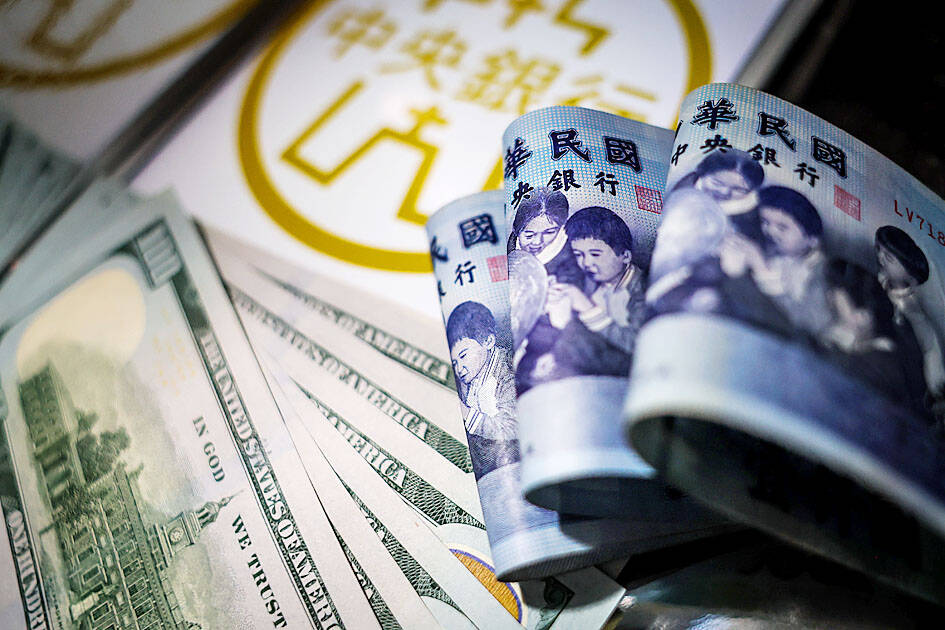
New Taiwan dollar and US dollar banknotes are displayed in front of the central bank’s logo in Taipei on May 6 last year.
The growth largely reflected an increase in holdings of overseas marketable securities by residents in Taiwan as well as a spike in the value of these securities, the central bank said.Meanwhile, Taiwan’s external financial liabilities increased at a much faster pace last year to reach a new high of US$1.92 trillion at the end of last year, soaring US$438.38 billion or 29.6 percent from a year earlier, the bank added.
The difference between the country’s external financial assets and liabilities reached US$1.35 trillion, the sixth largest in the world and down US $162.63 billion, or 10.8 percent, from a year earlier, the central bank said.Central bank Department of Economic Research official Tsai Mei-fen (蔡美芬) told reporters that the record external liabilities last year came after a strong showing in the local stock market, led by the bellwether electronics index, which soared 35.55 percent in the year amid the artificial intelligence (AI) boom.Foreign institutional investors trimmed their holdings in Taiwan’s stock market with a net fund outflow last year, but high share prices, in particular in the electronics sector, still boosted the value of their holdings, Tsai said.Foreign institutional investors largely favored Taiwan’s tech stocks with contract chipmaker Taiwan Semiconductor Manufacturing Co (台積電), which accounts for over 40 percent of total market value, one of their favorites.Taiwan experienced market conditions similar to those in South Korea last year due to fast-growing stock prices, she added.The previous record for Taiwan’s NIIP position was seen at the end of 2023 but fell the following year before rebounding last year on the back of a rise in market value held by foreign institutional investors, Tsai added.Among other countries, Germany took the top net creditor spot with a NIIP of about US$4.32 trillion as of the end of last year, ahead of China with US$4.07 trillion, Japan with US $3.68 trillion, Hong Kong with US$2.51 trillion and Norway with US$2.11 trillion, according to the central bank.