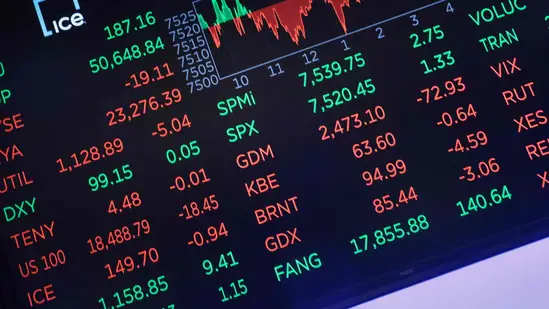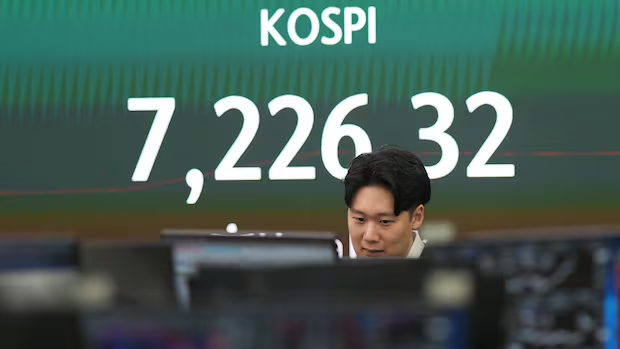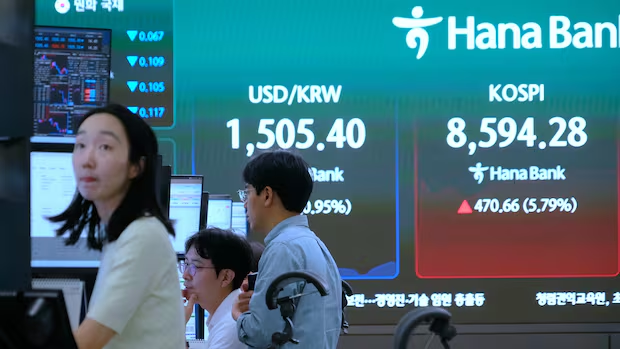
BusinessOil prices fell more than $4 US a barrel on news of a deal to end the fighting, as world markets responded positively to the developments. Wall Street futures also pointed up before the opening bell.Brent crude, the international benchmark for oil, was priced around $82 US a barrel Monday morningThe Associated Press · Posted: Jun 15, 2026 8:50 AM EDT | Last Updated: 2 hours agoListen to this articleEstimated 4 minutesThe audio version of this article is generated by AI-based technology. Mispronunciations can occur. We are working with our partners to continually review and improve the results.Currency traders watch monitors near a screen showing the Korea Composite Stock Price Index (KOSPI) and the foreign exchange rate between the U.S. dollar and the South Korean won at the Hana Bank headquarters in Seoul, South Korea, on Monday. (Ahn Young-joon/Associated Press)Global stock prices soared Monday after a tentative deal was announced on ending the Iran war and reopening the Strait of Hormuz, while oil prices fell more than $4 US a barrel.The future for the S&P 500 was up 1.2 per cent and that for the Dow Jones Industrial Average gained 0.9 per cent, auguring likely early gains for Wall Street.In early European trading, Germany's DAX advanced 1.3 per cent to 24,942.12, while the CAC 40 in Paris added 1.1 per cent to 8,444.00. Britain's FTSE 100 gained 0.2 per cent to 10,496.56.After repeated false starts, investors were betting that this time, the war might end. U.S. President Donald Trump confirmed the initial agreement and authorized an end to the U.S. naval blockade of Iranian ports.Iran confirmed it but signalled that implementation would not start until a signing that Pakistan said would be held Friday in Switzerland. Broader negotiations on issues like Iran's nuclear program are expected to continue over the next 60 days.In early trading Monday, the price of Brent crude oil, the international standard, fell $4.37 US to $82.96 per barrel. U.S. benchmark crude lost $4.53 to $80.35 per barrel.But it may take months for oil prices to stabilize after the disruptions from the war caused them to surge, pushing costs up for gasoline and many other products. Energy experts said shipping and insurance companies will want to be confident the pact will hold, ensuring that oil and gas supplies will flow freely enough for the world's needs to be met."The reopening of Hormuz is a relief valve, not a full peace dividend. The market can remove some crude panic, but it still has to price the gap between a headline, a signature and a regime that actually complies," Stephen Innes of SPI Asset Management said in a report.Still, the news was a huge relief for markets that have been roiled since the conflict began in late February.Stocks rallied in Asia, where Tokyo's Nikkei 225 gained five per cent to 69,317.50 as the benchmark logged another record high.Buying was heaviest for technology shares, especially those related to artificial intelligence. The boom in AI has been driving gains in Japan, where the benchmark has gained more than 80 per cent in the last year.WATCH | Why you can't just 'fully' reopen the Strait of Hormuz:Why you can't just 'fully' reopen the Strait of Hormuz | About ThatApril 17|Duration 9:14After more than six weeks of the de facto closure of the world's most critical energy chokepoint, Iran said the Strait of Hormuz was "completely open" to ship traffic. But as Andrew Chang explains, a few key factors complicate how open the shipping route actually is, and how long the status quo might hold.
Global stocks soar and oil prices drop as U.S., Iran reach tentative deal to end war | CBC News
Oil prices fell more than $4 US a barrel on news of a deal to end the fighting, as world markets responded positively to the developments. Wall Street futures also pointed up before the opening bell.
TL;DRAI
U.S.–Iran tentative deal to end war and reopen Strait of Hormuz: oil prices fall $4+/barrel, global equities rally 1–5%. Reduced geopolitical risk and lower energy costs strengthen macro conditions for tech M&A, capex, and hiring cycle expansion.
752 words~3 min read