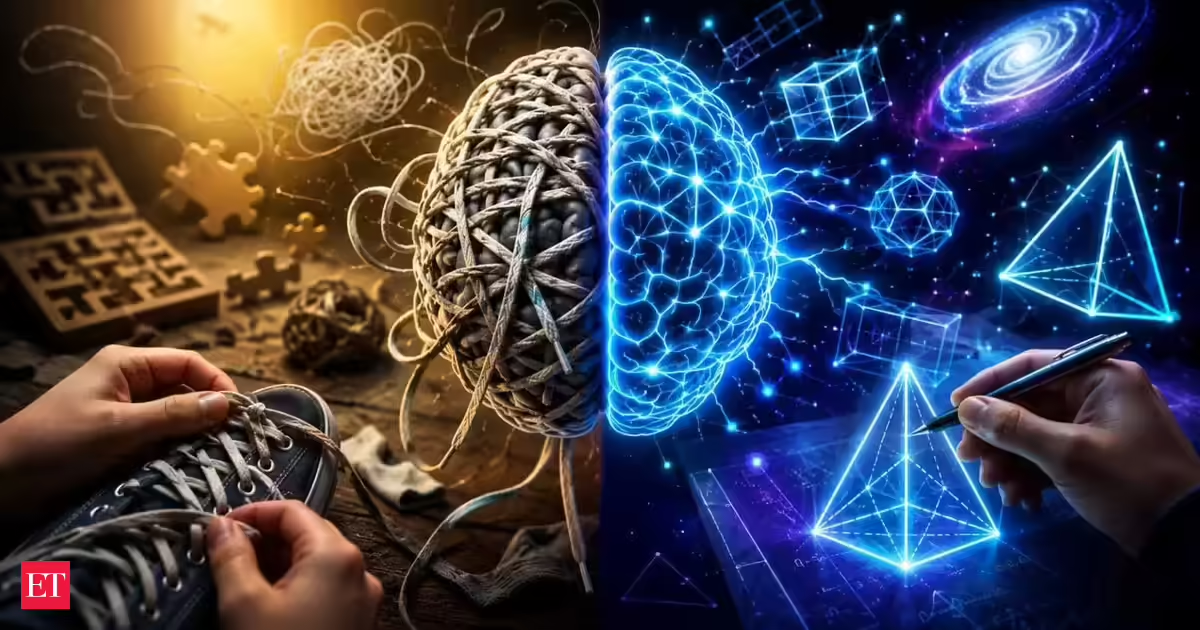
Have you ever met someone who can solve a difficult differential equation in minutes but struggles to make a necktie or tie their shoelaces properly? At first, it sounds strange. Many people assume intelligence works like a video game level. If someone is extremely smart, they should automatically be good at everything. But psychology says the human brain does not work that way. In reality, some of the world's brightest thinkers struggle with everyday physical tasks. This isn't because they are lazy, careless or less intelligent. It happens because the brain stores different kinds of intelligence in different systems.Modern psychology has a name for this idea: being brilliant in one area does not guarantee mastery in another.Psychology says intelligence is not a single superpowerFor many years, schools trained us to believe intelligence is one giant bucket. The smarter a person is, the better they should be at life. But researchers have repeatedly found that intelligence is more like a toolbox. A person may possess exceptional abstract reasoning skills while simultaneously finding physical coordination difficult. Psychology says people who can’t tie their shoelaces but solve impossible math problems may have an advantage: The surprising reason our brains work this wayDifferential equations belong to abstract thinking. Shoelace tying belongs to procedural and motor learning. These are two completely different brain jobs. This idea is closely connected to psychologist Howard Gardner's Multiple Intelligences Theory, which explains that human abilities are diverse rather than identical. Someone can be extraordinary at logic yet average at body coordination.You Might Also Like:The brain uses different systems for different tasksSolving advanced mathematics mostly depends on abstract reasoning, pattern recognition, working memory and analytical thinking. Tying shoelaces relies on procedural memory, sequencing and fine motor skills. Think of it this way. One system loves ideas. The other system loves movement. Sometimes one system becomes extremely strong while the other develops more slowly. That is why a software engineer may build an entire artificial intelligence model but still need extra time to fold clothes or tie a formal tie. The gap surprises people because society often treats intelligence as a universal skill. Psychology says it isn't.The hidden role of Developmental Coordination Disorder (DCD)For some people, there is another explanation. Researchers and organizations, including the UK's National Health Service (NHS), describe a condition called Developmental Coordination Disorder (DCD), sometimes known as dyspraxia. People with DCD may have perfectly normal or even exceptional intelligence while experiencing difficulty with movement-based tasks.Common challenges include:You Might Also Like:Tying shoelacesLearning to ride bicyclesHandwriting neatlyButtoning shirtsCoordinating body movementsResearch has also found connections between motor skill difficulties and executive function differences. Importantly, DCD does not mean someone lacks intelligence. Many adults never realize they have it because they become experts at creating shortcuts.The uneven profile phenomenon: Why strengths and weaknesses can exist togetherPsychologists sometimes call this an uneven cognitive profile. The brain is not designed to make every ability rise at the same speed. Imagine a city. One highway may be six lanes wide while another road remains narrow. Traffic flows differently in each place. Our brains work similarly. Some people invest thousands of hours into theoretical learning, coding, mathematics and analysis.Meanwhile, everyday physical routines receive less practice. Over time, the gap becomes larger. This is also related to neuroplasticity, the brain's ability to strengthen pathways that are repeatedly used. The more a person exercises analytical thinking, the stronger those networks become.Why modern life is creating more of these peopleTechnology has changed how humans use their brains. Today's students, engineers, programmers, researchers and data scientists spend enormous amounts of time working with symbols and screens instead of physical tasks. Many young professionals can build complex spreadsheets, train AI models and solve advanced formulas but struggle with small mechanical tasks.You Might Also Like:This is not necessarily a defect. It is often specialization. Modern jobs reward abstract thinking far more than physical sequencing. The brain naturally adapts to whatever environment it repeatedly experiences.The expertise paradox: Being highly intelligent can sometimes narrow practicePsychology also talks about something called the expertise paradox. When people become very good at one thing, they often invest less energy into unrelated skills. This creates an illusion. Observers assume a highly intelligent person should excel everywhere.When they don't, it feels surprising. But the reality is simple. Human brains are specialists before they become generalists. The same person who forgets how to tie a tie may understand equations that only a tiny percentage of people can solve. Both facts can exist together.What this says about human intelligencePerhaps the biggest lesson is this: Intelligence is not a single number. It is a collection of different abilities working together imperfectly. People should stop using everyday tasks as a universal measure of intelligence. Someone struggling with shoelaces does not automatically mean they are incapable. Likewise, someone who solves advanced mathematics is not automatically skilled at everything else. The human brain was never designed to be perfect. It was designed to be unique.FAQsWhy can some people solve complex equations but struggle with shoelaces?Because abstract reasoning and motor coordination are controlled by different brain systems.Is struggling with tying shoelaces a sign of low intelligence?No. It may simply reflect differences in motor learning, practice or coordination.
Psychology says people who can’t tie their shoelaces but solve impossible math problems may have an advantage: The surprising reason our brains work this way
The most important takeaway is that intelligence cannot be reduced to a single score or trait. It is a complex combination of different abilities that work together in unique and often imperfect ways. Everyday tasks should not be treated as a universal test of intelligence, because struggling with something as simple as tying shoelaces does not mean a person lacks capability or potential.
862 words~4 min read