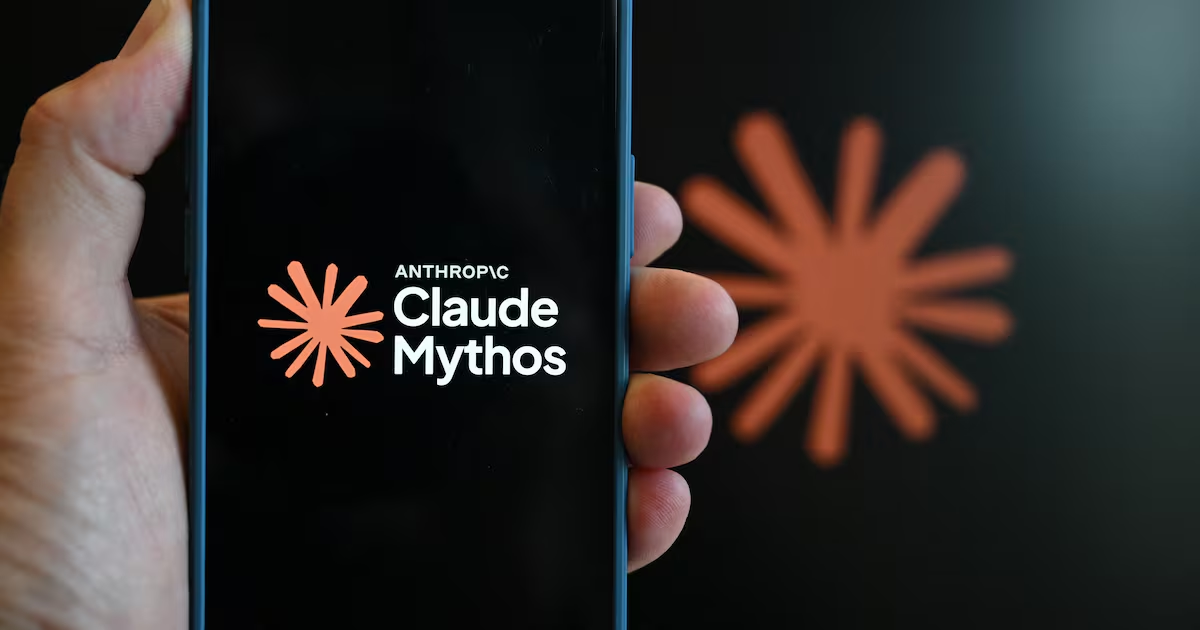
The Trump administration’s decision to force Anthropic to suspend its most advanced AI models, days after the $900 billion (€775 billion) company released them to the public, has blindsided the artificial intelligence (AI) industry and raised questions over Washington’s approach to the technology.The US department of commerce on Friday imposed export controls on Anthropic’s newest models, Fable and Mythos, barring foreign nationals from using the technology and prompting the company to suspend both systems for all users.Anthropic was given 90 minutes to comply and was not provided with detailed concerns before the order was issued, according to a person close to the company.Over the weekend, the company has flown in a senior technical team to Washington in an effort to contain the fallout.The directive followed a report by Amazon researchers identifying a potential “jailbreak” in Fable — a way of bypassing the model’s guardrails and extracting information about security vulnerabilities in software, according to a person familiar with the matter. Amazon first shared its findings with Anthropic.Andy Jassy, Amazon’s chief executive, discussed the issue with US officials on Friday, according to people familiar with the matter. Jassy, whose company has invested $13 billion in Anthropic, is understood to have raised broader concerns about frontier-model capabilities rather than issues focused specifically on Anthropic.[ Anthropic suspends latest AI models after US blocks access to foreignersOpens in new window ]Amazon said: “It’s not uncommon for governments to seek our counsel on potential security risks. When they occur, we don’t share the details of these discussions.” The Fable model had been tested and approved for launch days before its release by agencies within the same department, said people close to the matter.Anthropic disputes the administration’s targeting of its models, arguing that the capability identified is not unique and can be demonstrated in rival systems, including those developed by OpenAI.Fixing this type of issue would take weeks of research and development, with no guarantee that new ones would not emerge, according to security experts. A person close to Anthropic said it was working closely with the government to find common ground and work out the next steps.The clash is emerging as an early test of how the Trump administration intends to oversee increasingly powerful AI models. Executives and researchers say the use of export controls to address a model safety concern risks creating uncertainty around the deployment of frontier AI.‘No profit and crap governance’ – is Elon Musk’s SpaceX actually worth $1.75 trillion? Listen | 41:54“It is a pretty widely agreed upon fact that you cannot fully fix jail breaks in these models, it’s a very inexact science,” said Helen Toner, a former OpenAI board member and executive director of the Center for Security and Emerging Technology at Georgetown University. “Certainly government should expect [that] OpenAI and Google models are capable of similar things.”The government’s freeze does not, however, apply to leading models from Anthropic’s competitor OpenAI, despite those having demonstrated comparable capabilities.The intervention is particularly striking because Anthropic’s Dario Amodei has been among the most vocal AI leaders warning about the dangers posed by increasingly capable models.Its latest Mythos system has demonstrated the ability to overcome some existing cyber defences, and the company had been working with government officials on a controlled rollout before releasing it more widely last week.The order comes after senior government figures clashed publicly with Anthropic’s leadership over issues including AI regulation and the use of Anthropic’s technology in domestic surveillance and lethal autonomous weapons. The Pentagon has named Anthropic as a supply-chain risk to national security, and the two sides are in litigation over the designation.The Trump administration has characterised the move as a national security measure unrelated to those disputes. A US official told the FT that patching the jailbreak could resolve the current stand-off.But defence secretary Pete Hegseth linked the episode to his criticism of Anthropic, writing in a post on X that his department had previously kicked the company “out of our building — forever”, adding: “Every passing day proves why that was the right move.”Yet, US officials and company executives said the Pentagon and other US agencies were still using Anthropic’s most advanced models.The European Commission, which recently gained access to Anthropic’s latest models, said it was assessing the implications of the directive on its citizens.“These models offer significant benefits, including for cyberdefence, but they also raise serious cyber security concerns that need to be addressed,” the Commission said.“This is a shared challenge, not one confined to a single jurisdiction or company. We believe that contingency measures taken in this light should not be discriminatory against partners.”Toner said: “This lever they have chosen, export control, is very poorly suited to what they are trying to do. It prevents foreign governments from using it [and] now is the time allies are supposed to use it for cyber defence.”The White House previously signalled a less interventionist approach to the deployment of frontier models. An executive order signed earlier this month did not include a mechanism for the US government to stop a model from being released.Leading AI companies have worked with the government to implement the executive order, said a person close to OpenAI.In recent days, the industry has been working on ensuring foreign national researchers could continue to work on developing the most advanced models, a practice the Anthropic directive has now banned, the person said.Katie Moussouris, a researcher and chief executive of cyber security group Luta Security who received a copy of Amazon’s findings from Anthropic, said the capabilities Amazon identified, including the ability to identify potential cyber vulnerabilities, were not uncommon. She said rivals’ models, such as OpenAI’s GPT 5.5, were capable of doing the same.Moussouris said the model’s so-called guardrails were working as intended. “The administration got it wrong,” she said.The White House declined to comment. - Copyright The Financial Times Limited 2026
Anthropic scrambles after Trump administration freezes its top AI models
Export controls on Fable and Mythos raise doubts over how US will police the most powerful AI systems
TL;DRAI
Trump administration imposed export controls on Anthropic's models within 90 minutes following a jailbreak discovery, forcing suspension. The freeze—unlike OpenAI's models—signals regulatory unpredictability and supply-chain risk for frontier-model development.
970 words~4 min read