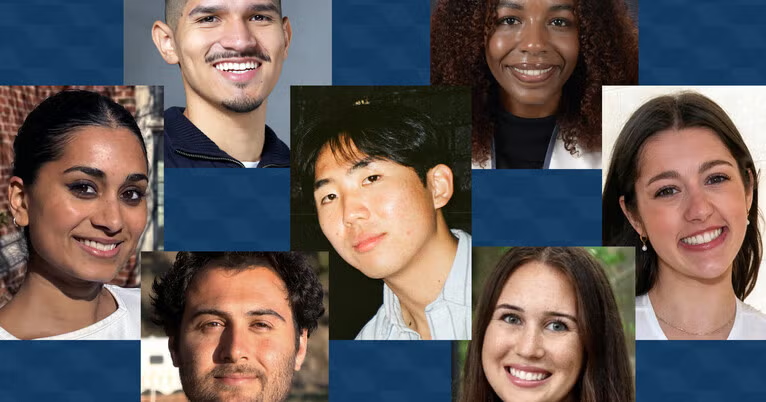
The inaugural cohort of Lafayette Fellows has been chosen for a year of postgraduate study in France.gettyThirty American college students have been chosen as the first cohort of Lafayette Fellows. Each fellow will receive financial support for one year of master’s study at one of 15 leading French universities, As part or their award, they will also participate in a leadership, mentoring and cultural program aimed at developing the next generation of French-American leaders.Established in September 2025 by the President of the French Republic, the new fellowship commemorates the 250th anniversary of French-American friendship. It is offered by Villa Albertine (a part of the French Embassy in the U.S. that supports cultural and educational exchange), in partnership with France Science, with support from the Albertine Foundation and a number of other sponsors. President Emmanuel Macron described the Lafayette Fellowship as a symbolic renewal of America’s ties to France with “a new generation of Americans crossing the ocean, not to wage war, but to invent the future of science and culture together with a common ideal, the legacy of Lafayette, which is a legacy of enlightenment, and belief, precisely in reason, in culture, and in education.”The fellowship calls for 30 outstanding American post-graduate students to be selected annually for one fully funded year of master’s study at a leading French university or grande école across STEM, the humanities, social sciences, and the arts. The first fellows were selected through a competitive national selection process chaired by Nobel Prize–winning economist Dr. Esther Duflo, with a jury that included Dr. Allan Goodman, President Emeritus of the International Institute of Education; Ms. Deborah Bial, President of The Posse Foundation; Dr. Catherine Dulac, Samuel W. Morris Professor of Molecular and Cellular Biology at Harvard University; Dr. Patrick Weil, Political Scientist at CNRS and Paris 1 Panthéon-Sorbonne University; and Mr. Mohamed Bouabdallah, Cultural Counselor of France and Director of Villa Albertine. MORE FOR YOUThis year’s fellows were chosen from a pool of 3,400 applications. They come from 26 different institutions that include small private colleges, major research institutions, regional public universities, and an HBCU. Four institutions — Harvard University, Columbia University, Stanford University and the University of California Santa Barbara — had two of their students selected in this first class of Lafayette Fellows. The fellows will study in a broad array of disciplines, including nanotechnology, AI regulation, climate science, economics, cognitive neuroscience, physics, public policy, and aerospace engineering. Half of the fellows will pursue their studies in Paris, while the other half will be spread across universities throughout the rest of France. You can view all of the new fellows’ profiles here. The fellows are scheduled to arrive in Paris on July 4, 2026, where they will begin a summer leadership program in Paris, Avignon, Arles, and Marseille. The leadership program will continue in Strasbourg in December and in the Paris region in spring 2027, where students will receive masterclasses on global challenges and engage with France’s research and education leaders.In addition to the partnership between France Science and the Albertine Foundation, the Lafayette Fellowship has received support from these patrons: Andrew Carnegie Foundation, formerly Carnegie Corporation of New York; Eric and Wendy Schmidt; The Richard Lounsbery Foundation; Hubert and Mireille Goldschmidt; Stephan Haimo and Veronica Bulgari; Reid Hoffman; Hubert Joly and Hortense le Gentil-Joly; David Sadroff; Fidji Simo; France and Christofer Descours; Maggie Lyon; Véronique and Jean-Hugues Monier; Gildo Pastor; Claire Simier and Gregg Galardi; American Friends of Blérancourt; Fondation de Chambrun-Lafayette; Ariane and Lionel Sauvage; Marc and Sally Onetto; and Allan Goodman; Air France; Campus France; the Franco-American Fulbright Commission (Fulbright France); Cité Internationale Universitaire de Paris – Fondation des États-Unis; and CNOUS.
30 Americans Awarded The Inaugural Lafayette Fellowship For Study In France
Thirty American students have been named the first Lafayette Fellows. They will receive a fully funded year of master’s study at one of 15 leading French universities.
610 words~3 min read