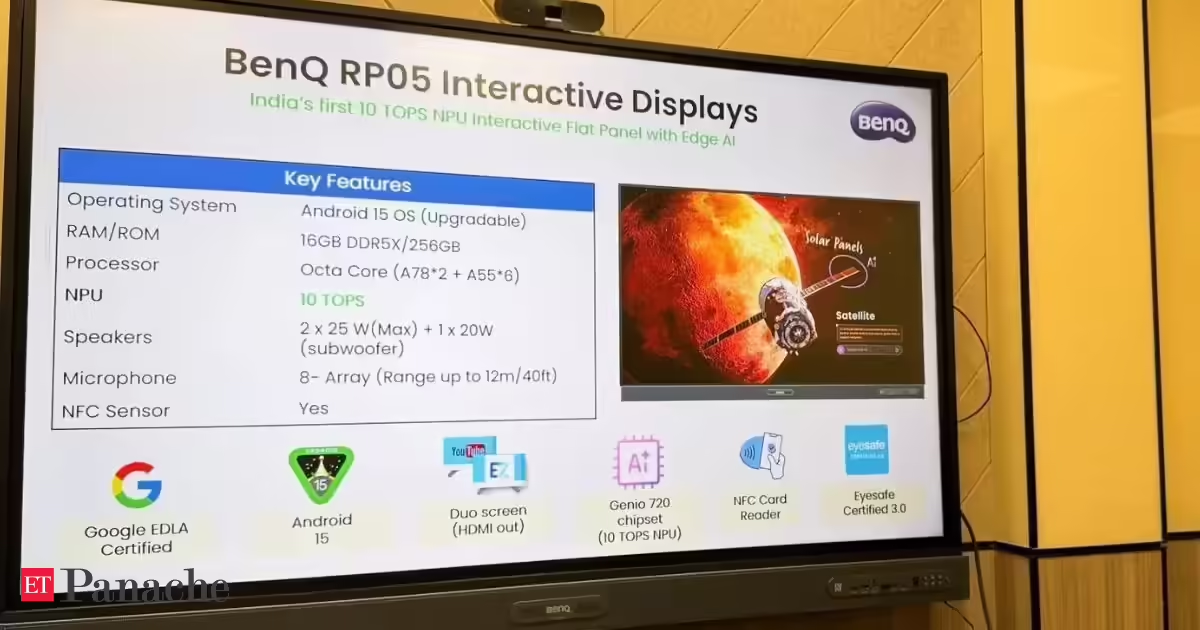
With the launch of the RP05 interactive display, BenQ is bringing on-device generative AI to classrooms. Yet, in a conversation with ET Digital, Managing Director Rajeev Singh revealed that the company's long-term growth story extends far beyond education, from portable projectors and golf simulators to Apple's rapidly expanding ecosystem.India's education sector is increasingly embracing artificial intelligence, but one challenge remains consistent: making AI genuinely useful inside the classroom rather than simply adding another feature to a specification sheet.BenQ believes it has found that balance with the launch of the BenQ Board Pro RP05, an interactive display designed specifically for AI-powered learning environments. The company claims the RP05 is the most powerful interactive display available in India today, driven by a dedicated 10 TOPS Neural Processing Unit (NPU) capable of running generative AI workloads directly on the device.The significance of that number goes beyond processing power. Unlike many existing classroom displays that rely on cloud connectivity for AI functions, BenQ's approach allows educators to access AI tools even without an active internet connection."We're bringing our best technology to Indian classrooms and helping educators, and in turn students, in new ways," said Rajeev Singh, Managing Director, BenQ India and South Asia. "Teachers should focus on teaching, not on managing technology."AI Built Around Teaching, Not DemonstrationAt the heart of the RP05 is a suite of AI-powered tools designed to reduce administrative work for educators.AI Lesson can generate lesson plans and teaching outlines instantly, while AI Quiz creates assessments and practice questions automatically. Ask AI enables conversational interactions directly on the board, allowing teachers and students to retrieve information without switching between applications.The company has also integrated visual learning tools such as Lasso Search, which allows users to circle an image or object on screen to retrieve contextual information, and Camera Gesture controls that let teachers navigate presentations from anywhere in the classroom.BenQ's whiteboarding software, EZWrite 6.0, further expands the experience through features such as EZMath, which converts handwritten equations into digital content and solves them in real time. Translation across 59 languages and AI-powered text-to-speech functionality aim to make classrooms more inclusive and accessible.The RP05 is available in 65-inch, 75-inch and 86-inch variants and combines its AI capabilities with a robust hardware package, including 16GB DDR5X RAM, 256GB storage, a 70W audio system, eight microphones and support for 50 simultaneous touch points.The Classroom Is Growing. But Home Entertainment Is Exploding.While the RP05 represents BenQ's latest push into education technology, Singh believes the projector industry is undergoing an even larger transformation elsewhere. Contrary to claims from some industry players that consumer projector demand is slowing, Singh argues that the home entertainment segment has become the primary growth engine for the category."The future of the projector business is at home. It's no longer in the classroom or conference room," Singh said during an interaction with ET Digital.According to him, more than two-thirds of projector demand today already comes from home users, a shift largely driven by changing consumer lifestyles.Generation Z consumers, he argues, are less likely to own permanent residences early in life and increasingly prefer flexible, portable technology.Projectors align well with those needs. Modern portable projectors now come with built-in batteries, integrated streaming platforms, automatic keystone correction and the ability to project onto virtually any surface without requiring a dedicated screen."People are living in rented homes, shared accommodation and more mobile lifestyles. A projector gives them a large-screen experience without permanently occupying space," Singh explained.Why Projectors Could Challenge TVsOne of Singh's strongest arguments revolves around viewing comfort. Unlike televisions, which emit light directly toward the viewer, projectors use reflected light, a characteristic he believes makes them more comfortable for prolonged viewing sessions."Human beings are naturally accustomed to reflected light. We don't look directly at the sun. We see objects through reflected light. A projector works in a similar way," he said.This distinction becomes increasingly relevant as consumers shift toward larger display sizes, with 65-inch and 75-inch televisions becoming mainstream.At the same time, BenQ sees growing demand for compact projectors that can be carried between rooms or even between homes.The company expects the market to gradually migrate from low-cost LCD projectors toward DLP-based technologies, which offer significantly longer operational lifespans and improved image quality.AI in Projectors Is Solving Real ProblemsWhile AI has become a buzzword across consumer electronics, Singh believes projector manufacturers need to focus on practical implementation rather than marketing labels. BenQ's approach has been to apply AI to long-standing user frustrations.For premium home theatre projectors, the company has developed systems that use integrated cameras to analyse ambient lighting and screen conditions continuously. The projector then performs real-time image calibration on a frame-by-frame basis.Historically, such calibration required specialised equipment and professional installation."Now the projector is effectively calibrating itself in real time," Singh explained.Portable projectors benefit in a different way. AI can automatically detect wall colours, screen dimensions, projection angles and obstacles, handling setup without user intervention."The biggest pain point for projector users has always been setup. AI removes that complexity entirely," he said.A Surprising New Growth Area: Golf SimulatorsBeyond education displays and home entertainment, BenQ is also investing heavily in golf simulation systems.While still a relatively niche segment in India, Singh sees strong long-term potential as affluent consumers increasingly adopt golf both as a sport and a networking activity. The company currently installs between 200 and 250 golf simulator systems every quarter, primarily across Delhi, Mumbai, Bengaluru and Hyderabad.The appeal goes beyond convenience.India's weather conditions often limit outdoor play due to heat, rain, pollution and fog. Indoor simulators allow enthusiasts to continue practising year-round. As golf participation expands and more high-income households emerge, BenQ expects this segment to become a meaningful contributor to its business.The Mac Ecosystem Could Be BenQ's Most Exciting OpportunityIf projectors represent BenQ's heritage, monitors may represent its next major growth engine. Globally, BenQ continues to dominate esports through its ZOWIE gaming brand. However, in India, Singh highlighted another segment that is generating significant momentum: monitors designed specifically for Apple users. Apple's growing Mac ecosystem has created demand for displays that can accurately reproduce colour profiles across MacBooks, Mac minis and Mac Studios without requiring manual calibration. BenQ's MA series monitors are designed around that requirement."The biggest pain point for Mac users was that monitor colours never matched what they saw on their MacBook screen. We've solved that problem," Singh said. The company already offers six Mac-focused monitor models and plans to expand the lineup further by the end of the year. As Mac adoption continues to accelerate globally, Singh believes this category could become one of BenQ India's most important growth verticals.The Bigger PictureThe launch of the RP05 underscores how rapidly AI is moving beyond software and becoming embedded directly into hardware. For BenQ, however, the larger strategy appears to be centred around solving practical problems rather than simply adding AI labels to products. Whether it's generating lesson plans inside a classroom, automatically calibrating a projector, simplifying portable entertainment, or improving the experience for Mac users, the company's focus remains on reducing friction. In an industry increasingly crowded with AI claims, that distinction may prove more valuable than raw computing power alone.
BenQ bets big on AI classrooms, but its biggest opportunity may still be in home entertainment
BenQ is integrating on-device generative AI into Indian classrooms with its new RP05 interactive display, simplifying teaching tasks. Beyond education, the company sees significant growth in portable projectors for home entertainment, driven by evolving lifestyles.
1,182 words~5 min read