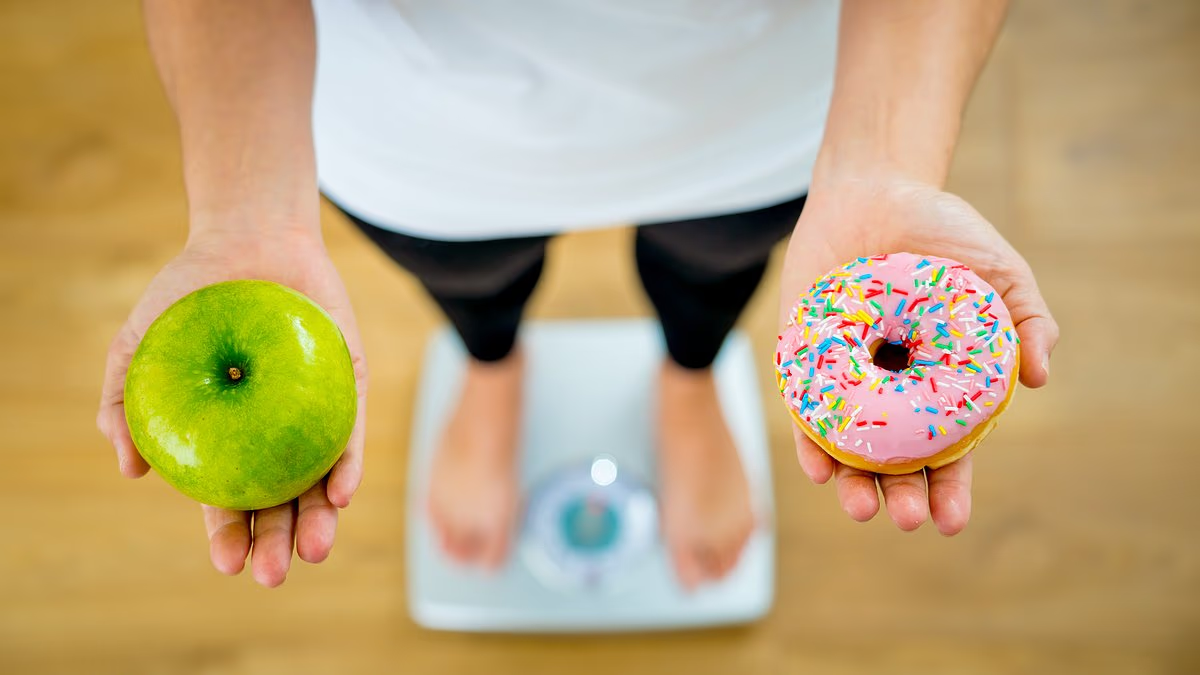
Rather than torturing myself by going without, I am thinking of allowing myself to eat my red velvet guilty pleasure and then “paying for it” by doing extra cardio. This way I am not miserable, I don’t gain weight, and I exercise more. Do you think this is a good strategy?You are opening Pandora’s box, and it usually ends in unhealthy obsession. The idea of doing more exercise if you eat more is not bad in and of itself. It’s just that the healthy version works the other way around: I am doing more exercise so I need to eat more.The other nuance is that you cannot see food just as calories. You get calories, and then you get calories. Red velvet cupcakes are delicious, but those 330-odd calories are inferior to the equivalent calories you’d get in 120g of lean beef biltong or 50g of almonds.The guilty treat is mostly refined carbohydrates and sugar. Rather than spiking your insulin and sending those cookie gremlins into your fat stores, biltong or cottage cheese would give you 10 times the protein for similar calories, which directly supports your training, recovery and body composition goals.If we apply your logic, it is likely to take a 75kg man, running at an “average” pace, about 26 minutes to “burn off” the 330 calories. Some people use a broad average calculation of about 1kcal burnt per kilogram of body weight per kilometre, but this is an approximation as a 90kg man would burn the calories quicker, and variables such as incline matter too.What I am about to share is really just for fun, and as a seasoned Water Cooler reader, you are no doubt capable of discerning tongue-in-cheek commentary from practical advice. I could not find a large-scale study that directly measured the exact energy expenditure of the “average” runner completing the Comrades Marathon (there are good sources discussing nutrition).However, well-established broad approximations for flat terrain, and then factoring in a substantial uplift in energy expenditure to factor in the “up run”, suggest that a 75kg runner at the weekend may have burnt 8,000-9,500 calories. This is broadly consistent with case study data from similar hilly ultramarathons.Why even try to quantify the impossible? Those runners ate properly, and trained and fed their bodies correctly. They all deserve applause and respect. But for the purposes of ridiculing your planned eating strategy, the up run is broadly equivalent to 25-28 red velvet cupcakes. How many do you want to eat in a week?I must confess as a writer I do believe the pen is mightier than the sword. It’s also far easier to use the pen to prescribe what one should do with the sword. Recently, despite my fairly decent knowledge and passion and fitness goals, the devils of temptation overcame the power of my sword.While at Checkers, a beautiful box of buttermilk rusks shouted across the aisle to grab my attention. A beam of evening light worked its way through the high windows and illuminated my weakness. “It’s cold,” I thought. “A rusk would be a welcome treat.”After finishing the entire box before 10pm, I found myself calculating the sugary calories I had forced into my body. I calculated the likely weight gain, how much of it could become fat and how long it would take to “burn it off”, just like you.It was 2,325 calories, if you were wondering. Not even a half marathon would absolve me of my sins! I almost, against my better judgment, opened Pandora’s box.But then I remembered that yes, I would be in a surplus that day, which was the last day of a 12-week high-intensity, three times a week full-body, progressive overload programme, complemented by two days of supplementary hypertrophy training for weaker body parts and two brisk 20-minute walks or light runs a week.Long-term fat gain would be minimal or negligible, as those carbs would have been shuttled straight into glycogen stores to help my recovery. A “guilty refeed” for lack of a better description.A far healthier relationship with food is built by understanding the bigger picture of committing to a long-term exercise plan. However, if I binge like that again and again, it becomes a lifestyle choice. And your lifestyle will determine your belt size no matter how much you exercise.
Devlin Brown at the water cooler | Sweet treats not worth the weight gain and regret
Sugary foods and refined carbohydrates cause insulin spikes and fat storage
TL;DRAI
Devlin Brown argues compensation cardio for refined-carb treats (e.g., 330-calorie cupcakes) fails: calorie quality matters, as sugar spikes don't support recovery like protein does. Sustainable fitness discipline requires long-term training consistency, not transactional food-exercise swaps.
714 words~3 min read