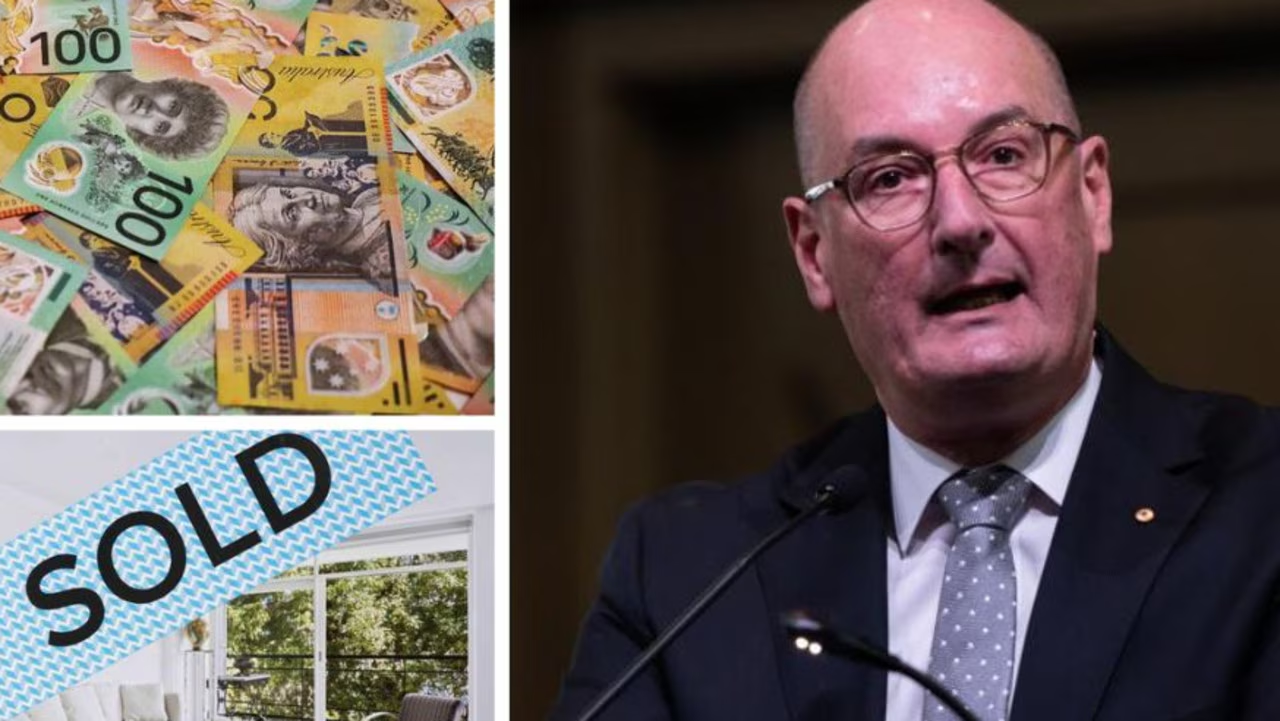
Australian mortgage holders are being battered by higher interest rates, leading to calls from a finance guru to ease the pressure on households.In a grim plea, Compare the Market economic director David Koch warns Australians cannot afford the sharp interest rate hikes, calling on the central bank to take a break from its rate hiking cycle.So far, the RBA has lifted interest rates at all three of its meetings in 2026, taking the cash rate from 3.6 per cent to 4.35 per cent. “These hikes are in after-tax dollars, which means you’re going to need to earn roughly $6000 more a year to afford them,” Mr Koch said. “Most people can’t just pluck that money out of thin air – it’s going to mean making some serious lifestyle changes, with things like holidays and family outings potentially on the chopping block. The previous three cash rate rises have already added about $342 to monthly repayments on the average loan of about $736,000. Mr Koch said he didn’t think the RBA understood how tough it was for Australian mortgage holders to cope with rising rates on top of cost-of-living pressures. “They’re being crunched, absolutely crunched, by the last three interest rate increases, rising petrol prices, and the uncertainty around tax changes, particularly for small business owners. It is essentially forcing everyone into hibernation,” he said.Mr Koch urged the RBA to consider that the damage to the economy could be difficult to unwind.“My great fear is that these blows are going to spark a big increase in unemployment,” Mr Koch said. “The latest figures showed a slight increase, but as we know, unemployment is often the last piece of economic data to deteriorate in a downturn and, when it does, it comes with a ‘bang’ – out of nowhere and it’s really hard to stop.”Ahead of Tuesday’s June rate meeting, experts all predict interest rates will be left on hold, but they are split on the future direction for interest rates. Case for future hikesAustralian mortgage holders are being warned persistently high cost of living prior to the start of the US-Iran war means interest rates need to rise. In a bitter blow for households, Westpac chief economist Luci Ellis – who worked at the RBA for more than three decades – warns that while the RBA is likely hold rates in June, she still expects two more rate increases before the end of the year. “If we are right about the inflation profile from here, the RBA will be surprised on the upside. We therefore retain our view that further rate hikes will occur in the following meetings (August and September),” she said. Should Ms Ellis’ prediction of two more hikes come true, the cash rate will rise to 4.85 per cent. Despite the added pressure on mortgage holders, the RBA has repeatedly said persistently higher inflation kills living standards, saying it will do what is necessary to take inflation out of the system. According to Ms Ellis, several factors could keep inflation higher, including the second-round effects from higher fuel costs. “Trimmed mean inflation is drifting up, and even after revising the outlook for the somewhat better oil price trajectory, our base case remains higher than the RBA’s May forecasts through the rest of this year,” she said.“Pass-through is starting to become evident in categories such as home-building costs, dining out and postal and courier services.” Australian Bureau of Statistics figures show yearly headline inflation fell from 4.6 per cent in March to 4.2 per cent in April.This was due to rapidly rising oil prices in March and a temporary halving of the fuel excise in April.By June 30, oil prices could rise again when the fuel excise runs out, depending on the US/ Iran conflict.The all-important trimmed mean inflation rate – which the RBA watches carefully because it strips out volatile and seasonal items – rose to 3.4 per cent for the 12 months to April, showing underlying price pressures are still in the Australian economy.Both numbers are still well above the RBA’s inflation target of between 2-3 per cent.Ms Ellis also noted the recent decision to lift the minimum wage would have consequences for the central bank. “The larger-than-expected increase in award wages will add a little to some market services components of the CPI, where labour costs are particularly important and many workers are on awards,” she said. It is a similar warning from AMP economist My Bui, who previously wrote the Fair Work Commission’s plans to lift the minimum wage by 4.7 per cent would have flow-on impacts for inflation. “The decision is only expected to add less than 0.6 percentage points to annual wages growth next year. The risk is that wage pressures spill over into other parts of the private sector,” she said.“Wage pressures will add to already sticky services inflation, as businesses pass on higher labour and input costs, which have remained elevated amid rising goods prices.”While Ms Bui said it was understandable the Fair Work Commission would give a decent pay bump to workers, it would have flow-on impacts. Ms Ellis noted it would be a difficult trade-off for the RBA, which is also dealing with a slowing economy. “As well as the more benign developments in energy prices and the conflict more broadly, some domestic data releases have been softer than generally expected,” she said.“Consumer spending looks to have stalled, tax changes have induced uncertainty in the housing market, and sentiment surveys have weakened. Weak GDP reads are likely in coming quarters.”Case for a move downDespite Ms Ellis’ bearish prediction, the major banks are split on their reading of the economy.NAB chief economist Sally Auld says recent data shows the economy is losing momentum, shifting the bank’s view on interest rates.“The next move in the cash rate is likely to be down, but the timing is uncertain,” she said.“In February, growth was above trend, the economy was operating above capacity and there was uncertainty over the restrictiveness of rates. None of these conditions exist today.”NAB has become the second of the big four banks to call for an interest rate cut in 2027, following similar predictions from Commonwealth Bank.Commonwealth Bank economists Trent Saunders and Ashwin Clarke said interest rates would be held until May 2027, although the duo noted “the risks to this outlook are tilted towards the cash rate remaining higher for longer”.HSBC chief economist Paul Bloxham also predicts rates will be left on hold after three consecutive rises before dropping again in 2027.“Inflation is still too high and is set to rise further before it falls. That being said, the RBA has already taken significant action to deal with this surge in inflation – and, critically, the action is working,” Mr Bloxham said. “Although there is some risk the RBA might choose to hike again beyond that, we expect the weakening in growth to convince them to be on hold.” “With the economy set to weaken, and inflation expected to decline through late 2026 and 2027, we now see cuts beginning from Q3 2027.”
‘Money out of thin air’: Kochie’s RBA plea
Australian mortgage holders are being battered by higher interest rates, leading to calls from a finance guru to ease the pressure on households.
1,175 words~5 min read