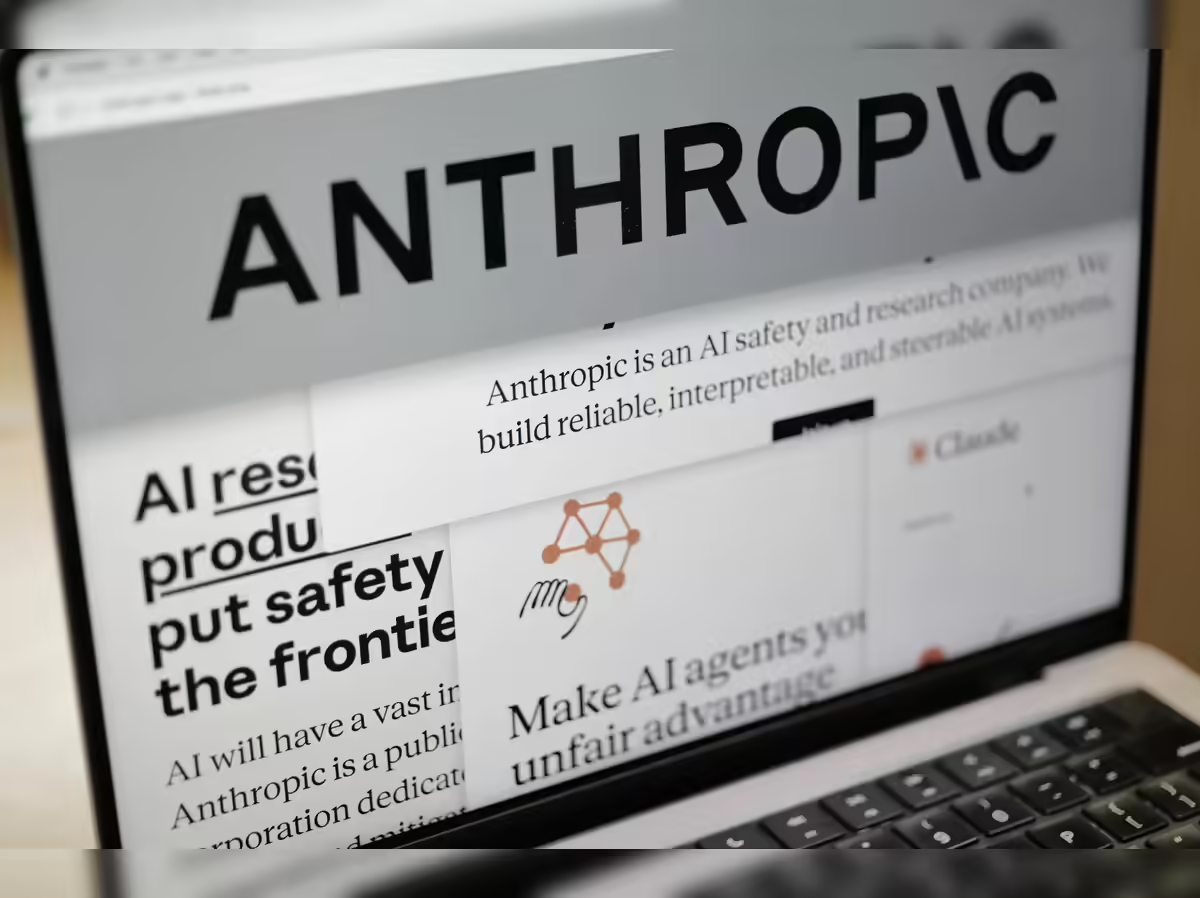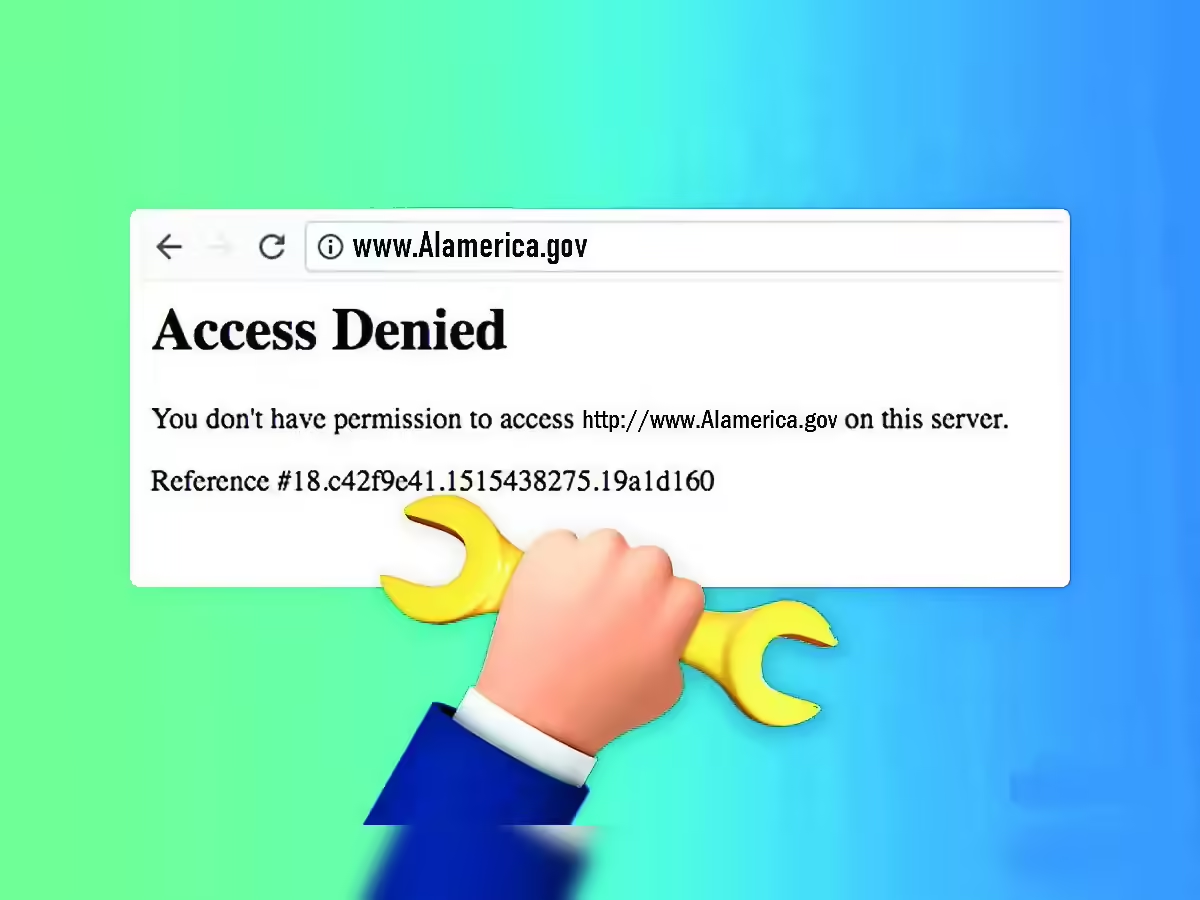
Last Friday, Anthropic switched off its two most capable models, Fable 5 and Mythos 5, for most customers. It did so not by choice but after being arm-twisted by a US government export-control directive, citing national security issues, that bars access by any foreign national, whether inside or outside the US, including Anthropic's own foreign-national employees.Because Anthropic couldn't cleanly separate US citizens from non-citizens, compliance meant disabling the models altogether. So, a frontier AI tool that was launched days earlier went dark within hours of a letter from the US commerce department. This also disrupts the Anthropic-led expanded Project Glasswing - uniting major tech firms like Amazon, Google, Microsoft and Apple - to combat AI-driven cyber threats that India would have benefited from.If one strips away specifics, the episode is a signal flare. For a decade, technology denial has crept from the periphery of sanctions on adversaries (like Huawei) to the centre. 2025 AI Diffusion Rule sorted the world into tiers and, for the first time, treated model weights as controllable munitions. Friday's directive is the next turn of that screw.The frontier of control is no longer geographic but the individual. What is alarming is the precedent it sets. If a security concern can vapourise a publicly launched model overnight, every other deployment now carries that contingent risk. That should unsettle every government betting its AI future on the US stack, India included.India has wagered heavily on tech diplomacy with the US - TRUST (Transforming the Relationship Utilising Strategic Technology) initiative launched by Trump and Modi in February 2025, the Pax Silica supply-chain compact, and India-US AI Opportunity Partnership signed this February. The framing is seductive with India as 'trusted partner' anchoring AI infrastructure outside East Asia's chokepoints. The latest Fable 5 episode, however, exposes the fine print - conditional trust that's revocable overnight.If Washington can turn off the lights on a model for its own engineers, an Indian developer's access is a privilege, not a right. China will read the same event and harden its conviction that sovereignty must be built at home, because any spigot the US controls is political. Even after the US cleared Nvidia's second-tier chips for Chinese buyers last December, Beijing has kept pouring capital into an indigenous stack.Middle powers are improvising, too. France, hosting this week's G7, is courting a 45 bn SoftBank build-out and branding itself as Europe's AI hub. The EU is chasing 'sovereign' compute. Japan and South Korea are nursing domestic foundries, while the Gulf trades investment for chip allocations. None yet rivals the US frontier. But the Fable 5 shock is exactly the kind of thing that accelerates the hunt for alternatives, the very fragmentation US strategists fear.The timing is almost theatrical. The 3-day G7 summit convenes in Evian-les-Bains from today, where Macron hopes to nudge AI cooperation forward, even as governance language is diluted and Washington presses its 'American AI technology stack' against Chinese rivals. India is attending as a guest, with lot of tech diplomacy work happening at the back. 120 Indian deep-tech startups are there in Nice since Sunday for the 3-day Bharat Innovates 2026, spanning semiconductors, quantum and space. Narendra Modi will be a speaker at the annual VivaTech conference in Paris later this week, where India is 'AI Country Partner' and is expected to unveil its MANAV (Moral, Accountable, National Sovereignty, Accessible, and Valid) governance framework.Founders in Nice are courting global investors at the exact moment the US has shown conditional tech control without warning. So, is 'trusted partner' now a probationary perch? Does anchoring to the US stack lock India into a dependency a future directive could throttle in an evening?The answer is not to walk away. Compute, capital and frontier models still flow predominantly from the US. What India should do is refuse exclusivity. India's strongest play is as that it's embedded deep enough into the US ecosystem to extract real infrastructure. It's sovereign enough in talent and standards to bargain, and open enough to France, Japan and its own stack to avoid single-point capture. The ecosystem is ramping up but GoI has to foster this further. Because technology denial has come home.(Disclaimer: The opinions expressed in this column are that of the writer. The facts and opinions expressed here do not reflect the views of www.economictimes.com.)
Tech denial’s come home: The Anthropic shock is India’s wake-up call - The Economic Times
The US government has restricted access to advanced AI models, impacting even its own engineers. This action highlights conditional trust for partners like India. The move prompts global efforts to build independent AI capabilities. India must leverage its talent and diverse partnerships to avoid single-point dependency.
714 words~3 min read