In early 2026, Anthropic researchers ran an experiment with 52 junior developers. Half used an AI assistant to learn an unfamiliar Python library. The other half worked without one. Both groups finished the task. But when tested on how well they understood the code they had just written, the AI-assisted group scored 50% on a comprehension quiz - versus 67% for the unassisted group.
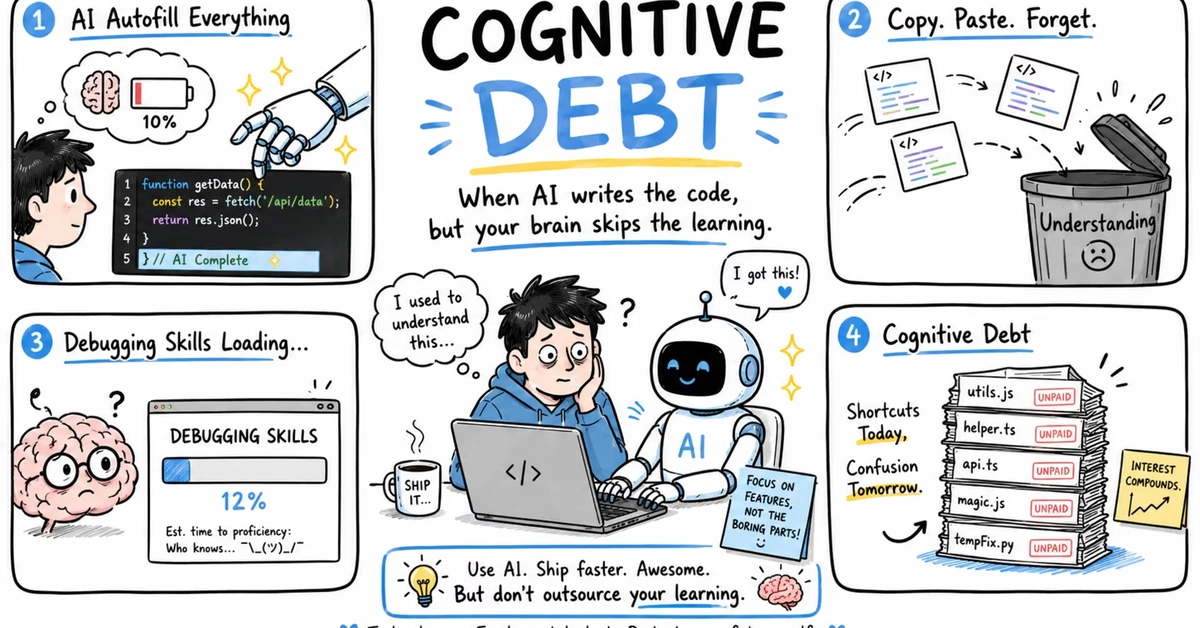
That 17-percentage-point gap has a name: cognitive debt. It is one of the most important concepts in software engineering right now, and most developers are not paying enough attention to it.
What Is Cognitive Debt?
Cognitive debt describes the growing gap between the volume of code that exists in a system and the amount that any developer genuinely understands. It is not a new term, but it crystallized across multiple research streams in early 2026.
Addy Osmani (Google Chrome) described it as "comprehension debt" - the hidden cost that accumulates when code becomes cheap to generate but understanding still requires deliberate effort. Margaret-Anne Storey (University of Victoria) formalized the concept in a March 2026 arXiv paper, framing it as a team-level problem and extending it into a Triple Debt Model: technical debt in the code, cognitive debt in the people, and intent debt - the missing rationale that both humans and AI agents need to safely work with code.