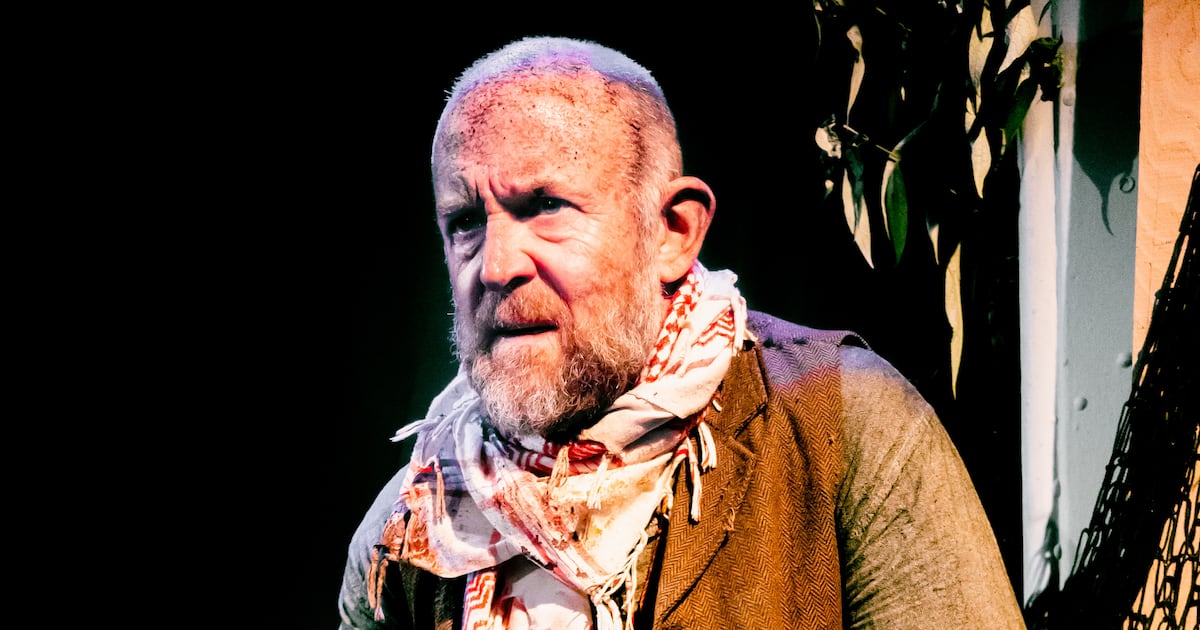
The Homecoming of Joseph GraceMarina Market, Cork★★★☆☆At the edge of the Marina Market, Cork Midsummer Festival workers guide the audience with torchlight through the darkness of an empty warehouse towards a square of cool white-blue light. In it stands a man in drab postwar trench coat and hat, suitcase in hand, waiting.Conceived by Owen Boss, the set for The Homecoming of Joseph Grace is spare and effective, evoking the liminal atmosphere of a ferry terminal as passengers newly disembarked on Irish soil wait for buses into the city: a corrugated metal roof, a row of connected seats and linoleum flooring.Directed by Louise Lowe, this Once Off production begins slowly. Joseph, who is played by Michael Glenn Murphy, takes pills from his suitcase and swallows them. The sound of an approaching engine grows louder. He appears ready to board, then changes his mind: he’ll get the next bus. He begins to tell his story.Written by Deirdre Kinahan, the play follows the fictional Joseph Grace, born in Kells in the late 19th century. An effeminate boy plagued by hay fever and unsuited to the physical demands of farm life, he enlists in the British army largely because he is infatuated with a handsome boy, Jack Bryan, who promises that the war will be “a big adventure”. Predictably, it is not. It’s the beginning of a life of displacement, loneliness and suffering.Joseph becomes a prisoner of war, joins Roger Casement’s Irish Brigade and is subsequently abandoned with its other members to an uncertain fate. He drifts into Weimar Germany, surviving as a rent boy amid the cocaine-fuelled queer nightlife of Berlin. Later come further wars, further migrations, a succession of lovers and, eventually, London, where, in old age, he cares for a cross-dressing partner whose death leaves him profoundly alone. Carl Kennedy’s sound design helps evoke these shifting worlds, from Max Hansen’s Weimar cabaret to the melancholy rhythms of Joseph’s later years.Kinahan’s script is often excellent: unusual, and alive to the strange contingencies of history and the madness of colonialism. The play imaginatively fills in the gaps surrounding the neglected members of the Irish Brigade while grounding itself in striking informed conjecture, such as Punjabi labourers singing Irish songs while building roads for the Germans.What’s most interesting about Joseph as a character is that his life often resembles the set-up to a dark joke. He is essentially a Zelig-like figure who adapts to survive. Again and again, he stumbles into some of the 20th century’s worst catastrophes just because he’s horny. The first World War, the Irish Brigade, the Freikorps milieu of interwar Germany that would eventually feed into Nazism. A brilliant comic premise is buried in the material, yet the play isn’t interested in being funny. Instead, and somewhat disappointingly, it’s a narrative about survivor’s guilt and religious shame. The gentle conclusion suggests that Joseph Grace is trapped in a kind of purgatory, condemned to retell his life until he can make peace with it.Michael Glenn Murphy’s performance is impressive and deeply felt, even if more restrained direction might have allowed the audience space to arrive at the feeling for themselves.The Homecoming of Joseph Grace is at the Marina Market, as part of Cork Midsummer Festival, until Saturday, June 20th; it will be at the Pavilion Theatre, Dún Laoghaire, from Thursday, July 16th, until Sunday, July 19th
The Homecoming of Joseph Grace: Michael Glenn Murphy gives an impressive, deeply felt performance
Cork Midsummer Festival 2026: Deirdre Kinahan’s play follows an Irishman whose enlistment in the British army begins a life of loneliness and suffering
555 words~3 min read