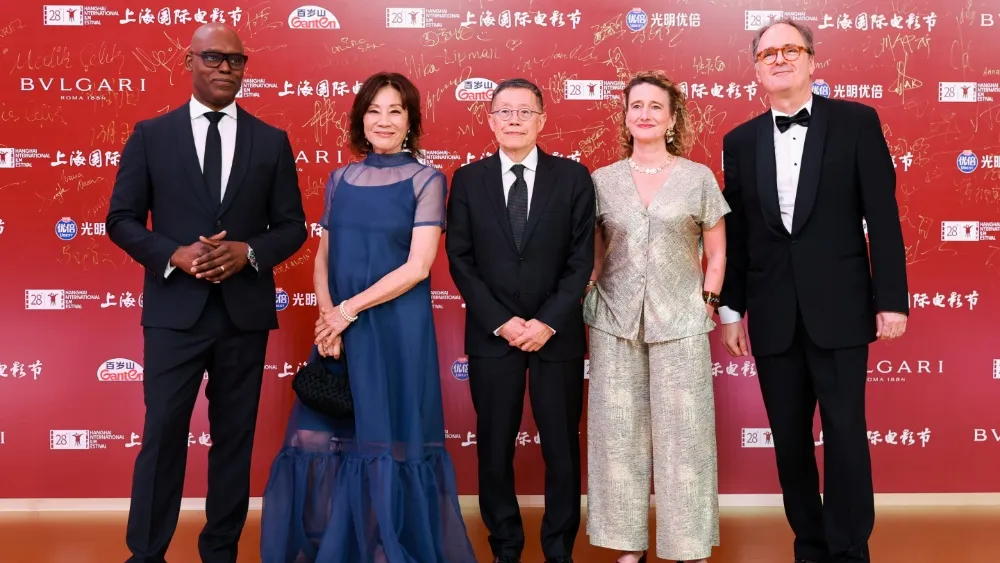
The leaders of three of the world’s most influential film festivals told Shanghai on Sunday that the role of the festival circuit in discovering and developing new voices has never been more critical – and that personal connection, not data, remains the truest compass for identifying talent.
Tricia Tuttle, director of the Berlin Film Festival, opened the main forum session of the 28th Shanghai International Film Festival by arguing that “discovery and connection” are the twin pillars that justify the festival’s existence in an age of algorithms and online networks. Tuttle pointed to Berlinale’s annual talent program, which draws applications from more than 100 countries and brings 200 emerging directors, screenwriters, cinematographers, editors, composers and critics to Berlin each year, as proof that the structured cultivation of careers remains irreplaceable. “A first-time filmmaker brings a little-known work to Berlin, Toronto or Shanghai, and within a week they are meeting distributors, sales agents, producers and future collaborators,” she said. “That is what discovery and connection mean.”
Cameron Bailey, CEO of the Toronto Film Festival, grounded the discussion in commercial reality, noting that TIFF has served as the launchpad for films ranging from “The Shawshank Redemption” to “The Martian” – the latter generating roughly $600 million globally after its Toronto bow. He recounted how a young British filmmaker arrived at TIFF in 1998 with a low-budget black-and-white debut that attracted considerable attention from audiences, press and industry. That filmmaker was Christopher Nolan with “Following.”