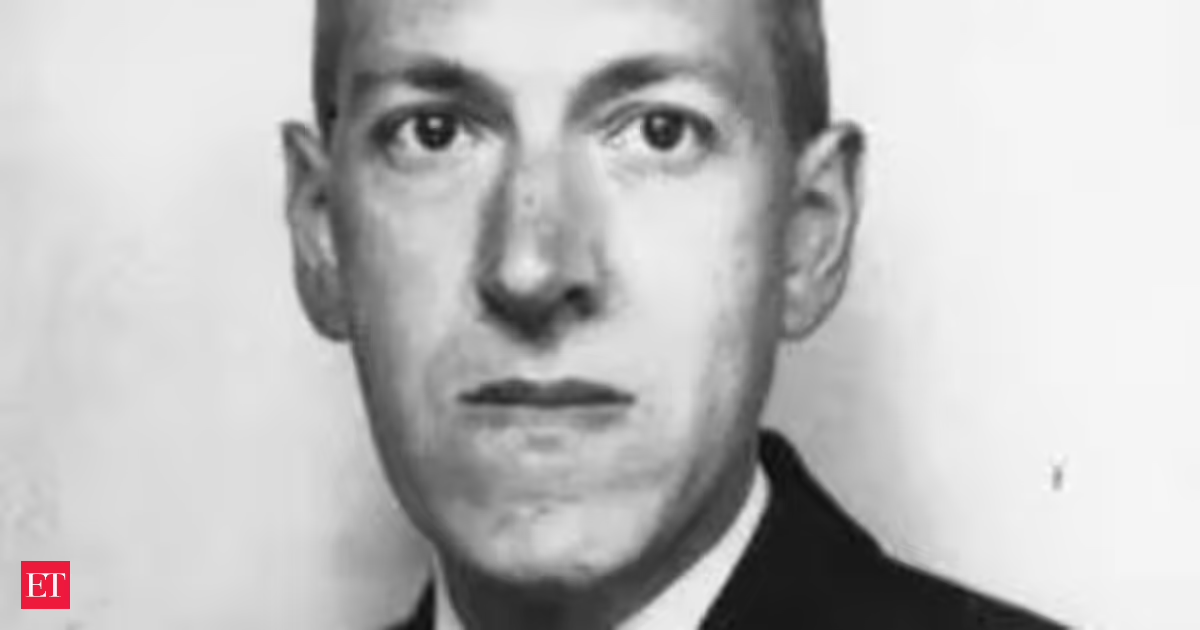
In the opening of Interstellar, when Professor Brand whispers, "Do not go gentle into that good night" to a dying world, something stirs in the quiet spaces between our breaths, a question that haunts every moment we dare to stare too long into the universe: What if we're not meant to know everything?There is no denying that our time demands that we know everything. We're told to track every trend, understand every crisis, correlate every data point, and stay informed about every disaster. And somewhere beneath the scrolling, under the endless feed of dread, there's a quiet question that no algorithm answers: What if we're breaking ourselves by trying to hold too much?But what if the answer isn't more knowledge? What if it's something softer, something stranger? What if it's the mercy of not knowing?There's a quote from an American writer of weird horror, cosmic dread, and forbidden knowledge that might help the scroll-addicted generation to find its way back to that mercy. A writer who understood that the human mind wasn't meant to voyage too far into the black seas of infinity. A writer who knew that sometimes, the most merciful thing in the world is that we can't know everything.Because maybe - maybe, that's what keeps us sane.You Might Also Like:Quote of the Day by H.P. Lovecraft: "The most merciful thing in the world, I think, is the inability of the human mind to correlate all its contents. We live on a placid island of ignorance in the midst of black seas of infinity, and it was not meant that we should voyage far."Why H.P. Lovecraft's quote on ignorance and existential dread matters todayLovecraft's words feel like a strange comfort in an era of information overload, anxiety spirals, and the constant pressure to understand every crisis. We're told to stay informed, to correlate every fact, to see the whole picture. But his quote suggests that our inability to grasp everything isn't a failure; it's protection. When we're drowning in news about war and ecological collapse, remembering that we're meant to live on a "placid island of ignorance" can be the difference between paralysis and peace.This matters especially now, when algorithms feed us endless content designed to make us correlate everything: every disaster, every scandal, every threat. Lovecraft doesn't offer hope; he offers mercy. The mercy of not seeing the full picture. The mercy of not voyaging far into the black seas of infinity, where ancient horrors wait. Because sometimes, not knowing is what keeps us sane.What H.P. Lovecraft's quote means in real lifeIn real life, this quote isn't about ignorance as weakness; it's about accepting that we're not meant to understand everything. It's the parent who doesn't scroll through every medical study about their child's illness. The activist who doesn't let every crisis consume them. The student who stops researching at midnight and sleeps. It's choosing to live on the placid island instead of voyaging into the black seas where the mind breaks.Lovecraft wrote this from The Call of Cthulhu, where characters who learn too much about ancient cosmic entities lose their sanity. But the quote applies to us: when we try to correlate all the contents of our minds, every trauma, every fear, every piece of terrible news, we risk the same destruction. The "merciful thing" is that our minds can't hold it all. We're protected by our limitations. And sometimes, the most human thing we can do is stop voyaging and stay on the island.H.P. Lovecraft's quotes"The oldest and strongest emotion of mankind is fear, and the oldest and strongest kind of fear is fear of the unknown."“That is not dead which can eternal lie, and with strange aeons even death may die.” “It is good to be a cynic — it is better to be a contented cat — and it is best not to exist at all.” “I know always that I am an outsider; a stranger in this century and among those who are still men.” “I never ask a man what his business is, for it never interests me. What I ask him about are his thoughts and dreams.” “To be bitter is to attribute intent and personality to the formless, infinite, unchanging and unchangeable void. We drift on a chartless, resistless sea. Let us sing when we can, and forget the rest.” H.P. Lovecraft, aka Howard Phillips Lovecraft (1890–1937), was an American writer best known for his distinctive style of "cosmic horror" or weird fiction. Writing primarily in the 1920s and 1930s, he blended elements of gothic horror and science fiction to create unsettling stories about ancient gods, alien beings, and the fragility of human sanity. His most famous works include The Call of Cthulhu, The Shadow Over Innsmouth, and The Witch House.Though he was mostly published in pulp and amateur magazines during his lifetime and died in poverty, his work has since gained widespread recognition and significantly influenced modern horror and speculative fiction. Lovecraft began writing as a child, publishing poetry and essays in his teens. His imaginative worlds, filled with forbidden knowledge and cosmic entities, created a new genre that shifted horror from physical threats to existential dread.H.P. Lovecraft's legacyLovecraft's legacy lies in how he reshaped horror by shifting its focus from physical threats to existential dread, the idea that humans are insignificant in a vast, unknowable universe. His imaginative worlds have inspired generations of writers, filmmakers, and artists.While his personal views, including racism and antisemitism, remain widely criticized and separate from his literary work, his contributions continue to shape popular culture. Board games, video games, films, and countless authors borrow his cosmic entities and themes. Today, he's remembered not just as a horror writer but as the creator of a new way of fearing: not the monster under the bed, but the terrifying truth that the universe doesn't care if we exist at all.
Quote of the Day by H.P. Lovecraft: 'The most merciful thing in the world is the inability of the human mind to…' - The Call of Cthulhu author reveals why not knowing everything keeps us sane
Quote of the Day by H.P. Lovecraft is on the merciful inability of the human mind to know everything offers a strange comfort. This perspective suggests our limitations protect us from existential dread, allowing us to live on a "placid island of ignorance" rather than be consumed by the vastness of the unknown.
TL;DRAI
Lovecraft's 1920s quote on ignorance resurfaces: minds break from correlating all information—wisdom for the algorithmic overload era. Tech leaders should embrace knowing less; selective ignorance protects decision-making and mental health.
976 words~4 min read