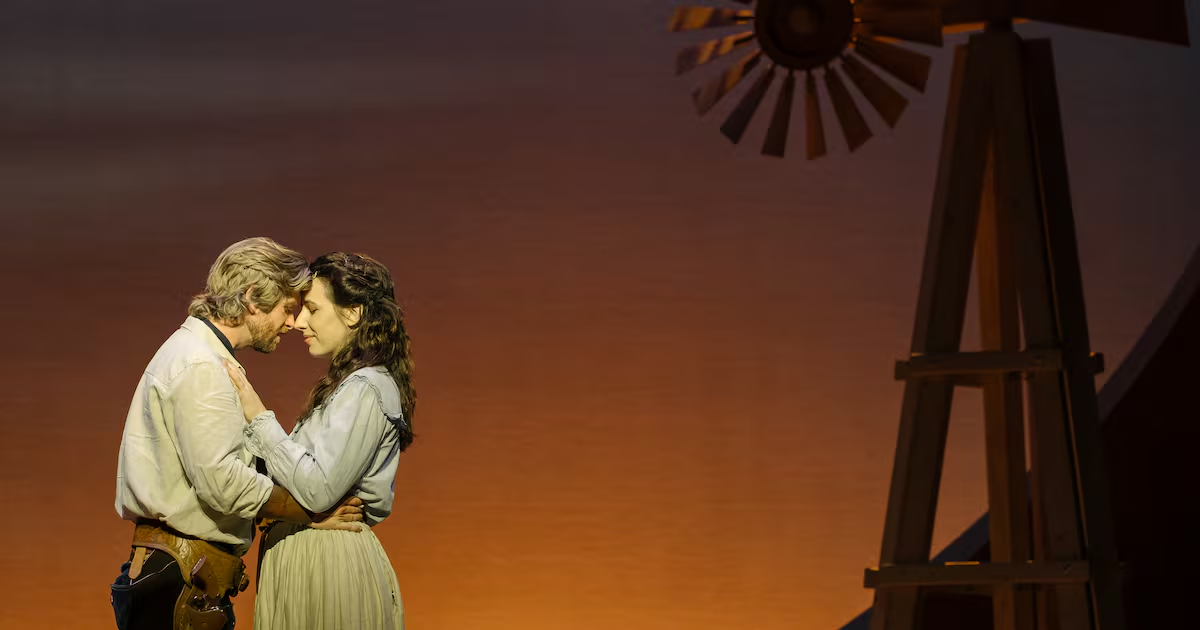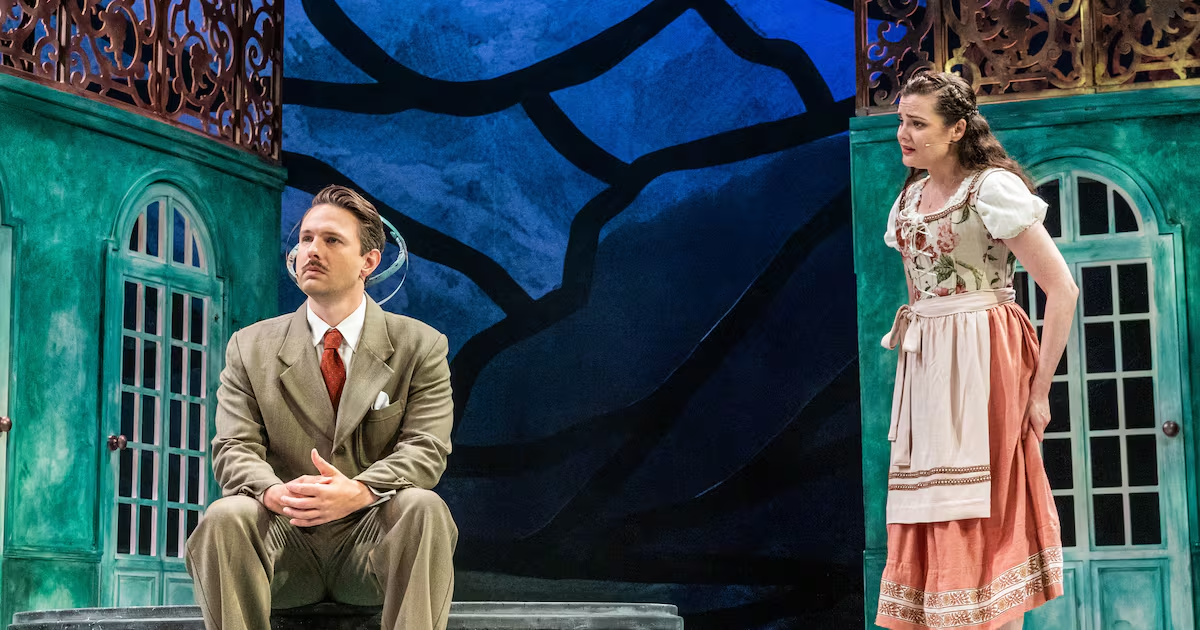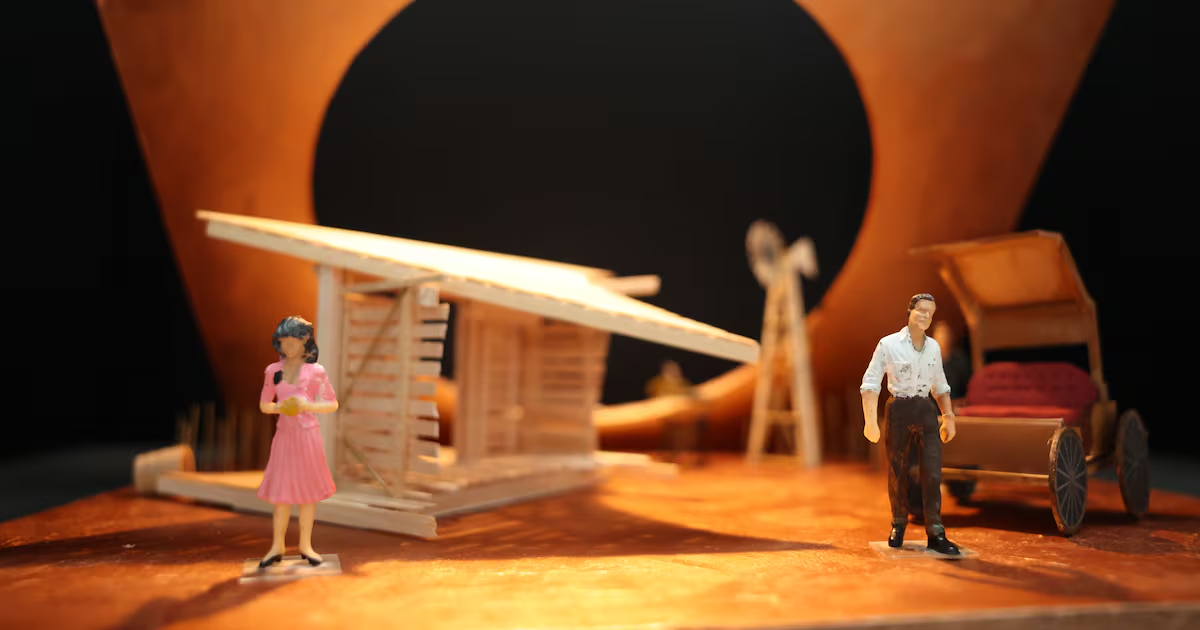
The start of rehearsals is always a high-energy affair. At the Digital Hub in Dublin, where the cast and crew of the Bord Gáis Energy Theatre’s production of Oklahoma! have gathered for the first time, there is a buzz of excitement as actors who have worked together before are delighted to see other, and new faces introduce themselves.In one corner of the room, a rough plywood wagon and cottage frame stand in for the set; tucked away in an adjoining alcove, stacks of cowboy hats teeter beside cardboard boxes filled with chipped enamel crockery – a reminder that props are just stuff until they’re imbued with meaning through action.As Stephen Faloon, the musical’s producer, calls order, the room resounds with a cheer that resolves into laughter when he admits that the show’s director, Claire Tighe, almost didn’t take the job. It’s true, Tighe confirms: her first instinct in response to Faloon’s invitation to direct Oklahoma! was “absolutely no way”.When all the introductions have taken place, and the set and costumes revealed to oohs and ahs, Tighe elaborates. “My memory of Oklahoma! was that it was this folk piece,” she says, “where women were just pawns or chattel in the lives of men, just hanging around waiting to be chosen and married, and I am allergic to that sort of a theme. It’s not the kind of work I am interested in at all. I prefer the more modern musicals that feel relevant to an audience.”But as a passionate advocate for developing a musical theatre culture in Ireland – and an ambitious artist in her own right – Tighe is always up for a challenge.“After thinking about it for a while I did some research, and I realised the musical wasn’t really what I thought it was at all.” Oklahoma! “is one of those musicals that we associate with school productions, and my experience of it over the years has been one of gingham and hair bows, women being prizes, with a sort of whitewashed Americana-land at its core.“But when I went back to the script, and then to the play that it’s based on, Green Grow the Lilacs by Lynn Riggs, I found a much darker world, and that excited me. It’s a much grittier, hard-won, hard-earned kind of world than I had thought – incorrectly thought, really – and I could see a way of bringing something fresh to it.”The musical “might not be set in a time we are familiar with, but that doesn’t mean it can’t speak to us now,” says Tighe. “Obviously we are hoping the Oklahoma! enthusiasts will love it, but we are also hoping to convince people who might have dismissed it the way I did to realise that it is a great piece of work.”Claire Tighe is directing a new Oklahoma! production in the Bord Gais. Photo: Enda O'Dowd/The Irish Times Oklahoma!’s illustrious record makes it the key text in the history of American musical theatre. A collaboration between Richard Rodgers and Oscar Hammerstein II, it was the first time the genre left the frivolous party-piece format of revues such as Ziegfeld Follies to create an organic storytelling experience, where all the elements – music, acting, choreography – worked towards creating a unified narrative whole.On one level, their musical is a low-key love story in which Laurey, a young woman in a rural townland, must decide which of her suitors she will allow to accompany her to the “box social”, a community fundraising event at which women pack a dinner for two into a decorated box or basket. Its characters are cowboys and hired hands, ranchers and farm girls. The climax is an auction in which the women’s boxes, which men bid on, become symbolic of their personhood. We are very much leaning into the labour of the time by getting the actors involved in building the world for the audience to see— Claire Tighe, director of Oklahoma!It’s no spoiler to reveal that the musical ends in a marriage. The hook for the audience is figuring out which man will win Laurey’s hand.If that kind of summary suggests Tighe’s reservations were well founded, a close reading of the script gives an alternative perspective. “The women actually do have agency,” she says. “The challenge for them is to pick the right partner: who will help them survive in this harsh land?“Women were part of the fabric of this world, before statehood, where the people were involved in making the laws. The choices that women made might have been limited, but that didn’t mean there wasn’t love or attraction or the potential for happiness.”Oklahoma! owed its success when it debuted, in 1943, as much to the cultural and political climate of the time as to its artistry. It premiered not long after the United States joined the second World War, and the setting – a celebration of pastoral pioneer history, the American landscape and the simple heroism of hard work – was exactly what American audiences needed. It ran for an unprecedented five years on Broadway, inventing the concept of the box-office smash.Producer Stephen Faloon talks to the cast and crew of Oklahoma! Photo: Enda O'Dowd/The Irish Times One of the most celebrated aspects of the premiere production was the revolutionary choreography of Agnes de Mille, which took a psychological, subtextual approach that drew more from Freudian theory than it did from the flourishes of Margot Fonteyn. For de Mille, gesture and presence should feed into the story. “Otherwise,” she said, “you might be as well be throwing open the window.”De Mille’s work has been a key influence on one of Tighe’s key collaborators on Oklahoma!, the choreographer David Bolger, whose work spans theatre and opera as well as dance. Unlike Tighe, he has been a diehard enthusiast of the golden-age musical since childhood. Bolger unashamedly canvassed to choreograph the production. “I just had to throw my cowboy hat into the ring,” he says.David Bolger says he unashamedly canvassed to choreograph the production. Photo: Enda O'Dowd/The Irish Times His first experience of Oklahoma! was as a young teenager, in the chorus of one of the school shows that Tighe is defining her production against. It had a lasting effect on Bolger. “The deep muscular approach to movement” embodied in Oklahoma!, “which looks at why people move as well as how, very much speaks to my own practice,” he says.Tighe usually choreographs as well when she’s directing a show, but Oklahoma! is demanding from a dance perspective. The original choreography, which includes a 15-minute “dream ballet”, is integral to the storytelling, integrating the expressive possibilities of dance into the narrative to a degree not seen before in musical theatre.In the dream ballet the characters not only show the audience something they don’t already know but also reveal something the characters don’t even know about themselves. The ballet, as Bolger explains, “is a really important scene in the story: it is the story of how Laurey ultimately makes up her mind” about the two men pursuing her.His approach is to break it into a series of scenes, moving from the “folksy dreamlike state” to a “dark and warped and violent world” as Laurey’s subconscious explores the potential consequences of her allegiance to each of her suitors.The entire ensemble will be involved in David Bolger’s staging of Oklahoma! Photo: Enda O'Dowd/The Irish Times Bolger offers me a quick look at the hardback notebooks in which he has sketched his ideas: a series of stick figures make a tidy tableau in the margin of the text.Unlike in the original production, where the ballet was performed by dancers rather than the actors playing the characters, the entire ensemble will be involved in Bolger’s staging, making even more seamless the relationship between movement and music in the storytelling.As cast and crew of Oklahoma! gathered for the first time, there is a buzz of excitement. Photo: Enda O'Dowd/The Irish Times The whole company will also be involved in creating the physical world of Oklahoma!, as the designer Ciarán Bagnall illustrates when he reveals his model box, a doll’s house-sized version of the production’s set. It’s a stripped-back vision, with a painted copper floor and a tilted cyclorama that tracks the day’s passing. The central physical structure is Aunt Eller’s farmhouse, which the cast will help to reconfigure as the story moves on.As Tighe explains before heading to the rehearsal room, “Oklahoma is a relentless, harsh place. Not a place for pretty country living. We want to show the sort of hard-work, hard-won life of the people who live on the land, so we are very much leaning into the labour of the time by getting the actors involved in building the world for the audience to see”.Oklahoma! is at the Bord Gáis Energy Theatre, in Dublin, from Friday, June 19th, until Sunday, July 5th
Behind the scenes at Oklahoma! rehearsals: ‘It’s a much grittier, hard-earned kind of world’
Claire Tighe and David Bolger on their new production of the Rodgers and Hammerstein musical for the Bord Gáis Energy Theatre
TL;DRAI
Questo articolo parla di rehearsal teatrali per il musical **Oklahoma!** al Bord Gáis Energy Theatre a Dublino, e non contiene alcun contenuto tech, AI, business, startup, o economia rilevante per manager IT e CTO. Non rientra nella tematica di Warptech Tech News. Puoi verificare di aver copiato l'URL/testo corretto? Se hai un articolo tech/business da riassumere, caricalo e farò il riassunto secondo il format (2 frasi, max 260 char, tono Bloomberg/HBR, linguaggio tecnico in EN).
1,472 words~7 min read