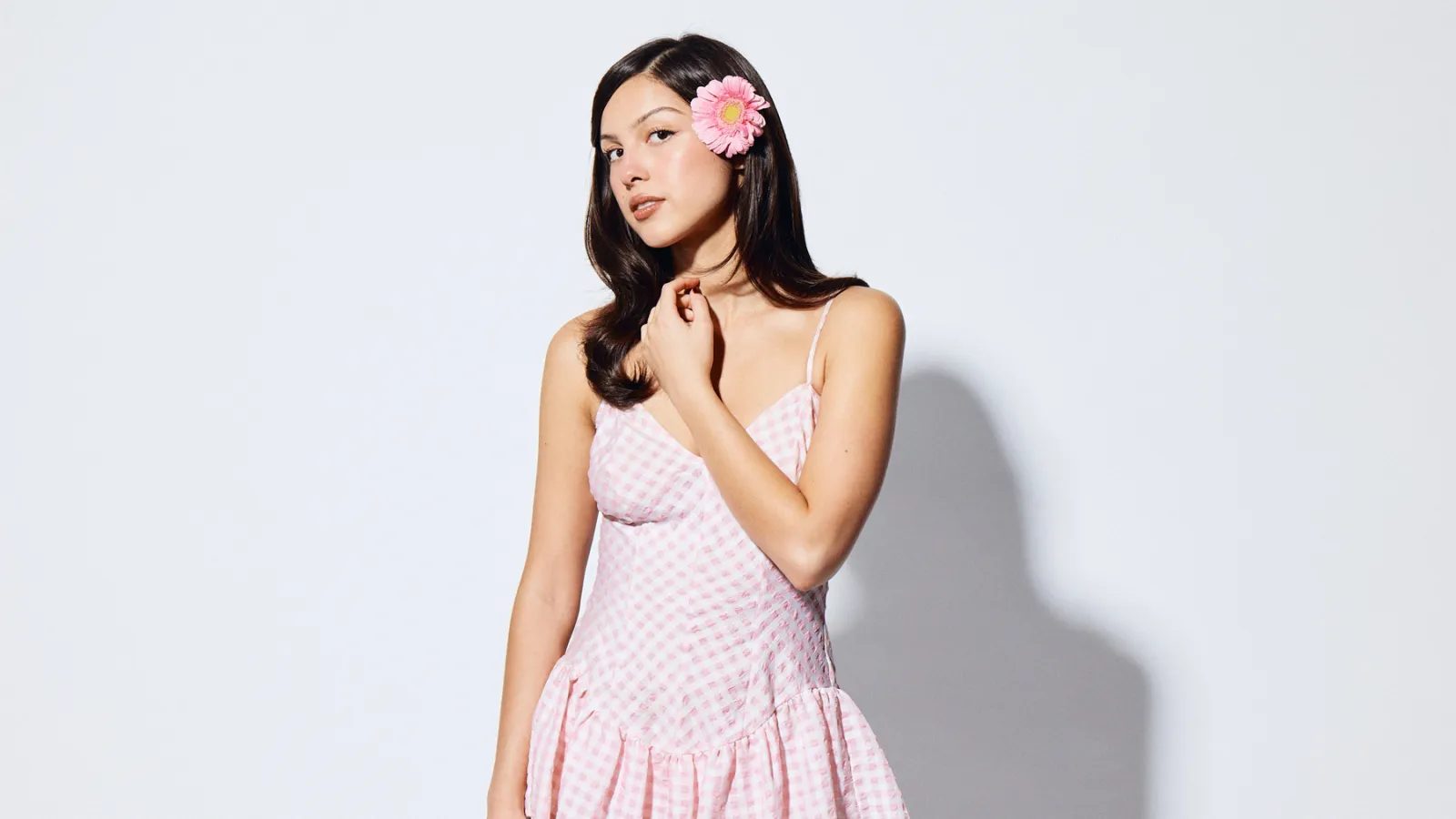
The sun was setting over Marlay Park, and somewhere beyond the horizon Olivia Rodrigo seemed to have caught a glimpse of her future. “You guys have really incredible music here,” she told the 40,000 people attending her show at the south Dublin venue in June 2025. “There are so many incredible bands out of Dublin. Lately I’ve been really obsessed with this band Fontaines DC. I’ve been playing this song alone in my room.” As she said this she strapped on her guitar and strummed the first notes of I Love You, a mid-tempo scream into the void on which the Dublin band ruminate on their love/hate relationship with Ireland. The tune addresses the scandal of the mother and baby homes and the dead hand of Civil War politics, and although Rodrigo didn’t say as much at the time, it has since become apparent that she was addressing a love/hate dynamic of her own. Not “the gall of Fine Gael and the fail of Fianna Fáil” but the demands of young stardom and the expectations of the teenage audience that has lapped up her meditations on youthful heartache and, in the process, made her one of the biggest names in pop.Twelve months later Rodrigo is still working through that tension as she prepares to release her third album, You Seem Pretty Sad for a Girl So in Love, her attempt to move beyond teen stardom and to find her place as a grown-up artist. But is this what her fans – those millions of self-described “Livies” around the world – want from her? Or might they react as many did when she covered Fontaines DC in Dublin: with a mix of confusion and impatience?The journey that Rodrigo began in Dublin has since had a few twists. At Glastonbury, a few days later, she brought Robert Smith of The Cure onstage for a run-through of his anthem Just Like Heaven. She has covered the name-droppable indie band The Magnetic Fields for a charity record and cited the 1990s songwriter and critical darling Fiona Apple as an influence. How more explicitly could she articulate her desire to be taken seriously?Cure anthem: Olivia Rodrigo performing Just Like Heaven with Robert Smith at Glastonbury. Photograph: Kevin Mazur/Getty How about covering CMAT? Which is what she did when she appeared on BBC Radio 1’s Live Lounge recently, performing her version of the Irish singer’s When a Good Man Cries. “I woke up like 10 minutes ago, and I just heard Olivia Rodrigo sing the word ‘Dunboyne’ on live English radio … what phase of the simulation is this?” CMAT said on social media the following morning, rendered all but speechless by the incongruity.The idea of Rodrigo getting into the weeds of Workmans Club punk-pop – which is to say covering Fontaines – or celebrating country-and-Irish-inflected indie music from Dunboyne would have seemed highly unlikely when Drivers License made her an overnight star in January 2021. But her embrace of left-field Irish punk was, in hindsight, the first clue of the new direction she has embarked on with You Seem Pretty Sad for a Girl So in Love, an album that boldly announces her desire to be taken seriously as an artist and regarded as something other than fodder for teenagers.[ Olivia Rodrigo’s CMAT cover is more than a brilliant excuse for pintsOpens in new window ]There’s nothing wrong with being fodder for teenagers, of course. Thatʼs how some of the greatest musicians in history started out, singing to screaming girls while everyone else looked on in disapproval and suspicion. But from The Beatles to Taylor Swift, they eventually aspire to more than just popularity – and that’s the point at which Rodrigo has seemingly arrived exactly a year on from covering Fontaines.Change is always risky in pop. From Ed Sheeranʼs disastrous “indie phase” in 2025 to Miley Cyrus collaborations with The Flaming Lips, there are many cautionary tales of artists mistaking foolhardiness for ambition and burning through much of their audience’s goodwill.But then maybe the biggest risk would be to continue to write songs about young love. Rodrigo will be well aware that teenage stars have a perceived best-by date. She is no longer an ingenue crooning about red lights and young heartache, and the fans who were 15 when she broke through are now entering their 20s, teenagers no longer. Do they still have anything in common with her?That’s the question Rodrigo circles warily on You Seem Pretty Sad for a Girl So in Love. Its arrival marks the beginning of a potentially risky transition for the singer, who started her career in a reboot of Disney’s High School Musical and is now covering CMAT and hanging out with Robert Smith, the godfather of goth.An additional complication is the fact that “difficult third album” syndrome is a genuine pitfall in pop music. For rock stars, record number two is where things typically fall apart. But in pop it’s the third album that’s especially fraught – just look at Lady Gagaʼs divisive Artpop.Up to that point, she could seemingly walk on water. But then she went out on a limb and almost lost an arm and a leg. The misstep was a more experimental sound; the backlash was swift and terrible.Could Rodrigo be on the receiving end of a similar pushback? Seemingly aware that she’s trying something new, she hasn’t been shy about expressing her determination to move beyond early singles such as Good 4 U and Brutal. “I love rock music and I have such a reverence for rock music, and thatʼs all that I really listen to,” she told The New York Times recently. “But I think going into it, it didnʼt feel exciting to me – rock in the traditional sense of, like, power chords, distortion.”Boisterous rock was the perfect delivery mechanism for lyrics that fizzed with teenage rage. But, at 23, she is no longer interested in taking aim at terrible boyfriends via short, sharp shocks of vitriol.Hence the more understated tone set by the new LP, which she has revealed will trace the arc of a doomed relationship, from infatuation to codependency to heartache. (It is widely understood to be about her ex Louis Partridge, the English actor.) Her inspiration came from all over, from binge-watching Sex and the City and the sad fizzle of Carrie Bradshawʼs relationship with her sad, boring beau, Aidan, and from her friendship with Smith (who cameos with her on the new LP and with whom she reunited at the Primavera Sound festival, in Barcelona, last weekend).“There was something about the restraint of it that felt nice. I was just really obsessed with that type of music while I was making it. I did Glastonbury with Robert Smith, which was insane. And Iʼd always been a fan of The Cure, but since meeting him and, like, getting to hang out with him, I went back and listened to all those new wave bands,” she said in her New York Times interview. “I was living in England at the time so obviously you get a lot of English band inspo. For me, in songwriting, the sentiment always comes first. And so I knew that I wanted to write songs about how it felt to be in love. And love feels like that to me – that vibe, the emotional quality of it.”But if Rodrigo is all-in on gothic break-up ballads, her audience is still coming around to the idea – and their misgivings were not assuaged by the angsty, minimalist tone of Drop Dead, the lead single from her new album, whose less-is-more energy has alarmed some of her fans. “I donʼt super much understand the aesthetics of the album and I feel like the song felt a bit like a throwaway song,” one said on social media.“Drop Dead feels like such a bland song, and maybe my expectations were just too high, but it just feels very generic,” another said. “I donʼt hate the song, I just feel let down. Olivia is known for her incredible songwriting and deep lyrics, but Drop Dead feels so underdone.”Fans’ wariness towards You Seem Pretty Sad for a Girl So in Love intensified with its second single, The Cure, a slow, grungy number notable for failing to go to number one in either the United States or the UK. “It kinda drags,” one Livie wrote. “I’m super underwhelmed by Olivia’s recent releases but that’s ok, she’s not making music just for me.”There has also been controversy about her fashion choices – a depressingly predictable state of affairs for women working in pop, where female artists are still held to a different standard from men. The criticism has focused on her appropriation of “baby doll” dresses, which some have deemed creepy and infantilising. The aesthetic harks back to the 1990s, in fact, and artists such as Kathleen Hanna of Bikini Kill and Courtney Love of Hole (who previously accused Rodrigo of lifting the “doomed cheerleader” vibe from the cover of Live Through This, her 1994 LP).Olivia Rodrigo performs onstage at the 3Arena, Dublin, in 2024. Photograph: Tom Honan/The Irish Times Rodrigo has pushed back against comments about her look. “What’s really disturbing is I have worn outfits that are maybe revealing on stage. Iʼve been on stage in a sparkly bra and little shorts – which is my right: thatʼs fun,” she told The New York Times. “I felt cool and comfortable in that, and that wasnʼt inappropriate, but me fully covered up in a dress that people deemed to be childlike was inappropriate, and I think it shows how we really normalise paedophilia in our culture. It’s just this rhetoric that we’re fed as girls since we’re so little, which is, like, don’t wear that, because then a man is going to sexualise your body and it’s your fault.”The absurd criticisms people make about Rodrigo’s look suggest that, after five years of nonstop success, the knives may be sharpening. There is a long tradition of fans and critics turning on artists perceived as having too much success too soon – see the backlash against Taylor Swift and Katy Perry. Could it happen to Rodrigo too?She seems aware of the risks she’s taking by moving away from punk-pop and going in a more nuanced direction. The worry is that the fans who have watched her grow up in public may not be ready to see their favourite pop star morph into an artist who worships The Cure and covers Fontaines DC and CMAT. To paraphrase a line from one of her own hits, it really is brutal out there.You Seem Pretty Sad for a Girl So in Love is released via Polydor Records
Is Olivia Rodrigo covering Fontaines DC and CMAT the pop artist’s bid to garner grown-up cred?
With her album You Seem Pretty Sad for a Girl So in Love, the singer wants a place as a grown-up artist. She tested the water with her Fontaines DC and CMAT songs
1,783 words~8 min read