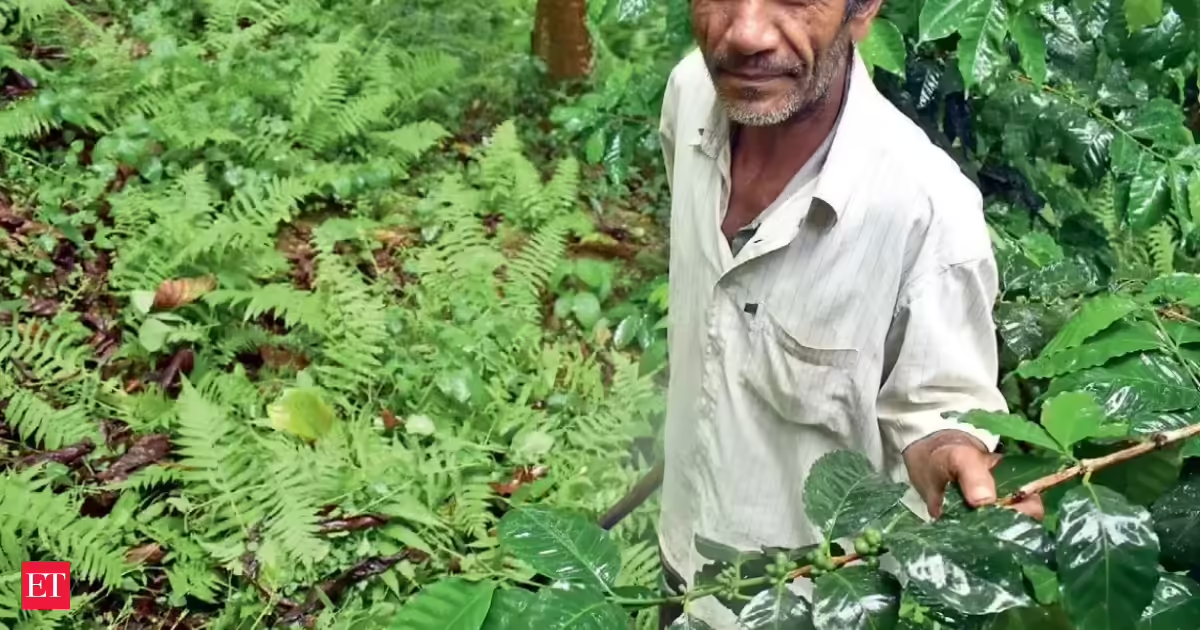
Kohima, Wokha, Dimapur: High up in the hilltop village of Lakhuti in the Wokha district of Nagaland lies the grave of Khodao Yanthan, one of the most enigmatic figures of the Naga insurgency.For nearly four decades, Yanthan lived in exile in London, largely hiding under the alias Charles Lamb. During his years in Britain, he held a variety of jobs, working in chemist shops and restaurants before embarking on a long career with the British Broadcasting Corporation (BBC), from where he eventually retired with a pension.When Yanthan passed away in 2010, he was vice-president of the National Socialist Council of Nagalim (Isak-Muivah), or NSCN (I-M), the powerful underground outfit that has been engaged in peace negotiations with the government of India since 1997.Today, at Lakhuti, villagers speak of him with respect, often invoking the local Lotha honorific “amotsu”. Yet they are equally quick to point out that insurgency belongs to the past. Instead, several village elders say, most households are now part of another revolution—coffee cultivation.“We send our coffee cherries, all arabica, to a processing facility in nearby Sanis,” says Zuben Yanthan, 68, a retired state government official who now devotes his time to coffee and rubber cultivation.HILLS ARE ALIVE WITH COFFEESanis, a sub-divisional headquarters in Wokha, is about 20 km downhill from Lakhuti. It has a sprawling coffee estate equipped with a state-of-the-art curing facility. The farm, called Lithanro—a word in the Lotha dialect that roughly translates into “entering a new world”—has emerged as one of the symbols of Nagaland’s growing coffee economy.The enterprise also runs a sleek retail outlet, Juro Coffee House, in Dimapur, Nagaland’s commercial hub, about 120 km south of Sanis. Together, the farm and the cafe embody an ambitious farm-to-cup model that is steadily gaining ground in the state.“We partner with more than 100 farmers, primarily from Wokha, Mokokchung and Kohima districts, to create a genuine farm-to-cup ecosystem,” says Searon Yanthan, 32, who co-owns Lithanro Farm and Juro Coffee House with his younger brother, Kilum.“Demand for Nagaland coffee is steadily growing, and we are planning to open a new Juro outlet in Bengaluru.”Nagaland is now home to more than 9,500 small coffee growers cultivating nearly 11,800 hectares across 16 districts. Together, they produce around 120 tonnes of coffee annually, underscoring the state’s growing prominence on India’s coffee map.No doubt, the aroma of coffee in the mist-covered hills of Nagaland is steadily replacing memories of a turbulent past. And if the trend holds, the state may well be on its way to becoming India’s next Araku Valley.Nagaland’s hillsides provide ideal conditions for arabica, the premium coffee variety that fetches a higher price than robusta and is favoured by specialty coffee markets. The lower reaches of the state, in contrast, lend themselves to robusta cultivation.Much like Araku Valley in Andhra Pradesh—an emerging coffee destination shaped by smallholdings of local tribal populace—Nagaland’s coffee story is also rooted in the efforts of local Naga farmers, each having modest holdings of 0.5 to 1 hectare on steep hill slopes. In both regions, coffee is cultivated in natural, forested conditions, with arabica being the dominant variety.Yet, important differences remain. The number of farmers engaged in the cultivation of GI-tagged Araku coffee is nearly 10 times more than those in Nagaland, underscoring the distance the northeastern state has to cover before matching Andhra Pradesh’s success in scale and outreach.Drawing on GIS data, Albert Ngullie, director of Nagaland’s Department of Land Resources, says more than 1 million hectares—over 60% of the state’s geographical area—is suitable for coffee cultivation. This, he says, reflects the state’s long-term ambition of expanding coffee cultivation to 50,000 hectares by 2047, with a strong emphasis on premium, traceable, single-origin specialty coffee.“We would like to be the next Araku coffee,” he says, recalling how members of the Coffee Board of India, convened in Kohima last September, had a broad consensus that Nagaland should prioritise quality-driven specialty coffee rather than chase large volumes.“We already have nine prominent coffee brands in Nagaland, all owned by private individuals. Let those brands and logos remain,” says Ngullie. “But to strengthen the overall branding, much like Araku, we are planning to introduce a common label—Coffees of Nagaland—to be featured on every packet.”BREW IT, BRAND ITThe ambitious mission of Coffees of Nagaland is projected to require an investment of around ₹175 crore, with funding expected to come from a combination of Central and state government agencies.The push has already received a significant boost: the Ministry of Development of North Eastern Region (DoNER) and Shillong-based North Eastern Council (NEC) have together committed ₹44 crore towards a pilot project aimed at strengthening the state’s coffee value chain.Government support has extended to farms as well.Two years ago, the Coffee Board introduced a scheme under which coffee growers in Nagaland became eligible for a one-time grant of ₹1.12 lakh per hectare for plantation development and farm management. The incentive has encouraged a growing number of farmers to convert portions of their land into coffee gardens, accelerating the crop’s spread across the state.While government agencies have played an important enabling role, the key driving force behind Nagaland’s coffee resurgence lies elsewhere. At the heart of this transformation is a new generation of young Naga entrepreneurs who have built brands, created markets and infused the sector with fresh ambition and confidence.Over the past seven-eight years, they have launched a string of specialty coffee brands—including Ete, Juro, Highlander, YES Coffee, Nagaland Coffee, Naga Tribal Coffee, Naga Hills Coffee and Coffee Lady—that are expanding even beyond the Northeast. Coffees from Nagaland are served in cafes across India, introducing consumers to the distinct flavours of the state’s highland arabica.Meet Vivito Yeptho, 37, who studied international marketing at Cardiff University, UK, and briefly worked with Amazon India in Pune before returning to his home state in 2017 to launch his own brand, Nagaland Coffee.A member of the Sumi Naga tribe, Yeptho designed his logo around the silhouette of a Sumi warrior holding a spear—a nod to his community’s heritage. The Sumis, like the Lothas, are among the 17 major Naga tribes.In his cafe in the heart of Dimapur where he is diligently attending to customers, Yeptho reflects on his entrepreneurial journey with a smile.“I was more fascinated by the word ‘export’ than by ‘coffee’,” he says.That fascination quickly translated into business. In 2019, Nagaland Coffee exported green coffee beans to markets such as South Africa, Bahrain, Dubai, the Netherlands and Germany.“Then Covid happened, and I shifted my focus to domestic consumers,” he recalls. “Today, we supply coffee to 47 cafes across India.”Apart from its flagship outlet in Dimapur, Nagaland Coffee also operates a retail cafe in Kohima, extending the brand’s footprint within the state.FULL OF BEANSIn Kohima, 35-year-old Thejanuo Kets operates a coffee-roasting facility perched atop a hill.The founder of YES Agro Park in Gariphema—her ancestral village located about 50 km north of the state capital—Kets has built an integrated coffee enterprise that includes a processing unit, two retail outlets and a range of roasted coffee products marketed under the brand YES Coffee.The journey of each bean begins in Gariphema, where coffee cherries are washed, pulped and dried at the company’s processing station. The dried parchment coffee is then transported to Kohima for roasting before making its way to consumers.“Our broader goal is to make coffee a part of every Naga household,” says Kets. “Beyond exports, there is a huge untapped market right here in Nagaland.”Kets is one of the state’s two prominent female entrepreneurs in the coffee sector. The other is Atsi Jamir, founder of Coffee Lady, whose processing facility is located in Medziphema, a town situated between Dimapur and Kohima.CAFFEINE KICKS INAccording to Coffee Board data, India produces around 3.6 lakh tonnes of coffee annually, nearly 70% of which is exported to more than a hundred countries. Italy, Germany, Belgium, Russia and the United Arab Emirates are among the leading importers.Coffee cultivation in India has traditionally concentrated in the southern states, with Karnataka’s Kodagu and Chikmagalur areas continuing to account for a lion’s share of production and export.By comparison, Nagaland contributes less than 0.1% to the country’s coffee output. But its coffee story is not about volume. Its strength lies in quality and distinctiveness, something that a new generation of educated, tech-savvy Naga entrepreneurs is aggressively marketing and skilfully branding.According to officials, coffee output grew nearly sixfold between FY22 and FY26, underscoring the momentum in the state’s emerging specialty coffee sector. The last fiscal’s figure of 120 tonnes is only an estimation, officials add, as data is still being compiled.“Our coffee has an excellent aroma. It is grown naturally, without fertiliser inputs,” says Kets. “The quality of our coffee is one of the reasons it received an enthusiastic response at Coffex Istanbul last year.”Kets was among five Naga coffee entrepreneurs who travelled to Turkey to participate in the internationally renowned coffee festival, showcasing Nagaland’s specialty coffee to a global audience increasingly interested in traceable, naturally grown beans.No doubt, from insurgency to specialty coffee, Nagaland is crafting a new identity—one cup at a time. While the state’s violent past shaped its history, coffee could well define its future.
From insurgency to Arabica: Nagaland finds a new revolution in coffee
Nagaland is brewing a new future, shifting from its past to a vibrant coffee economy. Local farmers and young entrepreneurs are leading this transformation. They are cultivating premium arabica beans and building brands. This initiative aims to establish Nagaland as a significant player in India's specialty coffee market.
TL;DRAI
Nagaland's 9,500+ farmers cultivate 120 tonnes/year premium arabica across 11,800 hectares, building a specialty-coffee economy modeled on Araku Valley. Nine entrepreneurial brands backed by ₹175 crore investment show how private-led, quality-focused positioning outpaces commodity volume strategies.
1,513 words~7 min read