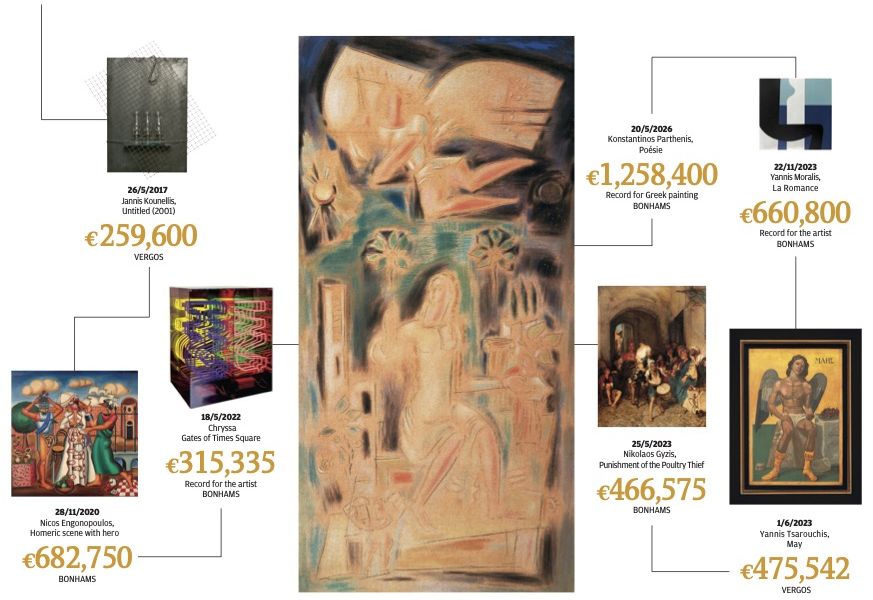
A small cork and a scarab rest on the metal “frame” made of lead and steel. Lot 117 “Untitled” (1988), a work by Greek-Italian artist Jannis Kounellis, was sold in May at an auction of 19th and 20th century modern Greek painting held by Vergos Auctions for €180,000. Another six-digit bid was made for “Cyclist Disguised as a Tsolias” by Yannis Tsarouchis (€120,000), while the large ceramic banner “Olive Harvest from Sunrise to Sunset” by Panos Valsamakis far exceeded the modest estimate of €5,000-7,000, fetching €55,000, after an unexpected bidding war.
The two major Greek art auctions – one through Vergos Auctions in Athens and the second through Bonhams in Paris – that define the domestic secondary market, brought excellent results. Both function as a living mechanism for valuing not only works of art, but also desires, ambitions, and even the buyers’ personal prestige.
“The consistent trend of the Greek art market is that truly top-quality (museum quality) works almost always find a buyer, and at high prices, regardless of the economic situation or trend,” says Terpsichore Angelopoulou, director of the art consultancy company Art Expertise and an associate of Bonhams in Greece.
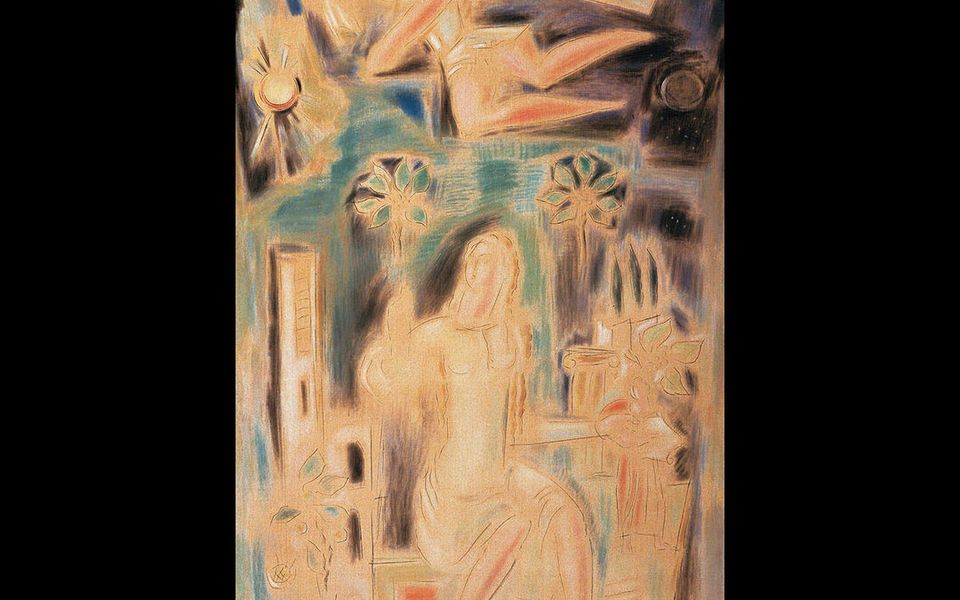
In this way, the monumental painting “Poésie (Annunciation),” by Konstantinos Parthenis, recently won the title of priciest Greek artwork of the 20th century ever sold at auction. “It was a well-documented work, with a rich biography that the public trusted,” Angelopoulou explains, commenting on the record price of one million euros. “This particular sale creates a new benchmark, proving that there is international interest and investment potential in the Greek art market.”