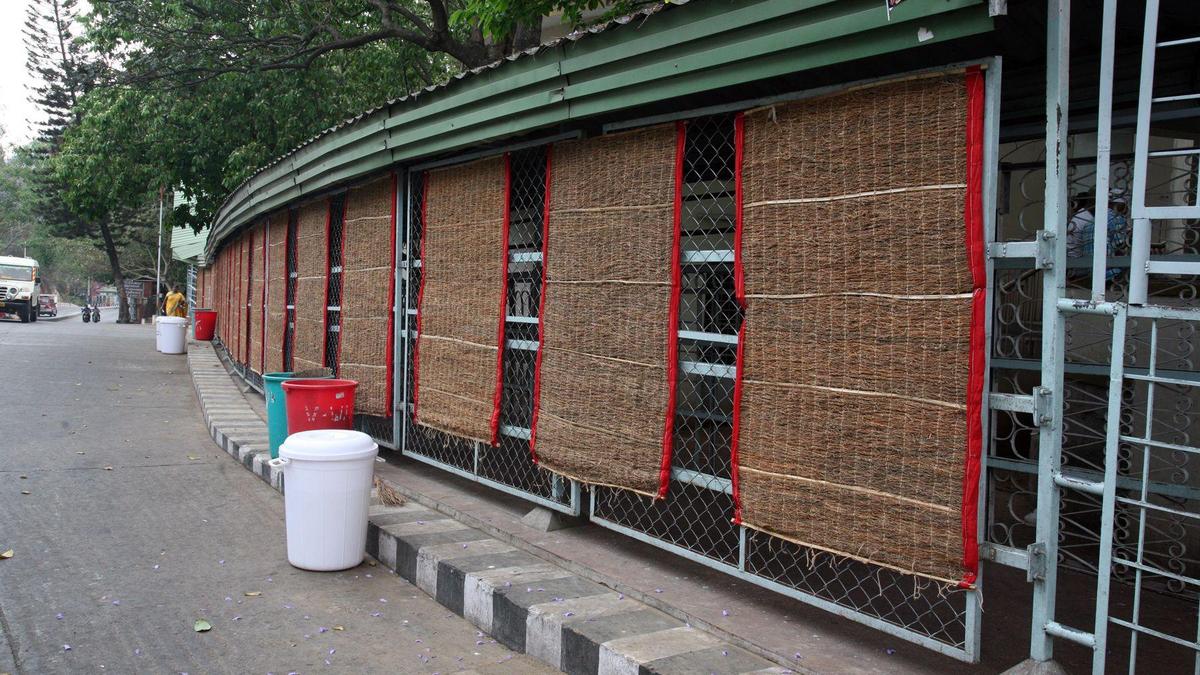
Khus (vetiver) mats are hung around the compartments to provide respite to the waiting pilgrims from sweltering heat at Tirumala. A 2014 image used for representational purpose only
| Photo Credit: Special arrangement
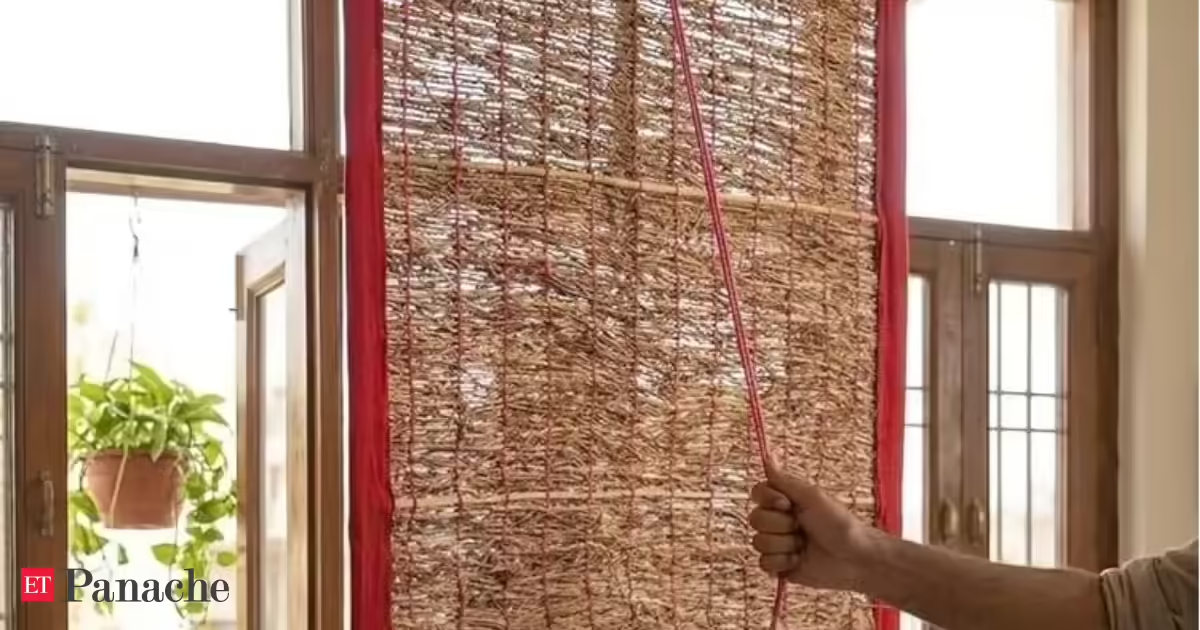
At the time of writing this (for the timestamp-obsessed: the afternoon of June 11), the sun has been served a memorandum of suspension for its obnoxious behaviour in the past few days. An overcast sky has ensured the fiery orb stays out of work. Clearly a reprieve from what was an unusually harsh beginning to June, generally known as the pre-monsoon season even in the sun’s long-held fiefdom, Chennai. Just as a lioness would deal an overly exuberant cub a surprise paw swipe, the joy could be short-lived for the Chennai people. Put it down to climate change, the weather has the vacillating mind of a Hamlet, and so it can be hot again before you know it. And it might not be too late still to “insulate” your house with cost-effective, heat-reducing traditional props. In any case, the benefits would carry over to the next summer and the ones beyond. Here is a cherrypicked solution, one lying under one’s feet. It is curtains made of vetiver (chrysopogan zizanioides), an aromatic perennial grass native to India that comes with an air of reverence, its fragrant roots occupying the front row in pujas. Off the religious altar, it is patronised for its cooling properties. When woven into curtains, vetiver comes into its own. A recommendation not to be ignored: vetiver curtains (also known as khus curtains) can be teamed with bamboo curtains for coverage of greater surface area, factoring in cost, the former taking a slightly oversized bite out of the wallet, and maintenance, the former again being the difficult one. Why these nature-based solutions, NbS as they call them? This poser needs to be put to those who make a livelihood out of making these curtains. Enter S. Jagadeeshwaran and Nagarajan, who along with their teams, work by the roadside in Alwarpet and Adyar respectively, ironically soaking up the sun to help people stay shielded from it.With some assistance, a vetiver curtain can cut out the heat to some extent. Jagadeeshwaran explains that sprinkling approximately half a litre of water on the vetiver screens every morning and evening helps maintain a cool atmosphere, while the moist roots release a natural earthy aroma. “Vetiver stands out not just for its cooling properties but also for its herbal and medicinal benefits,” says Jagadeeshwaran, owner of the family-run Jagadeeshwaran Bamboo Works on TTK Road. Jagadeeshwaran makes vetiver curtains too.With a life span of approximately two years and costing around ₹200 per square foot, vetiver curtains, says Jagadeeshwaran, can be an ally in keeping the sun in check. Let us not hoodwink ourselves into the outrageous, even hare-brained idea that vetiver or for that matter bamboo can replace technology-based cooling systems (aka fans and air-conditioners). Along with sustainable design of the house, these natural curtains can reduce the use of air conditioners, thereby resulting in savings on the power bill. But the house has to be prepared for them. They would fare better in a house with a generous provision for cross-ventilation. They do not so much cool a space as keep unwanted stuff such as too much sunlight and pollutants out of it. Having said that, the water-sprinkled vetiver curtains do bring in a whiff of cool air, but only so much. Their environmentally friendly nature should be a strong incentive to pair them with tech-based cooling solutions.‘Building design key to effectiveness of bamboo and vetiver curtains’Architect and co-founder of Design Co Lab, Pavithra Sriram explains when these traditional curtains, which she clubs among “materials that breathe”, can be effective: “The curtain system itself, whether it is a vetiver curtain or a bamboo curtain, is the last step of this entire spectrum. You are looking at a building that has to be designed in such a way that there is cross ventilation. Unless you do that, your reliance on air-conditioners is not going to stop. One vetiver curtain in an extremely developer-built apartment that lacks cross-ventilation cannot suddenly make for Ooty climate. The entire building needs to respond to the local context. It is important not to look at these things as topical, band-aid solutions. They need to be understood as part of a holistic approach. The entire building environment has to work together. When that happens, elements such as bamboo curtains, vetiver screens and other traditional materials can play a meaningful role in improving comfort and reducing dependence on mechanical cooling systems.”Bamboo versus vetiverrNagarajan, a maker of bamboo as well as vetiver curtains in Adyar (near the Aavin parlour park) is a believer in vetiver curtains, but tends to bat longer for bamboo curtains. From a design perspective, bamboo curtains stand out. With those roots, vetiver curtains can resemble the inside of an angler’s worm box. In contrast, the neat lines of the bamboo strips, horizontal, vertical or cross-stitched, make the curtains aesthetically more pleasing. “Available in a range of colours and finishes, bamboo curtains can complement different architectural styles while helping lower indoor temperatures” Nagarajan adds. Then, the cost equation. Nagarajan notes bamboo is also the more economical option, costing around ₹100 per square foot, against the price of ₹200 per square foot vetiver curtains come at. He adds that bamboo products are particularly popular among resorts, hotels and homeowners looking to combine functionality with visual appeal, whereas vetiver curtains are predominantly preferred by individual households seeking a traditional cooling solution. With electricity tariffs ever on the rise and heatwaves becoming more stinging, Chennai residents should not ignore these traditional options. Beyond being money-wise, this would signify a return to a sustainable practice that was once the norm, and now takes an article such as this to remind ourselves of their continuing relevance.S. Jagadeeshwaran can be contacted at 9841565239/ 9003183916 and Nagarajan at 9941538328. Published - June 13, 2026 09:14 pm IST