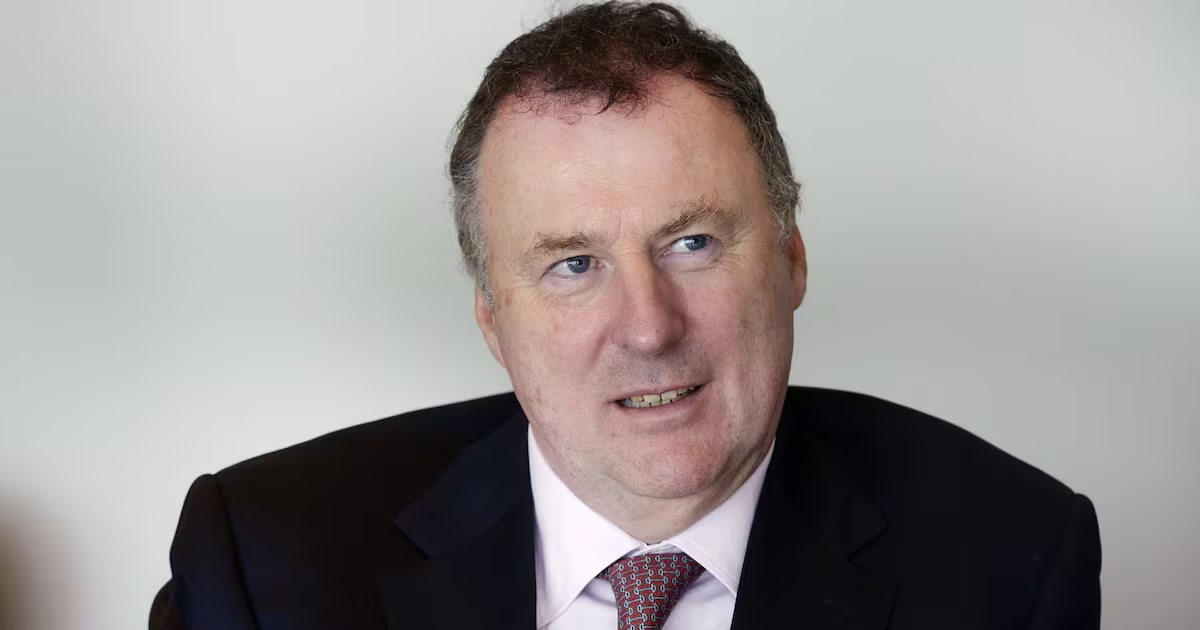
Having dusted himself off as a 21-year-old from a first-round judo defeat at the 1992 Barcelona Olympics and gone on to take silver at the world championship a year later, Zurich native Eric Born knows how to mount a comeback.The Grafton Group chief executive is hoping financial goals unveiled on Thursday at its capital markets day can spark one of its own at the merchanting and DIY retailing company, which has been on the back foot ever since he took charge in late 2022 – with group shares struggling amid weakness in its British, Dutch and Finnish businesses. Born is targeting earnings per share (EPS) growth at a compound annual rate of more than 10 per cent out to 2030 at the group, parent of the Woodie’s and Chadwicks chains in the Republic. It’s ambitious, especially when analysts see the group setting off by posting a 1 per cent dip in earnings this year after returning to growth last year (of 5.1 per cent) following a cumulative 25 per cent slump over the two previous years. Indeed, the performance would have been worse had Grafton not been reducing its number of shares in issue over the period. It has spent about £430 million (€498 million) since 2022 buying back and cancelling more than a fifth of its stock. The Swiss executive aims to end 2030 with the group delivering a return on capital employed – a measure of profitability against a company’s debt and equity – of about 13 per cent, compared to under 11 per cent last year. The objective is about four percentage points above the company’s estimated current cost of capital, suggesting it will be creating economic value for shareholders. Investors have given the plan a cautious thumbs-up. The stock has advanced as much as 4.5 per cent in the past two days. But it has much to do to break out of the range it has been stuck in ever since the Brexit referendum a decade ago this month – save for a brief breakout during the Covid pandemic when construction was deemed a critical industry and Woodie’s was mobbed by lockdown DIYers scrambling to transform their gardens. Grafton shares remain almost 40 per cent below their 2021 highs. The targets are predicated on the island of Ireland, which has replaced Britain as Grafton’s main earning market in recent years, remaining what Born referred to during an investor presentation on Thursday as the “powerhouse” of the group. [ Woodies parent suffers 5% hit to British revenueOpens in new window ]His team sees Chadwicks – by far the largest builders’ merchants – and Woodie’s benefiting as house completions grow at 9 per cent annually over the next three years. Repairs, maintenance and improvement spend is also seen remaining strong as 78 per cent of the Republic’s housing stock was built before 2000, according to Grafton. Britain, which accounted for more than two-thirds of group sales in 2016, has been the group’s biggest headache for the past decade. Grafton’s average daily like-for-like sales in that market fell by 5 per cent in the first four months of this year alone. But the British impact on the group has been diluted by restructuring over the years that culminated with the sale – under then chief executive Gavin Slark – of its traditional British merchanting business to rival Huws Gray for £520 million in 2022. Grafton continues to own businesses such as Selco Builders Warehouse, which is geared towards small-jobbing builders, the decorating and DIY brand Leyland and staircase maker StairBox on the other side of the Irish Sea. “Grafton is keeping the faith and believes the recovery is ‘when’, not ‘if’,” noted Flor O’Donoghue, an analyst with Davy. But Born and his finance chief, David Arnold, do not assume a full rebound in that market by 2030. Brexit alone may have already cost the UK economy as much as 4 per cent of gross domestic product (GDP), according to an analysis published by Bloomberg this week. UK housing output contracted for the 17th straight month in May, leaving activity at levels last seen at the outset of the pandemic six years ago, according to figures released this week. The country’s economy contracted slightly in April – by 0.1 per cent – according to figures released on Friday, as the Iran war has an impact on households and businesses. Expected Bank of England rate rises in the coming months to combat inflation stoked by that war won’t help. Having sold off a long-struggling Belgian merchanting business in 2019, Slark moved Grafton into Finland two years later with the almost €200 million purchase of IKH, the country’s largest specialist distributor of workwear, personal protective equipment, tools and spare parts. The Finnish economy – and construction sector – slid into recession in 2023 following a collapse in exports to Russia as a result of the Ukraine war and a spike in European Central Bank (ECB) rates. While most Irish home loans are now on fixed rates, most mortgages in Finland are on variable rates, leaving them exposed to moves in official borrowing costs. The ECB raised rates this week for the first time in two years and economists expected it to move again in September. The timing of a recovery in Finland and in Grafton’s business in the Netherlands remains uncertain. However, Born is decidedly bullish on the group’s prospects in Spain and, to a lesser extent, Portugal – two countries that, along with Ireland, were branded the so-called PIIGS economies and often disparaged by northern Europe during the sovereign debt crisis a decade and a half ago.He oversaw Grafton’s foray into Iberia in late 2024, with the €132 million purchase of Barcelona-based air-conditioning and heating products distributor Salvador Escoda. And he followed up last month by buying another Spanish air-conditioning company, Mercaluz, which also has sales in Portugal, in a deal worth up to €175 million. [ Grafton Group seals deal worth up to €175m for family-founded Spanish group MercaluzOpens in new window ]Executives signalled that they see a big opportunity for more deals in the air-conditioning and other merchanting areas in Iberia, given how fragmented the market is. The Organisation for Economic Co-operation and Development (OECD) estimates the Spanish and Portuguese economies will each grow at 2.2 per cent this year, far outpacing euro zone growth for the fifth straight year. Spanish house completions are forecast by Grafton to grow by 15 per cent annually over the next three years. They said that they expect Iberia will be Grafton’s second £1 billion sales market – alongside the island of Ireland – by 2030. The two Spanish businesses’ combined sales were running at about €360 million last year. A bold target but, as any judoka knows, it’s the execution of the throw that counts.
Grafton chief bets on ‘PIIGS’ boom as northern European markets stall
Ireland has replaced Britain as Grafton’s main earning market in recent years and group has high hopes for Iberian air conditioning investments
1,133 words~5 min read