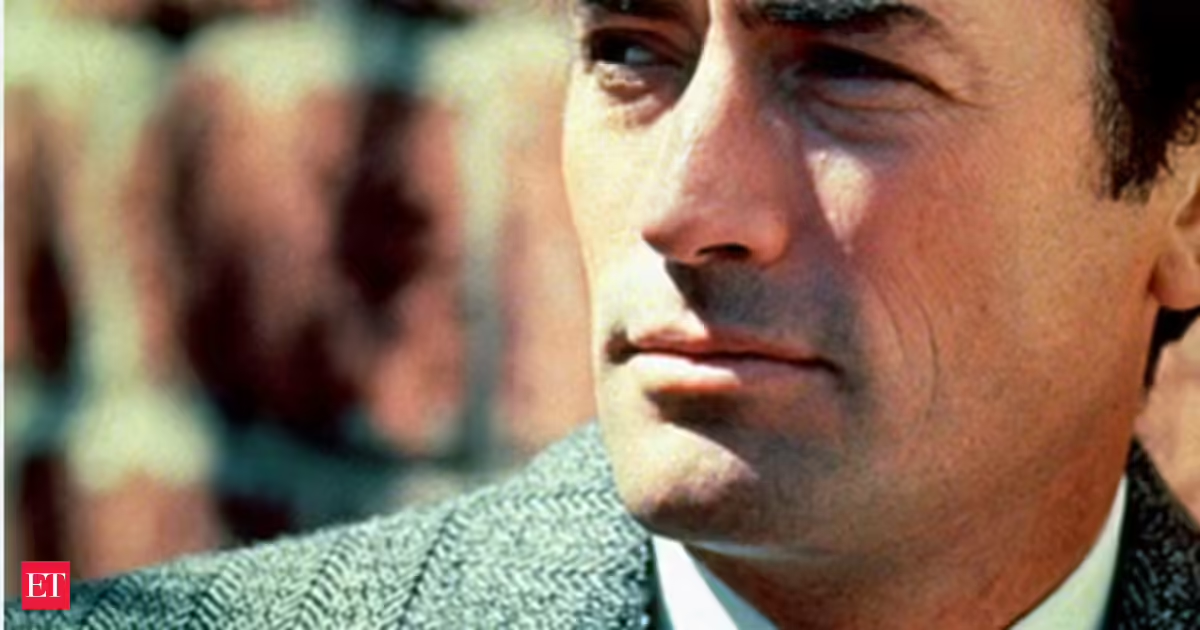
There are very few fictional characters who stay with people long after the final page is turned or the credits roll. Atticus Finch, the lawyer from To Kill a Mockingbird, is one of them. He was never the loudest man in the room or the strongest with his fists. Instead, he earned admiration through integrity, calmness, and the courage to stand by his principles when the world around him chose an easier path.Perhaps that is why Gregory Peck’s portrayal of Atticus Finch became so iconic, with his unwavering moral integrity, his superhuman empathy, and the dedication to fighting for justice even when he knows he will lose. The Oscar-winning actor understood that audiences are not captivated by costumes, makeup, or even the characters themselves. They connect with something deeper, the humanity behind the performance and the way a person confronts life’s obstacles. That timeless idea lies at the heart of today’s life lesson of the day.Life lesson of the day by Gregory Peck: “Inside of all the makeup and the character and makeup, it's you, and I think that's what the audience is really interested in... you, how you're going to cope with the situation, the obstacles, the troubles that the writer put in front of you.”The quote is widely associated with legendary Hollywood actor Gregory Peck, whose career was built on portraying characters of honesty, courage, and strength.Also Read: Quote of the Day by Rowan Atkinson: ‘The older you get, the more you realise how happenstance...’ - The Mr Bean creator’s thoughtful take on fate and life’s unexpected turnsWhat the quote is actually suggestingAt first glance, Gregory Peck appears to be talking about acting. But the quote carries a much heavier meaning. He suggests that no matter how much costume, status, or image a person puts on, the real test is how they respond when faced with challenges.Life constantly places obstacles in front of people, setbacks at work, difficult relationships, personal disappointments, or unexpected failures. According to Peck’s way of thinking, what truly matters is not the role someone is playing but the person underneath it. How do they react under pressure? How do they deal with uncertainty or hardship?The quote is also a reminder that authenticity creates the strongest connection. Whether in art, leadership, friendship, or family life, people are often drawn less to perfection and more to honesty. They relate to someone who faces struggles with resilience rather than someone who simply appears flawless.Gregory Peck: The thinker behind the ideaEldred Gregory Peck was born on April 5, 1916, in La Jolla, California. An only child, he experienced an unsettled childhood after his parents divorced when he was five years old and spent much of his early life living with his grandmother. He often recalled fond memories of weekly movie outings with her, experiences that would later shape his future.Peck initially studied pre-med at the University of California, Berkeley, but discovered a passion for acting and eventually trained at the Neighborhood Playhouse in New York. He made his Broadway debut in 1942 before moving to Hollywood, where he quickly rose to stardom with films such as The Keys of the Kingdom, Spellbound, Roman Holiday, and The Guns of Navarone.After four Academy Award nominations, he won the Oscar for his portrayal of lawyer Atticus Finch in To Kill a Mockingbird (1962), a role that came to define his legacy. Beyond his film career, Peck was known for his humanitarian work and support for civil rights, workers' rights, and anti-war causes. He received the Academy’s Jean Hersholt Humanitarian Award in 1967 and was later honored with the Presidential Medal of Freedom. Gregory Peck died on June 12, 2003, at the age of 87.Gregory Peck’s philosophy behind the quoteThroughout his career, Gregory Peck was drawn to characters who embodied integrity and moral conviction. Rather than chasing every commercial opportunity, he often chose projects that reflected values he believed in. His performances were rarely built on theatrics alone; they were grounded in emotional honesty and empathy.That philosophy is reflected in this quote. Peck believed that audiences connect with truth. The costumes, scripts, and dramatic settings may change, but what leaves a lasting impression is the person behind the performance. His own life shaped by childhood uncertainty, years of hard work, and a commitment to social causes reinforced his belief that character is revealed through adversity.In many ways, the quote is about more than acting. It is about the courage to be genuine, even when life demands that people wear different masks.Why this idea still matters todayGregory Peck’s words feel especially relevant in an age shaped by social media, personal branding, and constant public performance. Many people feel pressure to present a polished version of themselves, whether at work, online, or in their personal lives.Yet the moments that build trust and connection are often the imperfect ones, admitting a mistake, facing a challenge with honesty, or continuing to move forward despite setbacks. In careers, relationships, parenting, and self-growth, authenticity often matters more than appearance.Peck’s quote reminds us that while life may hand everyone different roles to play, what truly defines a person is how they face the obstacles placed in front of them. The image may capture attention, but character is what people remember.
Life lesson of the day by Gregory Peck: ‘Inside of all the makeup and the character... it’s you’ To Kill a Mockingbird actor on the power of authenticity in an appearance-obsessed world
Gregory Peck's iconic portrayal of Atticus Finch highlighted the power of integrity and empathy over outward appearances. His philosophy, captured in a memorable quote, emphasizes that audiences connect with the genuine human response to life's challenges, not just the performance or persona.
TL;DRAI
Gregory Peck's quote underscores authenticity over appearance: character emerges through how people handle obstacles, not in costumes or image. For tech leaders, genuine problem-solving and transparent communication during crises build trust more than polished presentations.
871 words~4 min read