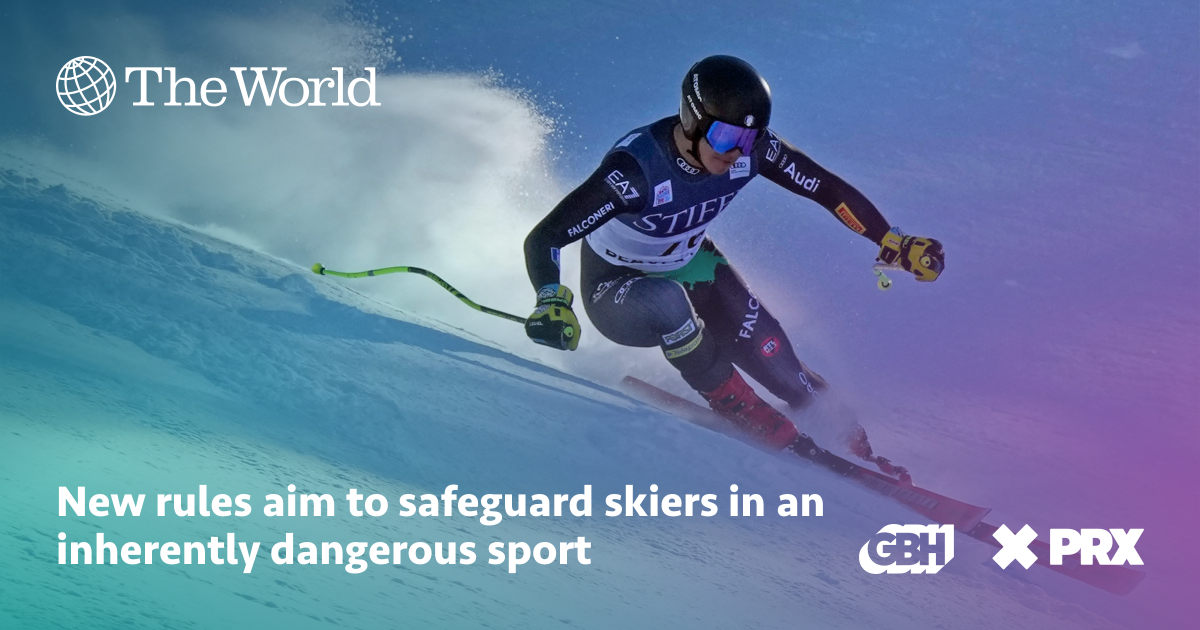
Public radio’s longest-running daily global news program.AboutContactDonateMeet the TeamPrivacyTerms of use©2026 The World from PRXPRX is a 501(c)(3) organization recognized by the IRS: #263347402.New rules aim to safeguard skiers in an inherently dangerous sportThe global sports body for skiing and snowboarding is introducing new safety rules in an attempt to curb accidents after a recent string of serious injuries and fatalities over the past year. Many people say the move is long overdue. SportsNovember 7, 2025Updated: November 7, 20256:03Italy’s Matteo Franzoso races during a men’s World Cup downhill training run in Beaver Creek, Colo, Nov. 30, 2022.Skiing has always been a dangerous sport, but a recent string of serious injuries and fatalities on the slopes has prompted the International Ski and Snowboard Federation (FIS) to implement new safety rules for the upcoming professional season.Starting this season, cut resistant undergarments are now mandatory across all events. That will help protect against sharp skis in crashes, said Paul Van Slyke, a leading ski racing safety expert.“I’ve witnessed lacerations on the ski hill and it’s really, really scary. So, I really am excited that this is taking place in our sport, that they’re requiring this,” said Van Slyke, who is also a consultant with the Kelly Brush Foundation.He added that the decision comes after Norwegian standout Aleksander Aamodt Kilde suffered nerve damage in his right calf from a crash in Switzerland last year. “Would a cut-resistant garment have made his accident and his laceration less severe? I have to believe that it would.”Norway’s Aleksander Aamodt Kilde falls during an alpine ski, men’s World Cup downhill race, in Wengen, Switzerland, Jan. 13, 2024.Alessandro Trovati/AP/File photoBut some of the accidents from the past year have been even more serious. Adolfo Lorenzi lost his daughter, 19-year-old Matilde Lorenzi, in October 2024 when she fell during a training runnear the Italian-Austrian border. She was airlifted to a hospital but soon died from her injuries.“Matilde, she was really [an unbelievably] great daughter. And we are … really proud,” Lorenzi told The World. The young skier was a rising star on the Italian national team, and hundreds of people attended her funeral. Lorenzi said the family quickly decided how they wanted to carry on Matilde’s legacy: The Matilde Lorenzi Foundation, which promotes and develops projects aimed at implementing safety in skiing.“Since the beginning, just the day after the accident [happened], we [decided] with the [whole] family all together that this was never the end of Matilde in the world,” he said.But all too soon after Matilde’s death, the skiing community mourned again — just six months later. In April of 2025, Margot Simond, an 18-year-old on the French national ski team, fell to her death during training. Then, in September, 25-year-old Matteo Franzoso of Italy also died after crashing while training in Chile.Italy’s Matteo Franzoso competes during a men’s World Cup super-G skiing race in Beaver Creek, Colo., Dec. 4, 2022.Robert F. Bukaty/AP/File photo“They can reach speeds of 80 and 100 miles an hour on some of these international courses,” Van Slyke explained. “And everybody in our sport wants to improve and innovate so that these serious accidents don’t happen.”Another new rule hoping to prevent these serious accidents is that everyone racing the speed events — namely, Downhill and Super G — now has to wear smart air bags. They fit like a vest underneath an athlete’s suit and inflate during a detected crash, before the skier hits the ground. The Italian company who makes them, Dainese, originally produced them for motorcyclists. But about 10 years ago, they came out with a new version specifically for elite speed skiers.In a statement to The World, FIS said between 30% to 60% of athletes have already been wearing the air bags voluntarily.“The moment they offered airbags, I found them immediately,” Lauren Macuga, a World Cup winner in Super G, told The World. “I don’t believe you can go out and just casually train Downhill. If you’re going to go out and do Downhill, [and] you’re going to put everything out there, then you need to have the safety [tools] with you.”United States’ Lauren Macuga speeds down the course of an alpine ski, women’s World Cup super G race, in La Thuile, Italy, March 14, 2025.Piermarco Tacca/AP/File photoBut other athletes have been resistant to wearing the air bags, expressing concerns of limiting performance and aerodynamics. The air bags are also expensive, currently selling for $1,699. Van Slyke said once the air bags go off, athletes have to send them back to the manufacturer to be reset.“So, the athletes probably need more than one of them because if they deploy one, the next day they can’t go back out again because it’s required,” he said. “So, it’s really expensive for the athletes and the teams.”Van Slyke said that he thinks part of the reason FIS is mandating the air bags is to help increase demand and lower the cost of production. He would also like to see a higher priority put on educational safety initiatives.“We’re always talking about, ‘Who is responsible for athlete safety?’ It’s everybody. It is everybody in the community,” he said. “It’s every coach. It’s every athlete. It is every parent. Everyone should learn as much as they can about ski racing safety if their kids are in the sport so that they understand how important this is, too.”Lindsey Vonn wears an air bag in under her racing suit in Åre, Sweden, developed by Italian manufacturer Dainese, Feb. 8, 2019.Giovanni Auletta/AP/File photoThe new air bag mandate does not apply to para-sports. Andrew Kurka, a Paralympic gold medallist in Downhill sit skiing, said the idea has been brought up, but he doesn’t support it.“Just simply due to the fact that we are on a single ski and we have 70 pounds worth of something attached to us and the dynamics of crashing is very different than it is for stand-up or able-bodied skiers,” he said, adding that he also does support the back braces that sit-skiers are mandated to wear.For able-bodied athletes, these new safety mandates are only applicable to competition — not training, when most of the fatalities from the past year have happened.“I think the biggest thing that we’ve noticed in the last few years is that the training needs to be safer,” said Lindsey Vonn, one of the most decorated alpine skiers in history. “And you saw that with the death of the young Italian gentleman in Chile on the same track that I was training on the week before. Which is, you know, really scary and definitely makes you realize how dangerous this sport really is.”US alpine skier Lindsey Vonn speaks during a news conference during Team USA Media Summit in New York, Oct. 28, 2025.Yuki Iwamura/APKurka agreed that safety is often not as highly prioritized during training.“I think when it comes to training, they want athletes to get out there and get in as much time as they can so that they can compete at their highest,” he said. “But it is also on the athletes to stand up for themselves in that situation and say, ‘This needs to be taken care of, this needs to happen, these b-nets need to be set up, and this needs to be changed, or I will not run it.’”Kurka said he has repeatedly stood up for himself throughout his career — during training and in races — when a course didn’t meet his own safety standards. He has never faced any pushback once he’s raised the issue, and he emphasized that the lack of adequate safety measures is never intentional. Instead, he thinks some safety measures are often overlooked because people in the sport are conditioned to accept it as dangerous.“People inherently put fear and their worries on the back burner because their fear and their worries are kind of always there. And if you focus on those things, you’re not going to be a great athlete at this sport,” he said. “So, people stop noticing those inherent dangers in those situations.”United States’ Ryan Cochran Siegle crashes onto the safety net during an alpine ski, men’s World Cup downhill in Kitzbühel, Austria, Jan. 22, 2021.Marco Trovati/AP/File photoFIS declined an interview request for this story, but in an email it said it’s currently discussing mandating air bags in training and it’s currently conducting detailed audits of training courses worldwide. That process is expected to be completed in May 2026.But before then, the sport will be on the biggest stage of all: the Winter Olympics, which will be spread across northern Italy. For the Italian ski community, it will be both a celebration of the sport and a poignant moment to reflect on the tragedies of the past year. Lorenzi, who lost his 19-year-old daughter, said there will be an event to honor her, and the family plans to use the limelight to spread its message.“It will be a moment where everybody will have their eyes on [skiing]. And then it will be very, very important also for us to keep up the interest on safety,” he said. “Because we cannot lose any efforts.”The Milano-Cortina Winter Olympics start on Feb. 6.
New rules aim to safeguard skiers in an inherently dangerous sport - The World from PRX
The global sports body for skiing and snowboarding is introducing new safety rules in an attempt to curb accidents after a recent string of serious injuries and fatalities over the past year. Many people say the move is long overdue.
1,520 words~7 min read