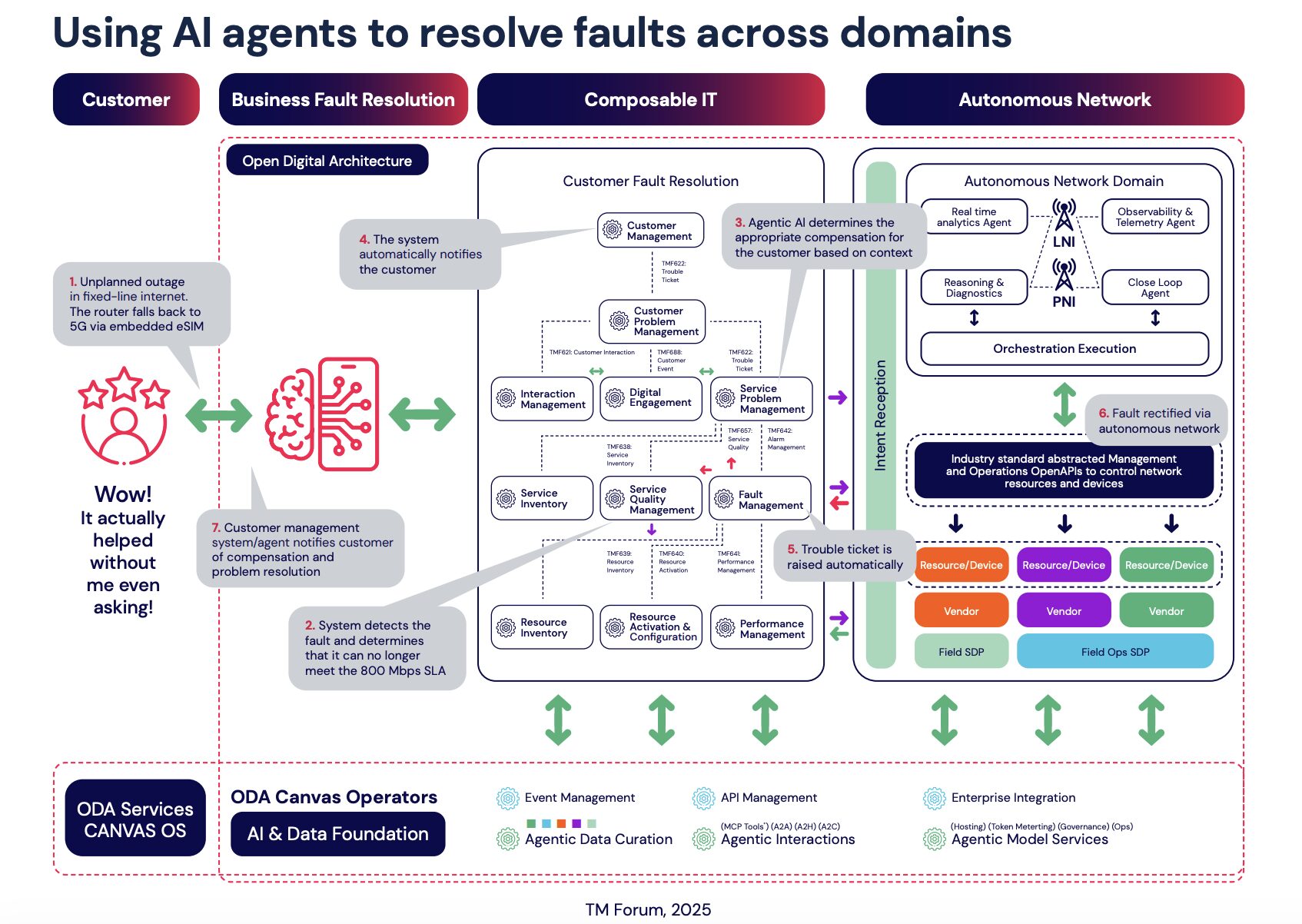
To achieve higher tiers of autonomy as defined by the global telecom industry association TM Forum, service providers must move beyond simple and reactive automation scripts. The goal is to achieve closed-loop, intent-driven operations where networks self-optimize, self-heal, and adapt to high-level business goals with zero human intervention. Enterprise and telecommunication service providers face a clear challenge: they need a robust, scalable, and secure cloud and an AI-native foundation that seamlessly integrates with specialized service orchestration.Red Hat is collaborating with Tata Elxsi to address this challenge, bringing together a set of solutions and capabilities from both companies that deliver the production-ready, high-performance intelligence required for full network autonomy. Merging service provider intelligence with enterprise AI to create autonomous network operations
Figure 1. Building autonomous network operationsBuilding an intent-driven autonomous network operations center (NOC) requires a technology stack of components that work closely together. As shown in Figure 1, the Tata Elxsi NEURON service orchestrator and the Red Hat portfolio have been engineered to handle immense amounts of telemetry data and process it through sophisticated AI models, with validation performed through a digital twin to safely execute network changes.At the foundational compute layer, Red Hat OpenShift serves as the common cloud- and AI-native edge-to-cloud compute platform. This ensures that the entire stack can be deployed anywhere—spanning physical, virtual, private cloud, sovereign cloud, public cloud, and edge environments. Crucially for AI workloads, Red Hat OpenShift supports diverse hardware accelerators, including those from NVIDIA, Intel, AMD, Google, IBM, and AWS. Red Hat Ansible Automation Platform handles network execution and provides the necessary auto-remediation capabilities to enact the closed-loop changes dictated by the AI engines.NEURON operates as an intelligent telco brain, providing a unified generative AI and network graph-driven network assistant that provides an intuitive interface for interacting with complex systems. NEURON facilitates the level 4/5 automation logic, including intent orchestration to manage network behaviors and multidomain and multivendor network observability. It also provides an artificial intelligence/machine learning (AI/ML)-powered network digital twin, along with a framework with strategic guidance for assessing how mature an organization is in terms of automation, orchestration, AI adoption and operational intelligence. Red Hat OpenShift AI and Red Hat Advanced Cluster Management for Kubernetes empower NEURON with true cognitive capabilities, providing an AI factory capability and inference engine. To handle the high-throughput, low-latency demands of service provider environments, the solution leverages vLLM inference for fast-token generation, alongside llm-d for distributed inference across multinode and multi-graphical processing unit (GPU) setups. This solution equips the NOC with a comprehensive suite of AI tooling, including robust machine learning operations (MLOps), large language model operations (LLMOps), a centralized model catalog, retrieval augmented generation (RAG), and a multiagentic framework powered by Llama Stack. Most importantly, it enforces strict AI guardrails that aim to keep autonomous decisions safe and compliant.An aligned multidomain strategyAchieving level 4/5 autonomy isn't just about localized automation; it requires the seamless translation of intents throughout the entire stack and across highly distributed network domains. Red Hat’s collaboration with Tata Elxsi models the TM Forum-aligned approach through precise vertical and horizontal integration.The workflow begins by translating high-level business intents into service intents, and then into specific network and infrastructure intents. Throughout this intent-to-action lifecycle, tools from Red Hat and Tata Elxsi take on complementary responsibilities:Red Hat powers the cognitive loops by supplying the AI/LLM inference (Red Hat AI Inference), the multiagentic frameworks (Llama Stack), and the overarching governance and security layer.Tata Elxsi takes charge of intent management, workflow automation, service orchestration, and the underlying network automation.The solution is aligned with the TM Forum resource operations layer, with Red Hat providing a fully autonomous cloud domain having its own knowledge layers, agents, automation, and AI/LLM inference capabilities alongside an agentic closed loop. The cloud autonomous domain interacts horizontally with other autonomous domains, including the radio access network (RAN), core, transport, cloud, and IT autonomous domains. These domains are not siloed; they communicate efficiently using standardized Agent2Agent (A2A) and A2A for telecoms protocols.To maintain continuous closed-loop operations across this vast ecosystem, the architecture leverages advanced operational tools. Red Hat OpenShift GitOps and Red Hat Advanced Cluster Management constantly maintain the declarative state of the network. Red Hat OpenShift LightSpeed capabilities bring intelligent and conversational assistance directly to the platform operations layer, accelerating troubleshooting and cluster management.Delivering true autonomyThe transition to this joint solution and architecture represents a fundamental shift in operational capability. By fusing Tata Elxsi's carrier-grade autonomous intelligence with Red Hat's carrier-grade cloud- and AI-native platform that provides MLOps and LLMOps, the solution delivers true autonomy for service provider networks.Key benefits and value propositions include:Faster intent-to-action cycles: The deep integration between NEURON's orchestrator and Red Hat's fast-token vLLM inference accelerates the speed at which high-level business intents are translated into executable, real-time network changes.Lower inference costs at scale: Running continuous AI models across a massive network can be computationally expensive. By utilizing vLLM-optimized infrastructure, this solution delivers high performance while significantly lowering cost at scale.Production-ready operations with complete governance: The inclusion of Red Hat OpenShift AI provides carrier-grade governance and compliance. Service providers gain full lifecycle management over their models.Seamless integration with no operational support systems (OSS) re-engineering: A major roadblock for level 4/5 adoption is legacy technical debt. This solution is designed for seamless integration into existing network stacks, enabling advanced closed-loop automation without requiring massive, disruptive OSS re-engineering.Together, Red Hat and Tata Elxsi fundamentally alter the service provider operational baseline by actively reducing manual operations while increasing policy-driven automation and efficiency. The end result is a vastly accelerated mean time to resolution (MTTR) for network anomalies. That gives service providers confidence to run production-ready autonomous operations and focus on delivering innovative new services to their customers.Hands-on validation is the next step for service providers that are ready to move beyond theory and build autonomous operations. Engaging in a proof of concept is the ideal way to experience the collaboration between Red Hat and Tata Elxsi. Whether the immediate goal is demonstrating intent-based closed-loop automation, exploring AI-driven network optimization, or simulating changes with a network digital twin for predictive assurance, the foundational solution is ready. Learn more about Red Hat’s telecommunication solutions and surrounding ecosystem.