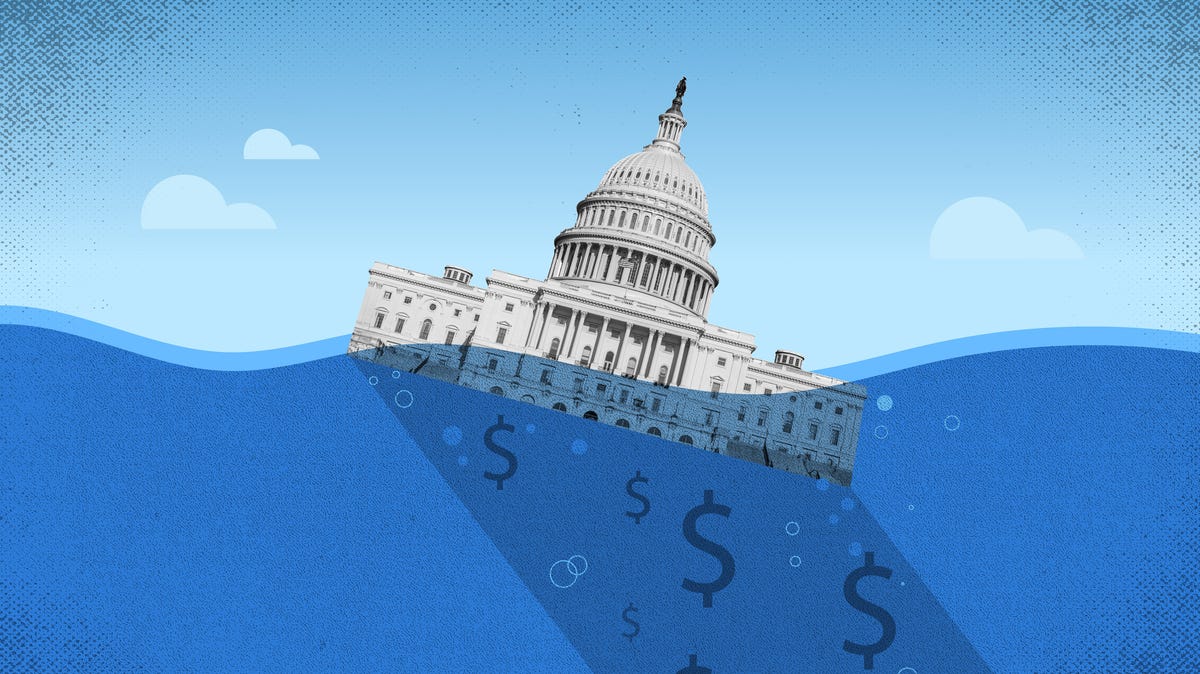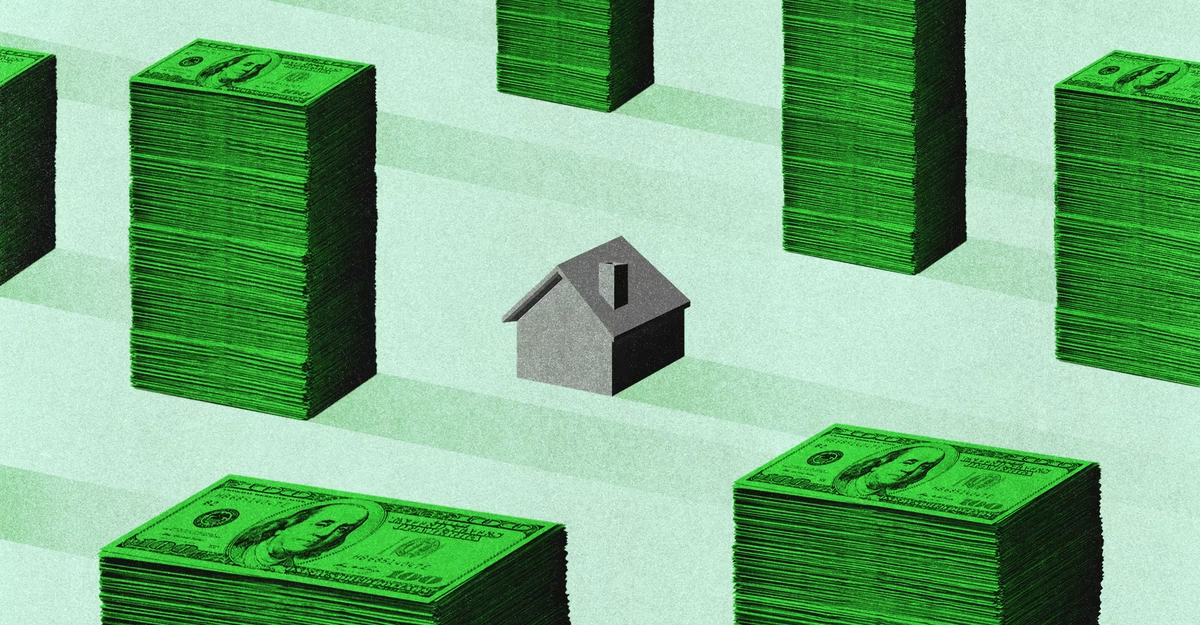
The National Debt Is Raising Borrowing Costs for EveryoneConsumers are already paying the price for the government’s deficits.Illustration by The Atlantic. Source: Getty.June 12, 2026, 7:30 AM ET Fiscal hawks like to drum up interest in the national debt by making the astronomical numbers more tangible. The United States owes $31.6 trillion to public creditors, more than $290,000 for each household. You could spend $1 million every day for almost 86,000 years before having to borrow more. But no one really cares. Talking about how many times all of the dollars laid end to end would go to the moon and back (6,000, as it happens) is just not going to get people to think differently about the national debt.What should matter is that the consequences of this debt are not off in the future, but already here. The government’s deficits have saddled many American families with higher costs, largely from rising interest rates. The Budget Lab, the policy research center at Yale where I am the executive director, recently estimated that congressional-spending decisions since 2015 have raised Treasury yields by almost a full percentage point, which affects what American households pay to borrow. For someone taking out a 30-year mortgage at last year’s median home price, this rise in long-term interest rates has increased their borrowing costs by about $2,500 a year, or roughly $76,000 over the life of the loan. (The Budget Lab has built a tool to help users calculate their own extra mortgage costs.)The problem is not just for Americans who are lucky enough to buy a home. The bloated government budgets and waning federal revenues of the past decade are driving up costs across the board. Compared with a world in which these fiscal-policy changes did not take place, the annual borrowing costs on a typical auto loan are now up by about $120, and by about $770 on a typical small-business loan. Credit-card borrowing rates are also hovering near record highs.Although affordability has become a watchword for politicians who understand that rising prices are hurting American families, lawmakers seem to have forgotten that reducing federal deficits would help bring down prices. In the 1990s, Congress and the White House prioritized bringing deficits down by both cutting spending and raising revenue—moves that lowered borrowing costs for American families by about 0.6 percentage points, according to Budget Lab calculations. But few lawmakers seem to be suggesting the spending cuts and tax increases necessary to lower costs now.Jared Bernstein: The national debt’s unforgiving mathThe relationship between federal spending and household costs is mostly one of supply and demand. When the U.S. government needs to borrow funds to cover existing and new promises, these demands compete with those of all borrowers, which drives up interest rates for everyone. Lenders only have so much money to offer, so they can charge more for loans when demand is high. When investors have fewer borrowers competing for their funds, they will lower interest rates to appeal to more people.Much of the big legislation of the past decade, such as the Tax Cuts and Jobs Act, pandemic stimulus bills, and the One Big Beautiful Bill Act, has grown the deficit. Lawmakers have passed some legislation to improve the fiscal outlook, such as the Fiscal Responsibility Act in 2023, which cut spending and clawed back unspent coronavirus-relief funds, but most federal policy has lately involved spending money that the country doesn’t quite have. This is hurting consumers, businesses, and the federal government.The cost of the war in Iran, which the Pentagon put at $29 billion last month (other estimates are higher), will put slight upward pressure on interest rates (0.002 percentage points), according to our calculator. The One Big Beautiful Bill Act, which we estimate will raise the deficit by $2.4 trillion over the next decade (not including interest costs), will raise interest rates on a typical 30-year mortgage by 0.4 percentage points by the end of 2030—about $1,060 annually for a home bought at the 2024 median price with a 20 percent down payment—and by 1.5 percentage points by the end of 2055.Most economists support deficit spending during temporary crises, such as a recession, or in cases where an investment can be expected to generate more government revenues in the future, such as funding for infrastructure. But the United States has been spending far more than it takes in for well over two decades.Listen: What happens if the U.S. defaults?The main remedies for these problems—higher taxes and spending cuts—are generally politically unpopular. Every budget fix will have its critics, but some options are more palatable than others. Better funding for the IRS, for example, could help close the “tax gap”—the amount of taxes legally owed that are not paid in a timely way—which the IRS estimated at about $700 billion a year in 2022. Other levers include raising the retirement age and reducing Social Security benefits for high earners, who also tend to live longer; reforming Medicare Advantage, a program that has been shown to allow private insurers to overcharge the federal government; and removing the tax exemption on employer-provided health insurance, so that these benefits can be taxed as income. The Congressional Budget Office regularly publishes policies that could help close the deficit, and Americans need to decide what we’re willing to pay for and what we’re not.A big challenge in making these hard choices is that the costs and benefits are asymmetrically understood: Whereas the costs of deficits are diffuse, the costs of policies that close the deficit are acutely clear only to those affected. For example, the Budget Lab has estimated that closing the carried-interest loophole could raise more than $100 billion in federal revenues over 10 years, which would help lower mortgage rates by 0.0064 percentage points. But this collective benefit is too slight for most people to know or care about it. The few people who benefit from this tax break, however, in industries such as private equity and venture capital, very much do care, so they are far more likely to push hard to keep it than the millions of affected Americans are to push to end it.Politicians respond to electoral consequences. Right now there is nothing stopping them from doling out tax cuts and spending promises while also driving up interest rates. Voters may complain that their lives are becoming unaffordable, but hardly anyone seems to appreciate that federal deficits are partly to blame. If we want to see lawmakers actually address this problem, economists need to do a better job explaining the stakes. This means that instead of talking about the fact that our national debt could fill all 32 NFL stadiums with two tiers of construction pallets filled with $100 bills, we should be talking about how deficit spending is making it harder to pay our own bills.
The National Debt Is Raising Borrowing Costs for Everyone
Consumers are already paying the price for the government’s deficits.
1,135 words~5 min read