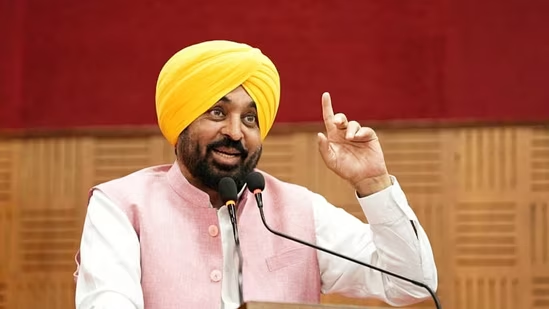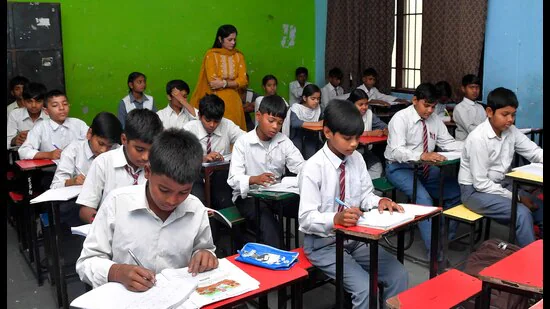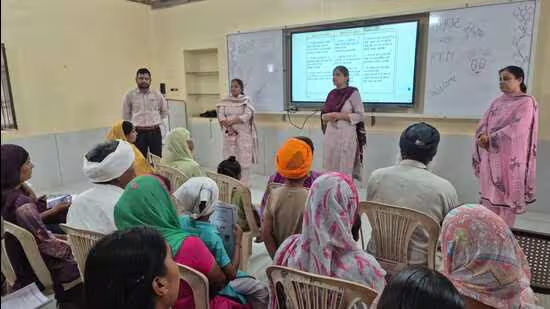
Punjab’s move from the twenty-seventh position in 2020 to the top of NITI Aayog’s School Education Quality Report 2026 has drawn attention for good reason. The state now ranks ahead of Kerala, Maharashtra and Delhi in a national assessment of school quality. That result becomes more striking when set against large northern and central states such as Uttar Pradesh, Bihar, Madhya Pradesh and Rajasthan, where staffing, continuity and learning outcomes continue to pose serious challenges.(Sign up for THEdge, The Hindu’s weekly education newsletter.)Punjab’s reform story is concrete, not vague. The state set up 118 Schools of Eminence, of which 14 had been completed by March 2025 and another 26 were nearing completion or ready for inauguration. It regularised 14,417 contractual employees in 2023 and later approved a wider plan to regularise 65,048 outsourced workers across 51 departments, including 7,704 in school education. It also sent teachers and school leaders to Singapore, IIM Ahmedabad, and Finland’s University of Turku for leadership and pedagogy training. It also launched Mission Samarth for foundational learning and used mega PTMs to bring parents directly into school governance. Those PTMs were not symbolic; more than two million parents attended a statewide meeting and over 40,000 teachers were trained to run structured parent workshops.Punjab’s rise is not just a political talking point. It reflects a series of operational choices, including filling vacancies, upgrading schools, investing in leadership, and making parent engagement part of governance. That is why it is also a systems story. The NITI Aayog report on school education, released in May 2026, and the PARAKH Rashtriya Sarvekshan 2024 show that India’s school crisis is no longer only about access. The deeper question is whether state governments can build the administrative and academic architecture that allows children to stay in school and learn.What Punjab changedPunjab’s gains rest on a mix of upgraded infrastructure, tighter staffing, leadership training and sharper performance tracking. Taken together, those choices help explain the turnaround. The official findings show that Punjab performed strongly across language and mathematics at both foundational and middle stages.What makes this moment especially revealing is that the same NITI Aayog report also documents the structural weaknesses that continue to define Indian schooling at large. India has approximately 7.3 lakh primary schools, 4.34 lakh upper primary schools, only 1.42 lakh secondary schools and 1.64 lakh higher secondary schools, according to UDISE+ 2024-25. Only 5% of all schools in the country offer uninterrupted schooling from Grade 1 to Grade 12. For millions of children, especially in rural and poor districts, the school system remains a ladder with several rungs missing.The problem is particularly acute in the Hindi heartland. According to the report, more than one-third of Indian schools operate with fewer than 50 students and UDISE+ 2024-25 data shows that over 1.04 lakh schools run with a single teacher. These institutions are not marginal curiosities. They are concentrated in the districts where learning outcomes are already weakest and they place one teacher in a position where multi-grade instruction, administrative work and welfare duties all fall on the same person simultaneously.Teacher vacancies compound the picture further. Bihar alone has more than 2.08 lakh elementary teacher vacancies, along with tens of thousands more at secondary and senior secondary levels. Jharkhand and Madhya Pradesh report similarly large shortfalls. These vacancies feed directly into the single-teacher crisis. When so many posts remain unfilled, rural schools are pushed into multi-grade arrangements where one teacher is expected to do everything and learning suffers. These numbers matter more than any scheme announcement because they describe basic distance between policy intent and classroom reality.This is where Punjab’s rise becomes a challenge to other states, not just a story about one state. If Punjab can show measurable gains in foundational and middle-stage learning, the obvious question is why larger states have not adopted the same operational habits. The PARAKH national report shows that only around 40% of students at the middle stage perform at grade level in social science, while national averages in language and mathematics also remain well below expectation. These are not the numbers of a system on the verge of breakthrough. The contrast is visible in the national learning data below.
From 27th to 1st: How Punjab became best-performing school education state
Discover how Punjab transformed its education system, rising from 27th to the top in India's school performance rankings.
948 words~4 min read