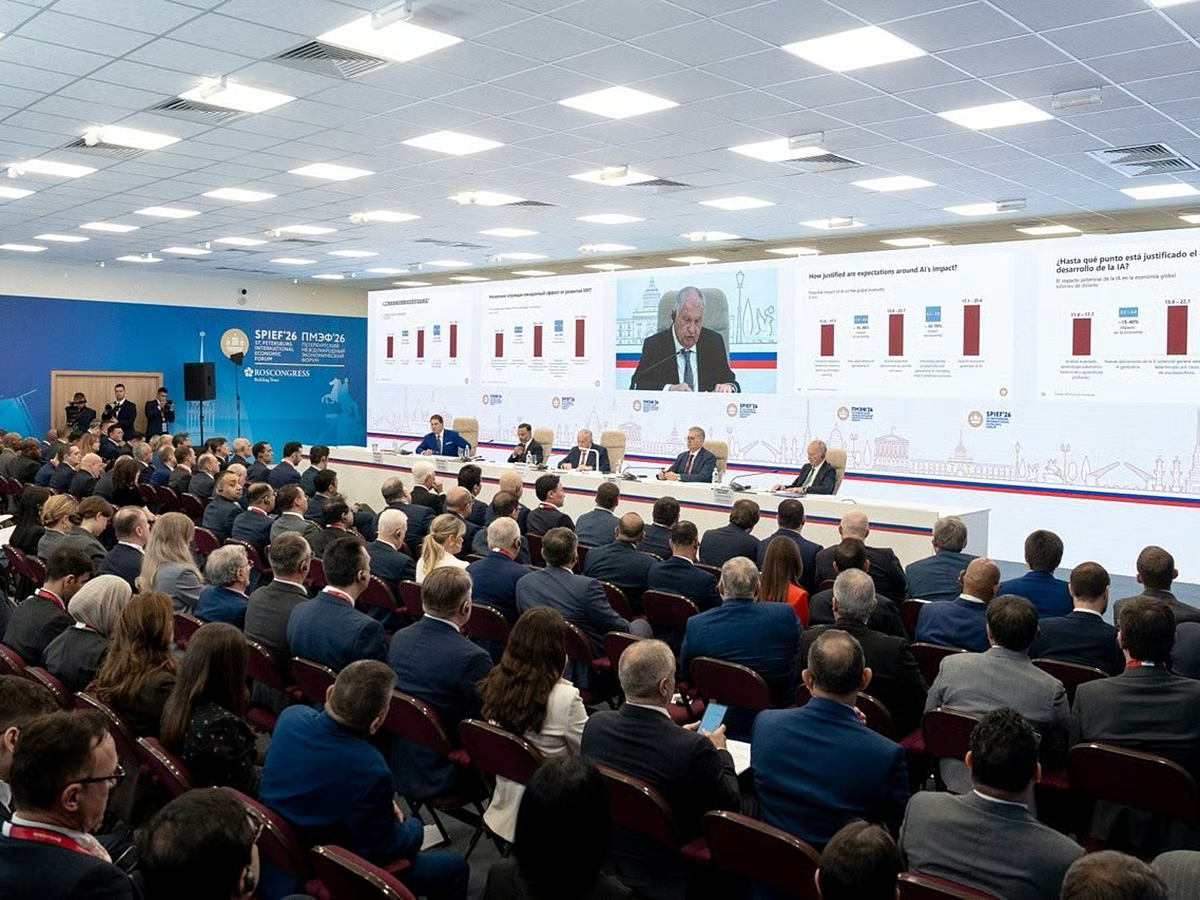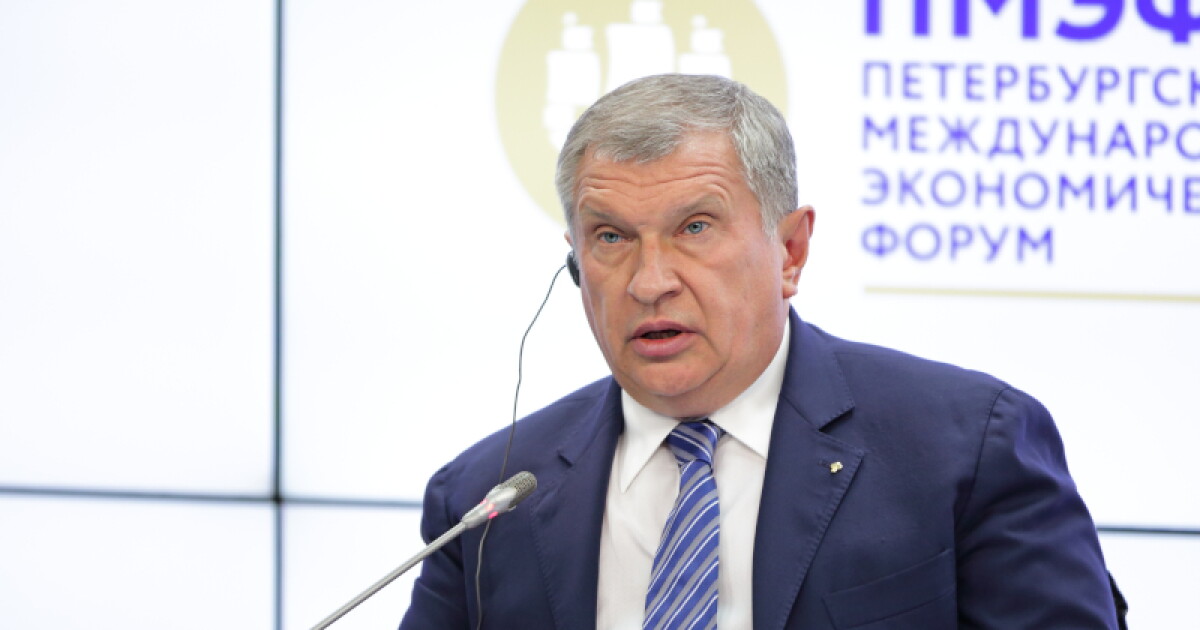
At the 29th Saint Petersburg International Economic Forum last week, Igor Sechin, CEO of Rosneft and executive secretary of the Russian Federation Presidential Commission for Strategic Development of the Fuel and Energy Sector and Environmental Security, gave a wide-ranging speech titled “The Beginning of the End or the End of the Beginning: What’s Left in Pandora’s Box.” What follows is an edited version of his presentation, focusing on the geopolitical shifts and key points for the energy industry.A year ago, we compared the development of the global economy to the dangerous journey of Odysseus that was full of surprises. Today, in my opinion, a more relevant parallel is another ancient Greek myth — the myth of Pandora's Box, which brought illnesses, disasters and suffering to humanity.The so called rules-based order, where the rules were dictated by an unquestionable hegemon, collapsed as a result of the actions of its creator.An attempt is in evidence to replace the global legal system with the legal system of one country. Such international institutions as the United Nations, the World Trade Organization, the International Monetary Fund, the World Bank, the nuclear arms control system and other regulators turned into zombies.New leaders have come to the fore: The global economy now is an absolute hostage to political decisions that are made in the interests of large corporations, mainly tech, military and financial ones that have formed a vicious circle of beneficiaries.Pandora's Box opened and the troubles and misfortunes that escaped from it will not go back. The key question is: What problems are still left at the bottom of Pandora’s Box? What else do we have to face?The Face of the Global Economy Is ChangingThe current development of the conflict in the Middle East invited the global crisis. Besides oil and gas, a significant volume of global fertilizer exports passes through the Strait of Hormuz. Supply disruptions, along with the lack of strategic reserves in these markets, increase the risk of a global food crisis.The Hormuz crisis is a precedent. Obviously, the same threat may now loom over other global logistics bottlenecks: the Straits of Malacca, Bab al-Mandeb, and Gibraltar, the Cape of Good Hope, the Danish and Turkish Straits, and the Suez and Panama Canals that are crucial not only for the global energy sector (almost all the global oil production passes through them), but also for the entire global trade.Problems Are Growing Like a SnowballThe global economy has entered not simply a period of volatility, but that of strategic risks.Illusions of accelerated energy transition along with the neglect of energy security issues in recent years have led to underinvestment in the energy sector. This decline is part of a broader trend of declining investment in industrial production.Global military spending has been rising continuously for the past 11 years. Along with the military-industrial complex, the high-tech sector is also attracting large-scale investments.Today, artificial intelligence-related companies are actually consuming a significant portion of investment resources, to the detriment of the rest of the economy. New technologies are shaping the transition to a new socioeconomic order.Transition From Molecules to ElectronsThe use of artificial intelligence technologies requires the entire energy infrastructure expansion and modernization.A "molecules to electrons" model is emerging, with data centers as a key element. As a result, the world is currently entering a phase of electricity consumption structural growth.The lack of a balanced approach to energy system development has already resulted in [an] electricity prices increase. Power grids and energy storage remain the key constraint.Metals are also critical for the development of a new type of energy system. Copper, a key metal in the "new" economy, is particularly important. Access to metals, particularly rare earth elements, is also critical for the defense industry.China is an Example of Balanced DevelopmentIn recent decades, China demonstrated not only economic success but also remarkable science and technology advances, enabling it to become a global energy power. In particular, China proved to be the best prepared for the Hormuz crisis and its aftermath, thanks to its balanced approach to ensuring energy security based on the real risk assessment.China has created an affordable urban and intercity transport infrastructure for its domestic market. China has a significant competitive advantage in electricity prices. Unlike Western countries, China has successfully addressed the challenge of curbing rising electricity prices, in part through optimization of distribution of energy resources and computing capacities.That means that if necessary, the issue of constructing additional generation capacity is resolved at the expense of the data centers themselves, rather than the consumers.According to the 15th Five-Year Plan, technology must become a key driver of growth. Achieving this goal is impossible without developing the energy sector.At the same time, the cost of electricity generated from renewable sources is declining significantly. Simultaneously with the development of renewable energy sources, China continues to construct new coal-fired power plants. China is implementing the largest nuclear power development program. Strengthening energy security is part of a comprehensive program to mobilize domestic reserves implemented by China.India Is the Driver of Energy DemandToday, India's economy is one of the key drivers of global energy consumption growth. India also holds a unique position in the oil market: Over the next 10 years, the country will account for approximately half of global oil demand growth.The conflict in the Strait of Hormuz along with new risks will unfortunately have a negative impact on meeting the needs of Indian economy. But this is also an incentive to seek long-term solutions in energy security.The Oil and Gas Market Is Going Through an “Ideal Storm”Objective analysis of the oil market situation shows that with the exit of the United Arab Emirates, and previously Qatar, Ecuador and Angola, Opec-plus has lost part of its potential. As a result, over the last 10 years, the alliance's production has dropped from 58 [million barrels per day] down to 37 million b/d.Considering that Iran, Venezuela and Libya were not initially subject to production cuts, and that Iraq and Kazakhstan significantly exceed their established quotas, the output of the alliance's member countries that comply with the caps actually amounts to 27 million b/d, which is less than one-third of global production.Nevertheless, having undertaken commitments to cut oil production, Russia has strictly fulfilled them and by all means contributed to achieving the alliance's goals.Most of the major Opec-plus member-states have increased their production during the term of the agreement. In Russia during the same period of restrictions, oil production has fallen by 1.5 million b/d.It is a 15% decline, which will have to be offset by required investments of at least 10 trillion rubles ($138 billion). We expect that investment cooperation between the alliance member-states and our country will also develop.Rising Hydrocarbon Prices Passed On to ConsumersThe closure of the Strait of Hormuz is an attempt to reshape the regulation of the global energy market to benefit the US. The measures undertaken to block the strait were aimed against Iran, but they backfired against the whole world. The strategic risks were underestimated.As a result, the suffering is on consumers. Western countries are experiencing a double price shock: Besides electricity, now it’s for motor fuel as well. Fuel prices in the United States have increased by more than 50%, and in Europe the price growth has exceeded 20%.Undeniably, the main beneficiaries here are American companies which gained noncompetitive advantages and the ability to organize supplies at a high price. American hydrocarbon exports are breaking all records.But how long will this abundance last? Clearly, continued tensions in the Strait of Hormuz will undermine long-term demand for oil. It could also trigger a renewed surge of interest in alternative energy.Sources of oil production growth in the world are limited. In recent years, American shale oil production growth has been slowing down. Oil production in Venezuela requires significant investments.The lessons of Hormuz are to be thoroughly analyzed, and a defense system must be built. But it seems that no one is drawing any conclusions. The European Union is imposing more sanctions [on Russia]. The US is carrying on with the same policy. The risk of reduced Russian supplies bodes even greater problems than the current crisis.ConclusionSo, what is left under the lid at the bottom of Pandora's Box? In our case, at the bottom of the box we will inevitably discover a global energy shortage, deficit of food, copper and other metals, shortage of water, which will determine the new face of the global economy.Is everyone ready to face new threats? Those that are best prepared for this will survive. The real end of the systemic crisis and the formation of a new normality are still very far away. Not everyone will see it come.
Igor Sechin: What’s Left in Pandora’s Box?
In a wide-ranging address, Igor Sechin examines shifting geopolitical realities and their implications for the future of energy.
1,441 words~7 min read