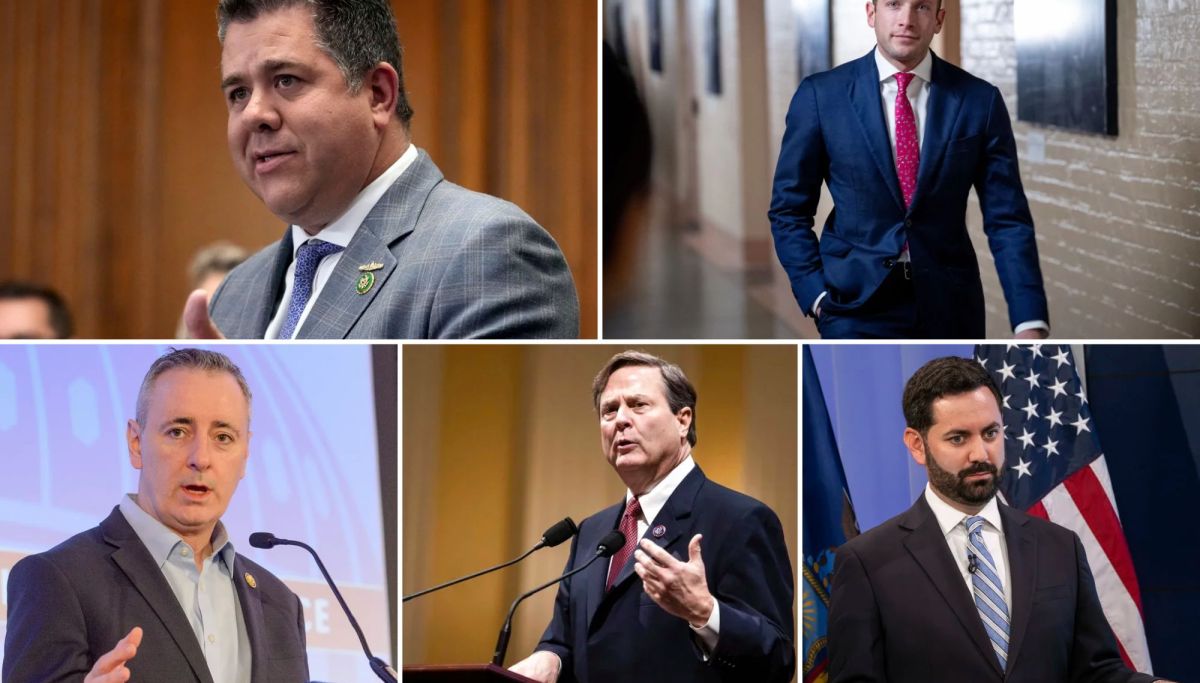
In Oscar Wilde’s 1895 comedy The Importance of Being Earnest, the epigram-spouting Lady Bracknell is told by Jack Worthing, her daughter’s suitor, that he’s lost both his parents. To this, the lady replies imperiously: “To lose one parent, Mr. Worthing, may be regarded as a misfortune; to lose both looks like carelessness.” I thought of Lady Bracknell this week on learning that Republican House Speaker Mike Johnson has now let not one but two pro-union bills tiptoe past him to win a House floor vote. Even in a Democratic House, passage within a six-month period of two measures to expand labor rights would be a rarity. I’d begun to wonder when we’d see a third when I learned that the House Armed Services Committee last week adopted an amendment to this year’s defense authorization bill restoring collective-bargaining rights for civilian workers in the Defense Department, and that the same language last year cleared the House as part of that year’s defense authorization bill before the Senate stripped it out in House-Senate conference prior to final passage. Clearly the legislative politics surrounding labor rights are shifting in labor’s favor. Having said that, I advise you not to get too excited. The first of these labor bills, introduced by Representative Jared Golden, Democrat of Maine, would restore collective-bargaining rights to all federal workers; like the defense authorization amendment, the Protect America’s Workforce Act would reverse a couple of union-busting executive orders (here and here) from President Donald Trump. But after clearing the House in December, 231–195, it’s going nowhere in the Republican Senate. The second labor bill (text; summary) was introduced by Representative Donald Norcross, Democrat of New Jersey (who also sponsored the defense authorization amendment). The Faster Labor Contracts Act would make it easier for newly established union locals to win their first contract. But after passing the House on June 9, 230–193, Norcross’s bill faces similarly dismal odds in the Republican Senate.Even if the Senate managed to pass one or both bills, it wouldn’t matter, because the dependably anti-labor Trump (who, bafflingly, increased his share of the working-class vote from 51 percent in 2016 to 56 percent in 2024) would veto it. Norcross’s defense authorization amendment, if it clears the House again, will attract less notice, and Trump might not bother to veto an entire Defense bill over a labor provision. But my guess is he won’t have to, because the Senate will likely strip it out again before it gets to his desk.I can’t tell you how to get a pro-labor bill through the Senate. But to get one through the House, it seems pretty clear that, so long as Republicans are in the majority, you must avoid the Education and the Workforce Committee. None of the three pro-labor bills under discussion cleared that committee, which is so anti-labor that every time the GOP retakes the House, Republican leaders change its name from “Education and Labor” to “Education and the Workforce” because the very word “labor” disturbs their sleep. The defense authorization amendment bypassed Education and the Workforce because it lacks jurisdiction over the military. December’s bill to restore collective-bargaining rights to all federal workers and this week’s bill removing management obstacles to negotiating union contracts both got to the House floor by discharge petition, a parliamentary procedure by which any House member may collect signatures to force a vote on a bill bottled up in committee. Once that member has acquired 218 signatures (i.e., a majority), they can bring the bill to the floor. Organizing a workplace can be a pyrrhic victory if management refuses to agree to a contract. Bloomberg’s Robert Combs calculated in 2022 that it took 465 days on average to negotiate a union contract, and that was when we had a pro-labor National Labor Relations Board. It almost certainly takes longer now. According to the nonprofit Economic Policy Institute, Starbucks baristas in Buffalo have been negotiating a contract for 1,645 days, and Amazon warehouse workers in Staten Island have been at it for 1,532 days. There isn’t much a union can do about such management foot-dragging except file an unfair labor practice complaint with the NLRB, and if a Republican is in the White House, the NLRB won’t likely be very responsive. Even under Democratic administrations the NLRB lacks statutory authority to level meaningful penalties. The Faster Labor Contracts Act would amend the 1935 National Labor Relations Act to require that employers begin negotiating a labor contract within 10 days of a union election. If 90 days pass without an agreement, the matter will be referred to a mediator, and if the mediator can’t hammer out an agreement within 30 days the matter will be referred to a binding three-person arbitration panel. Getting a bill like that to the House floor was no small accomplishment.Labor bills aren’t the only measures that are moving through the House by discharge petition these days. As Trump’s popularity plummets, Johnson is losing control over his caucus, resulting in the House turning into a sort of discharge-petition rager. There have been 23 in this Congress, of which nine have been successful. That’s an excellent batting average. One discharge petition was used to compel Trump to release the Jeffrey Epstein files. Another was used to pass a Ukraine aid package. What’s unusual about the labor discharge petitions is that they cross an ideological boundary. Republicans don’t intrinsically oppose releasing files about child predators or containing Russian aggression. But they do intrinsically oppose labor unions. Now a breakaway Republican faction is challenging that.Five Republicans signed the discharge petition to bring the Protect America’s Workforce Act to the House floor. They were: Representatives Nick LaLota and Michael Lawler of New York; Representatives Brian Fitzpatrick and Robert Bresnahan of Pennsylvania; and Representative Don Bacon of Nebraska. All except Bacon represent blue states. That was a year ago. In March and April, all five signed the discharge petition for the Faster Labor Contracts Act, joined this time by two red-staters: Representatives Max Miller of Ohio and Riley Moore of West Virginia. And in the final vote, these seven Republicans were joined by 13 more. In both last December’s bargaining rights bill and this week’s union contract bill, 20 House Republicans voted for a pro-union bill. That tells me the December vote was not a fluke. When more than one-third of the Republican House caucus casts pro-union votes, even though few of these members supported labor rights in the past, that’s news.Notably, this latest vote is about something the business lobby cares about a lot more than it does about whether federal workers organize; federal workers don’t work for private employers. The Education and the Workforce Committee website (controlled by the Republican majority) posted a list of objections to the Faster Labor Contracts Act from business leaders: “an unconstitutional taking,” “a rushed floor vote,” “undermines the principle of voluntary agreement,” and so on. Meanwhile, the committee’s ranking Democrat, Representative Bobby Scott of Virginia, took to the floor to praise the bill for “making the right to organize real, not theoretical.” In the end, it didn’t matter what the Education and the Workforce majority thought. The bill cleared the House anyway. Those 20 pro-union Republican votes aren’t yet able to make much difference. But they’re a sign that labor solidarity is starting to undermine partisan solidarity. Senate Republicans, take heed.
How to Get a Labor Rights Bill Through a GOP House
How scared are the Republicans of the lower chamber? They’re starting to support unions.
1,224 words~6 min read