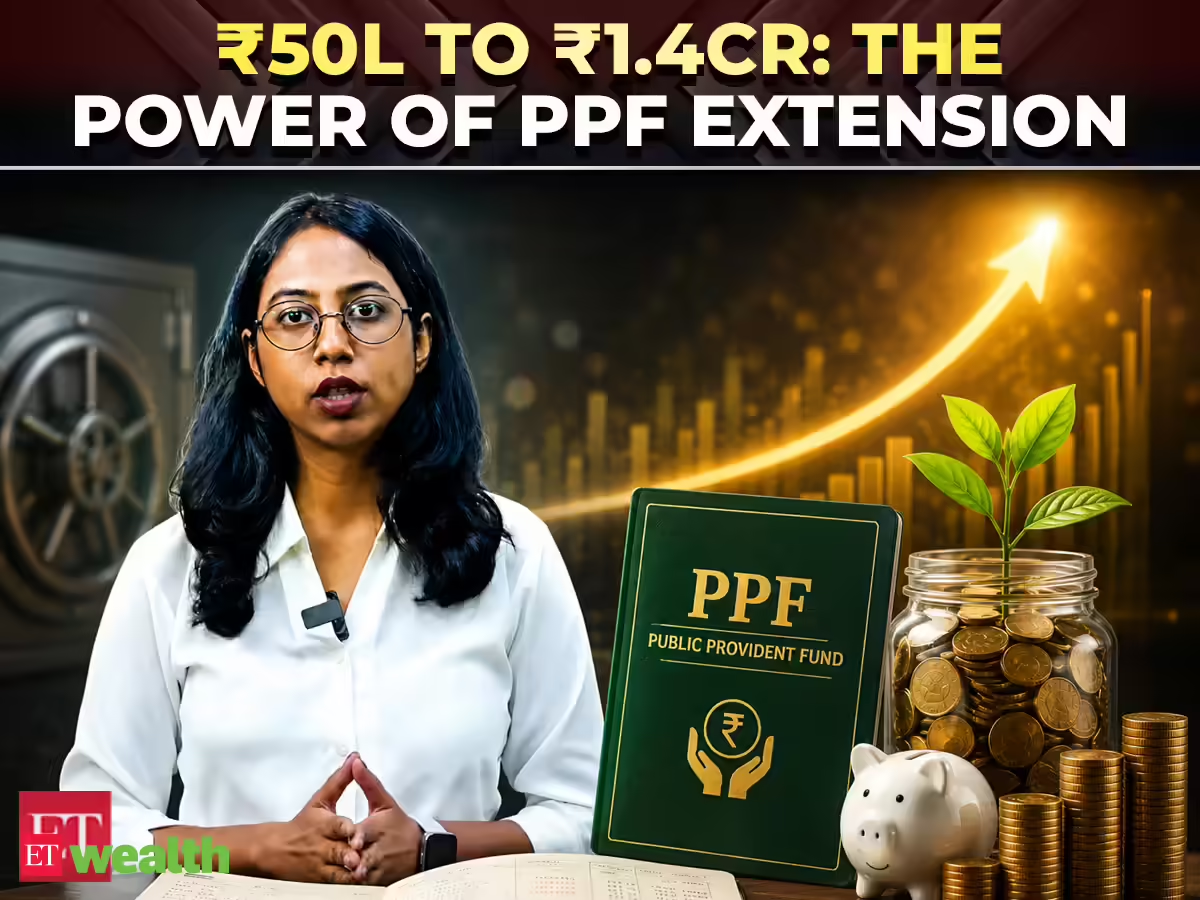
For many Indians, the Public Provident Fund (PPF) is one of the first long-term investments they make. Its appeal is easy to understand. The scheme offers government backing, tax-free returns, and the power of long-term compounding. But while much attention is given to building a PPF corpus over 15 years, far fewer investors think about what happens when the account actually matures. Should you withdraw the money and move it elsewhere? Or should you extend the account and let the corpus continue compounding? The answer can have a significant impact on retirement planning.PPF maturity: Should you withdraw or extend the account? A PPF account matures after 15 years, but it is not mandatory for investors to withdraw the money at that stage. The account can be extended indefinitely in blocks of five years, either with fresh contributions or without making additional deposits. But is there an optimal age or life stage at which investors should stop extending their PPF account and withdraw the corpus instead? "There isn't a specific age at which everyone should stop extending their PPF account," says Atish Jain, CEO, Choice Connect. The more relevant question is whether the PPF continues to serve a purpose that other investments cannot easily replace, he says. For many investors in their 40s and 50s, the answer is often yes. The combination of sovereign backing and tax-free compounding remains difficult to replicate through other fixed-income products.How much more wealth can PPF extensions create? The biggest advantage of extending a PPF account is continued tax-free compounding. Consider an investor whose PPF corpus has grown to ₹50 lakh at maturity. If the corpus remains invested and earns 7.1% annually without any additional contributions, it could potentially grow to approximately: PPF Corpus at Maturity After 5 Years After 10 Years After 15 Years ₹50 lakh ₹70.5 lakh ₹99.2 lakh ₹1.39 crore Source: Atish Jain, Choice Connect The difference becomes even more striking when compared with taxable alternatives. “Now compare that to someone who withdraws at maturity and puts the same ₹50 lakh into a bank FD at 7%. In the 30% bracket, they're actually earning 4.9% post-tax. By Year 20, they have roughly ₹63.8 lakh. The PPF extension beats that by ₹6.7 lakh in the first block alone — and the gap widens every five years because the base keeps growing tax-free,” says Jain.Does it still make sense to extend PPF after age 60? Retirement is often the point at which investors begin questioning whether further extensions make sense. “Extending the Public Provident Fund beyond the age of 60 only makes sense if you have enough money coming in from sources. These sources can include pensions, rental income or the money you have saved for emergencies, from the Public Provident Fund,” says Raghvendra Nath, MD, Ladderup Asset Managers. Once retirement approaches, the objective gradually shifts from accumulating wealth inside the PPF or begin using the corpus to generate retirement income. Extending a PPF account after age 60 should be based on individual circumstances rather than habit, says Jain. For those who need liquidity or regular income, drawing down the corpus may become more appropriate. Important PPF extension rules investors should know While extending a PPF account is relatively straightforward, there are a few operational rules that investors often overlook. One of the most important is the requirement to submit Form H if you wish to continue making fresh contributions after maturity. According to experts, this application must generally be submitted within one year of maturity. Missing the deadline does not close the account, but it can affect the ability to contribute to the extended account in the manner intended. Investors should also remember that:Extensions occur in blocks of five years.Only one withdrawal is permitted per financial year during the extension period.Administrative processes can vary across banks and post offices.Updated KYC, nominee records, and extension documentation should be maintained carefully. Why PPF remains attractive for high-income taxpayers In an environment where many fixed-income products are fully taxable, PPF continues to enjoy a unique advantage. “For investors who are in 30% tax bracket, Public Provident Fund is one of the most attractive fixed income option available,” says Nath. The scheme follows the EEE (Exempt-Exempt-Exempt) structure, meaning: Contributions qualify for tax benefits under Section 80C (under the old tax regime) Interest earned remains tax-free Maturity proceeds are also tax-free This tax treatment can make a substantial difference to actual returns. By comparison, many fixed deposits, bonds, and other fixed-income investments deliver considerably lower post-tax returns. “For an individual in the highest tax bracket, a taxable fixed deposit yielding 7.5% may effectively deliver a post-tax return closer to 5.2% to 5.4%, depending on the applicable surcharge and cess,” says Umesh Sharma, CIO – Debt, The Wealth Company Mutual Fund. That tax efficiency continues even after maturity if the account is extended. Liquidity is another factor that often gets overlooked. While the initial 15-year lock-in period may seem long, investors who have already reached maturity are looking at extensions in five-year blocks, which can feel far less restrictive. Moreover, extending a PPF account does not mean locking away the entire corpus indefinitely. During the extension period, investors can make partial withdrawals, allowing them to access a substantial portion of their savings if needed while the remaining balance continues to earn tax-free returns. Recent PPF changes and operational issues to watch While the core framework governing PPF remains unchanged, a few recent developments deserve attention. Jain points out that PPF accounts held by NRIs and extended beyond the initial 15-year period stopped earning interest after September 30, 2024. Meanwhile, Aadhaar-based e-KYC has been extended to post-office PPF accounts, making account management easier for many investors. Experts also caution that account transfers between institutions remain largely offline, which can create administrative delays. These operational issues may seem minor, but they can become important when approaching maturity or planning an extension. While accumulating wealth is important, knowing when and how to use it can be just as critical to a successful retirement.
₹50 lakh to ₹1.4 crore: How extending your PPF can add lakhs to your corpus and who should do it - The Economic Times
PPF maturity presents a choice: withdraw or extend for continued tax-free compounding. While government backing and tax benefits remain attractive, especially for high-income earners, individual circumstances dictate the optimal decision. Understanding extension rules and recent changes is crucial for effective retirement planning.
1,000 words~5 min read