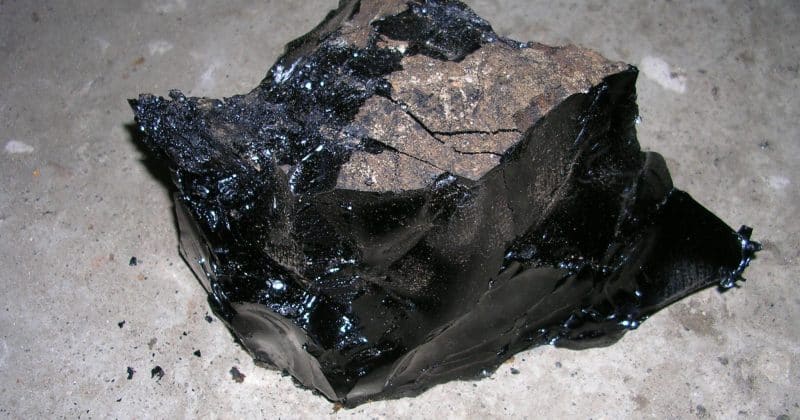
Most real-world asset projects in crypto tokenize what is already liquid: treasuries, money-market funds, gold. AetherStrike picked the opposite end of the spectrum — an illiquid physical commodity in structural undersupply – one that every state DOT in America must buy, can’t substitute for, and is finding harder to source each quarter. AetherStrike’s first Strike brings an NSAI-certified bitumen deposit in Utah’s Uinta Basin to accredited investors as a Dynamic Resource Reserve Unit (DRRU): one token, one barrel, on-chain.
The pitch isn’t a narrative. It’s an arbitrage between a real-world supply shock and a tokenization framework that finally meets institutional standards.
Asphalt binder is the heaviest 2% of a refinery’s slate. No one runs a refinery for it. Capacity decisions get made on light-end crack spreads — gasoline, diesel, jet — and when those margins compress, the refinery doesn’t reconfigure for binder. It closes. Asphalt supply leaves with it as collateral damage.
That collateral damage is now structural. Phillips 66 shut its 139,000-bpd Los Angeles plant in Q4 2025. Valero followed in April 2026, idling Benicia and taking roughly 45% of Northern California’s paving-grade binder offline in a single decision. California has gone from 23 active refineries in 2000 to 11. The same arithmetic is playing out across the West Coast, Midwest, and East Coast — analysts project on the order of 1.9 million bpd of U.S. refining capacity reductions through 2045.