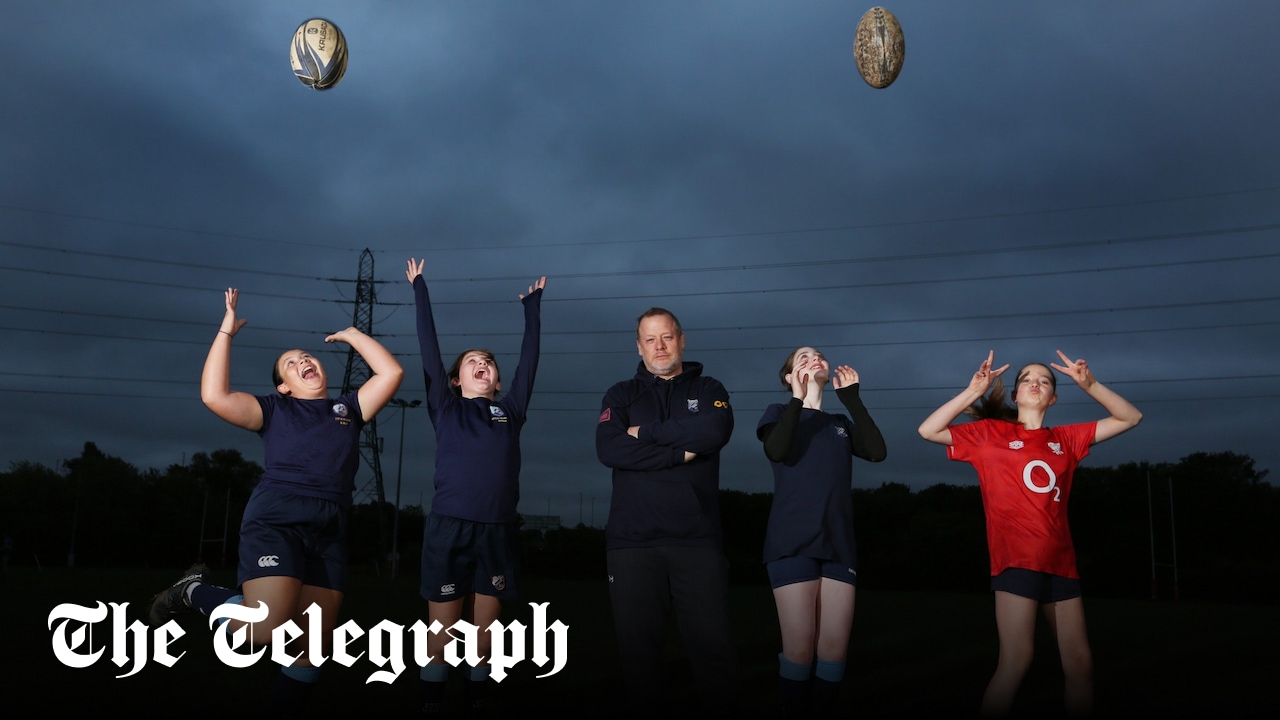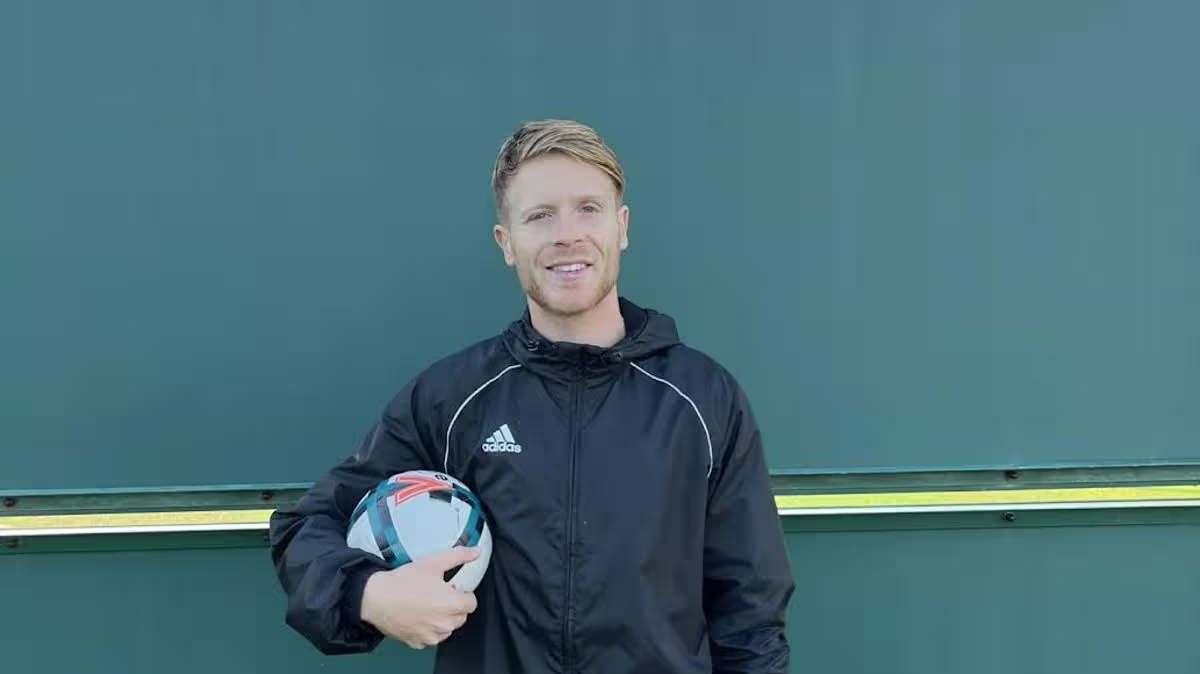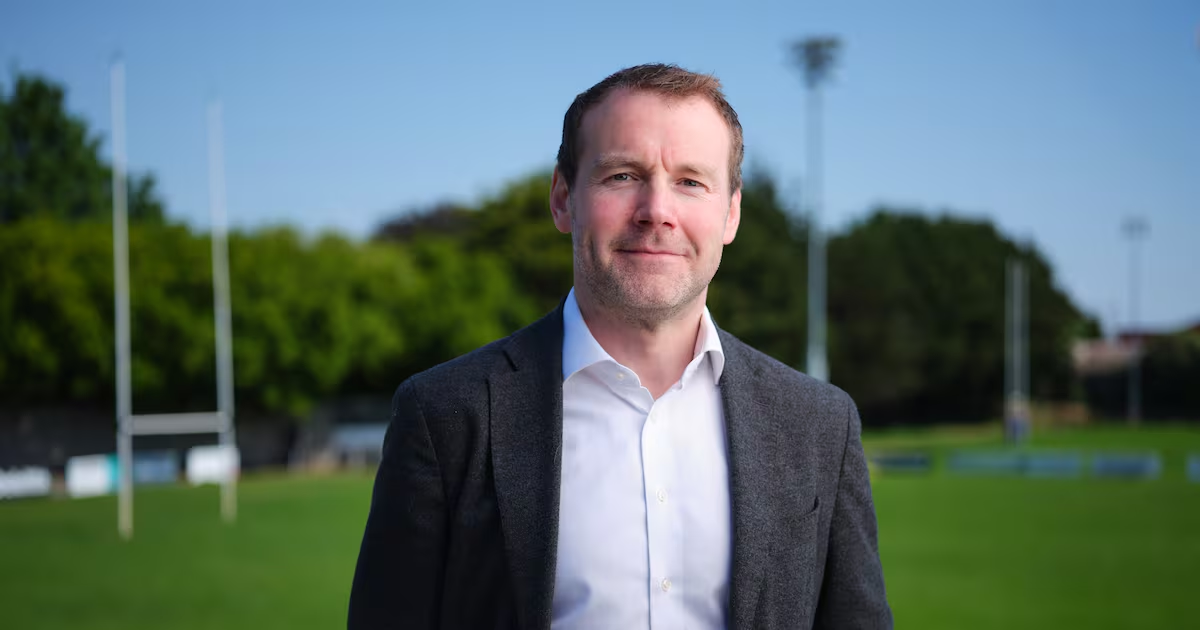
On most Sunday mornings you’ll find Gary Notley standing on the sidelines of a sports pitch, whistle in hand. He started out helping the odd time and now coaches the Lansdowne rugby under-10s, among them his son, Jack. Somewhere along the way, coaching has become something a bit more personal. “I love the sense of community it brings. My dad was involved in my sports as a kid so the instinct to become part of the ‘team behind the team’ feels quite natural for me,” the father of three says. “I enjoy teaching the kids to see how success is more enjoyable if others around you are part of it too.”It explains a lot about how Notley sees the world. Today, as a partner in Deloitte Ireland’s human capital business, he spends much of his time advising organisations through periods of disruption and reinvention. Yet unlike many operating in the future-of-work space, he doesn’t speak of systems, but about behavioural psychology when it comes to change. And perhaps that perspective was shaped earlier than he realised.Born and raised in Dublin, Notley’s mother was a teacher at Rathfarnham Parish National School. “All the teachers knew me, knew my mum,” he says, smiling. “There was always an extra kind of eye on me, but I was a studious kid. I loved the more practical work like projects and enjoyed solving problems. Looking back now, I can see how that evolved into what I do: understanding where problems exist and finding solutions to improve them.”Straight out of college, Notley joined Deloitte’s strategy and operations consulting practice, which was heavily growth focused. But then the financial crisis hit. “The market changed overnight,” he remembers. “Organisations also had to change, but it was also a time where many showed incredible ‘bouncebackability’. That was probably my first real exposure to working closely with HR teams and understanding the role the people function could play during periods of significant business change.’ A formative chapter came during his time at Etihad Airways in Abu Dhabi where he moved to gain international and industry experience outside consulting. “When I joined, it was still a relatively small airline, but through major growth, M&A, technology transformation and organisational redesign, it evolved into a large-scale aviation group by the time I left to return to Deloitte. It was an incredible lesson in how quickly growth changes not just operations but culture and leadership and the way people experience work.”Reflecting on the other cycles he has worked through, Notley notes that outside forces tend to reshape how organisations think about their people. “Brexit, post-Covid labour market and now technology, the trigger is always different, but underneath it the core questions that organisations wrestle with are remarkably similar. How you do you bring people with you through change successfully? How do you unlock people’s potential in a way that helps organisations continue to grow, adapt and navigate uncertainty? These are the moments that really test the mettle of businesses. I’m seeing that again now and there’s cause of optimism. Those that tend to navigate uncertainty best are usually those that move at pace, are agile and future-focused, not afraid to make mistakes and who stay optimistic.”Gary Notley: 'People are the lifeblood of organisations and unless you have a team that’s fully motivated and productive, businesses won’t succeed.' Over time, Notley’s work has increasingly moved into organisational transformation, HR and workforce strategy and large-scale change programmes. “People strategy can’t be separate from business strategy or technology strategy,” he points out. “The people are the business strategy. People are the lifeblood of organisations and unless you have a team that’s fully motivated and productive, businesses won’t succeed.”And change is everywhere.This year’s Deloitte human capital trends research shows that a third of workers experienced up to 15 major workplace changes in the past year alone. At the same time, seven in 10 business leaders say their primary competitive strategy over the next three years is to be fast and nimble. Artificial intelligence dominates headlines but beneath the technology conversation, Notley says there’s a lot of uncertainty. “Twenty years ago, the future was portrayed as exciting,” he says. “Back to the Future hoverboards and all of that. Now, when people think about the future, there’s much more fear attached to it. There’s uncertainty around jobs, technology, around what skills will matter.” He is keen to point out that technology itself will not solve organisational problems.“The pace of technology is going to continue,” he says. “The speed companies need to react at is going to continue too. But the mistake I see many organisations making is that they’re still approaching transformation with old instincts. They are still talking about five-year strategies and defined transformation programmes with a clear start and end point. That’s not the environment any more. Now businesses are operating inside continuous adaptation, influenced by factors ranging from economic volatility and geopolitical instability to workforce fatigue and cost pressures.“[Chief human resources officers] have to lead their organisations to be resilient and set up for long-term success,” says Notley. ”They need to create environments where people can move at pace, adapt, where they feel psychologically safe enough to test, fail, learn and evolve.“This isn’t about deploying tools, it’s about redesigning work and identifying how skills can evolve. The technology will find its own way. The question is whether your people will.”This is increasingly where Deloitte’s work sits: helping organisations design themselves for continuous adaptation, helping leaders build capability and confidence through uncertainty, and helping businesses unlock the talent and potential already sitting inside their organisations rather than endlessly searching externally. ‘The future will favour the teams that can read the environment quickly’— Gary Notley, partner in Deloitte Ireland’s human capital business“What is the differentiator when everyone has access to the same technology?” Notley asks. “It’s human. And look, the technology is undeniably fascinating, but ultimately what matters more is how people and clients work with it and build trust around it. What interests me most is the potential outcomes when human talent is multiplied by AI.”He references work currently under way with supporting global HR and business leaders to shape their people agenda and guiding fast-growing indigenous Irish companies who want to mature internal capability quickly enough to keep pace with expansion. “Technology is moving incredibly fast, but most of the discussions I’m having with leaders are about helping people adapt, because transformation only sticks if people buy into it. The next era of work is much more human than we think. The most valuable skills are becoming the ones that can’t be automated: those enduring human capabilities like curiosity, judgment, communication and emotional intelligence.”Notley says he is an unshakeable optimist about what is coming down the tracks. “The world my children enter will probably value many of the things that make us most human. Those things aren’t disappearing. And if repetitive or administrative work can be reduced, then what does that free people up to do? That’s the most exciting part for me. There’ll be better problem-solving perhaps or more creativity and strategic thinking. The opportunity is there if organisations choose to reinvest those productivity gains in the right way.”Notley, clearly someone most comfortable in motion himself, says the worst thing businesses can do is become static right now. “At some point you have to take a risk, upskill and pivot into the unknowables.”That attitude extends to his coaching of the under-10s. “The future will favour the teams that can read the environment quickly. You have to maintain trust under pressure and be ready for when the direction of play suddenly shifts.”To learn more about the future of the workforce, visit Deloitte.ie
‘The next era of work is much more human than we think’
As technology transforms the workplace at speed, Deloitte’s Gary Notley believes the biggest opportunity lies in doubling down on human capability
1,275 words~6 min read