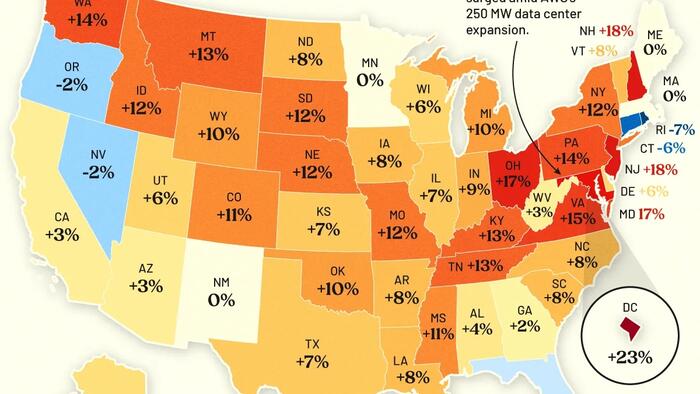
Back in the last century, when neo-liberalism, deregulation, and privatization were all the rage, we, in the USA, decided to restructure and deregulate the electricity industry, on the theory that such action would bring about the same benefits to electricity consumers as it did for consumers of transportation, natural gas, and telecommunications. The idea took hold mainly in states where consumers paid high prices for electricity. The other states decided to leave well enough alone.The introduction of competition and industry restructuring to the electricity business, it was believed, would lead to lower generating costs, greater incentives to build needed transmission, freedom of choice for consumers and innovation. Those improvements, then, would drive down prices in deregulated states, bringing them more in line with prices in states that eschewed the benefits of the new wave of economic thought.As the figure below shows, they did not. In fact, in recent years, the gap between deregulated and regulated prices seems to have widened. That brings us to the big problem, as we see it. In deregulated states, the market price for all electricity is determined by the offering price of the last generator needed to fulfill hourly demand for power, usually a gas generator. In simple terms, this means the price of natural gas (the determinant of cost to that last generator) sets the price of electricity and all generators selling power that hour receive that (elevated) price. It doesn’t matter if 90% or 10% of electricity is generated by natural gas. All generators get the same price. mainly set by the price of natural gas. Some experts, in fact, argue that changes in the gap between regulated and unregulated prices is largely determined by the price of natural gas. We see a tendency for the deregulated electricity prices to rise vs unregulated electricity prices when natural gas price peaks, and a tendency for the gap to decrease as gas prices decrease, but perhaps more slowly. At present, after almost three decades of deregulation, the gap between regulated and deregulated electricity prices is bigger than it has ever been. Deregulation was not supposed to raise prices more in places where prices were already high. But don’t get hung up on precise relationships. That’s not what we want to discuss.Prices of electricity in regulated and unregulated states, and the price of natural gas as a generation fuel (1997-2025)Note:Weighted average price of electricity in regulated, deregulated and all states (¢ per kwh), and price of natural gas used as fuel in electric generation ($ per mm btu) for 1997-2025Sources: EIA, APPA and authors’ estimates.The Trump administration wants to increase natural gas exports, reduce energy prices, encourage more usage of fossil fuels, and hobble renewable resources like wind. In other words, increase the demand for natural gas, which could raise domestic gas prices, and make natural gas prices more volatile by tying them to international commodity fluctuations. (We haven’t figured out how those policies will reduce gas prices, but maybe we are missing something.) If gas prices go up, so will electricity prices, especially so in deregulated markets, because of the way the market has been constructed. Some governors and local politicians in deregulated states have begun to complain about electric bills, big utility management salaries, and the supposed costs imposed by green policies. They need to get real. If they want to protect their consumers from increasing and increasingly volatile prices, they need to encourage renewable generation, not discourage it, and address the systemic faults that afflict the marketplace. Especially the reliance on natural gas. As for customers in those states, especially if AI centers are in the cards nearby, you might hedge the chances that the politicians will act in your best interest by installing solar panels and a battery.Electricity prices have entered the political discussion in the US. As we’ve shown, power prices in deregulated states have already moved up sharply. If deregulated states continue to build more gas-fired generation, prices are likely to move even higher and with greater volatility. The only question is whether regulated states also build lots of new gas-fired power plants. If so, their power prices are likely to follow a similar upward trajectory. (China, by contrast, is dramatically reducing gas-fired power plant construction while the US ramps up.) We think this building surge of gas plants is a mistake, and it will ultimately threaten our utility monopolies and their respective franchises. By ignoring renewables, which offer the same commodity at lower prices, all we can say is that much of our industry is committing acts of financial self-harm.Given that today’s utilities are now much smaller than their technology-oriented customers, we wonder if we are on the cusp of a major industry restructuring. A power-hungry technology company wants megawatts and has no use for an integrated utility’s customers and extensive distribution system. Our point here is that this may soon change. Why? Because tech companies will realize that everyone's energy usage is potentially another information business. Demand for power, which we once thought of as inflexible, can be shaped by algorithmic suggestion. Where better to start than in places with high and volatile prices? We can’t wait to see the new meters!By Leonard Hyman and William Tilles for Oilprice.comMore Top Reads From Oilprice.comIndia Secures Crude Supply Through August with Higher UAE ImportsAnother Gulf Producer Joins Dark-Mode Tanker Traffic Through HormuzSanctioned Private Chinese Refiner Seeks Non-Iranian Crude
Why Power Prices Are Rising Faster in Deregulated States | OilPrice.com
Nearly three decades after electricity deregulation, power prices in deregulated U.S. states have generally risen faster than in regulated states, with the gap now at its widest level.
898 words~4 min read