AFP, GENEVA, Switzerland
The number of forcibly displaced people dropped for the first time in a decade last year, as more opted to return home, the UN said yesterday.At the end of last year, 117.8 million people worldwide were forcibly displaced from their homes, a decline of 5.4 million compared with a year earlier, the UN High Commissioner for Refugees (UNHCR) said.The agency said the number of people who had been forced to flee due to war, violence and persecution remained “unacceptably high,” urging action to dramatically reduce long-term displacement over the next decade.
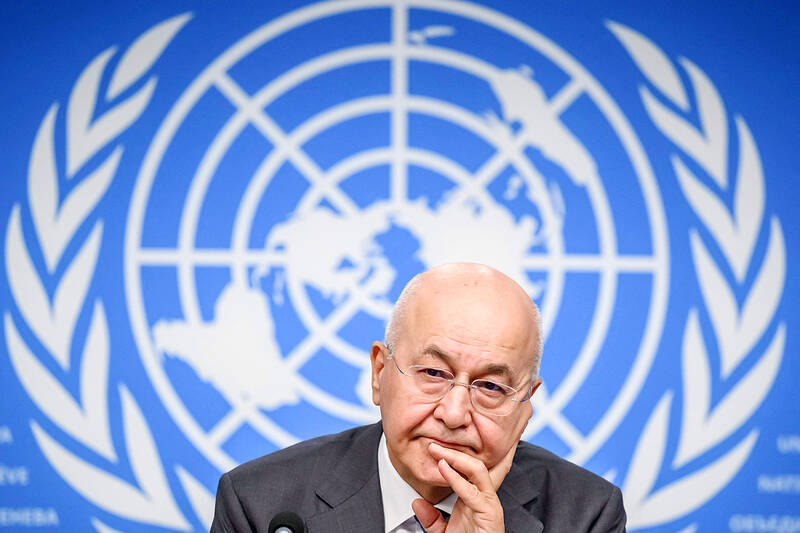
UN High Commissioner for Refugees Barham Salih speaks at a news conference in Geneva, Switzerland, on Tuesday.
The declining displacement number was linked to “a sharp increase” in the number of refugees and internally displaced people (IDPs) returning home, UNHCR said in its annual report.In all, 14.7 million displaced people returned to their places of origin last year, the report said.
They included 4.4 million refugees who crossed back into their home countries, marking the second-highest number of refugee returns since records began 60 years ago, it said.UN High Commissioner for Refugees Barham Salih told reporters in Geneva that “more than 90 percent” of refugee returns last year were concentrated in Afghanistan, Sudan and Syria.However, “many of these returns occurred not under conditions of safety and stability, but under pressure,” Salih said.They had gone back to “countries where insecurity persists, where infrastructure has been damaged, and where basic services and economic opportunities remain scarce,” he said.“Returns that are not safe ... are not a solution,” he said. “They risk becoming the beginning of a new displacement cycle.”Among those displaced at the end of last year, 41.6 million were considered refugees, including nearly 5.4 million people who fled across borders to become refugees in the course of the year, the report showed.Sixty percent of those new refugees fled from just eight countries, including nearly 1 million from war-ravaged Sudan alone, while almost 800,000 fled from Ukraine.The report also pointed to several crises driving mass displacement since the start of this year.They included the Middle East war launched by the US and Israel in February, which it said had forced 3.2 million people from their homes in Iran alone.In Lebanon, Israeli attacks since March have displaced more than 1 million people, the report said.The agency voiced concern over a narrowing space for refugee resettlement last year, estimating that the number of refugees needing to resettle in third countries stood at 2.9 million.The number of resettlement spots had reached 188,800 in 2024 — its highest level in four decades, but last year, the number was more than halved to just 81,800, the report said, pointing in particular to a sharp decline in the numbers accepted by the US.“The gap between places and needs is enormous and has been widening,” the agency said.