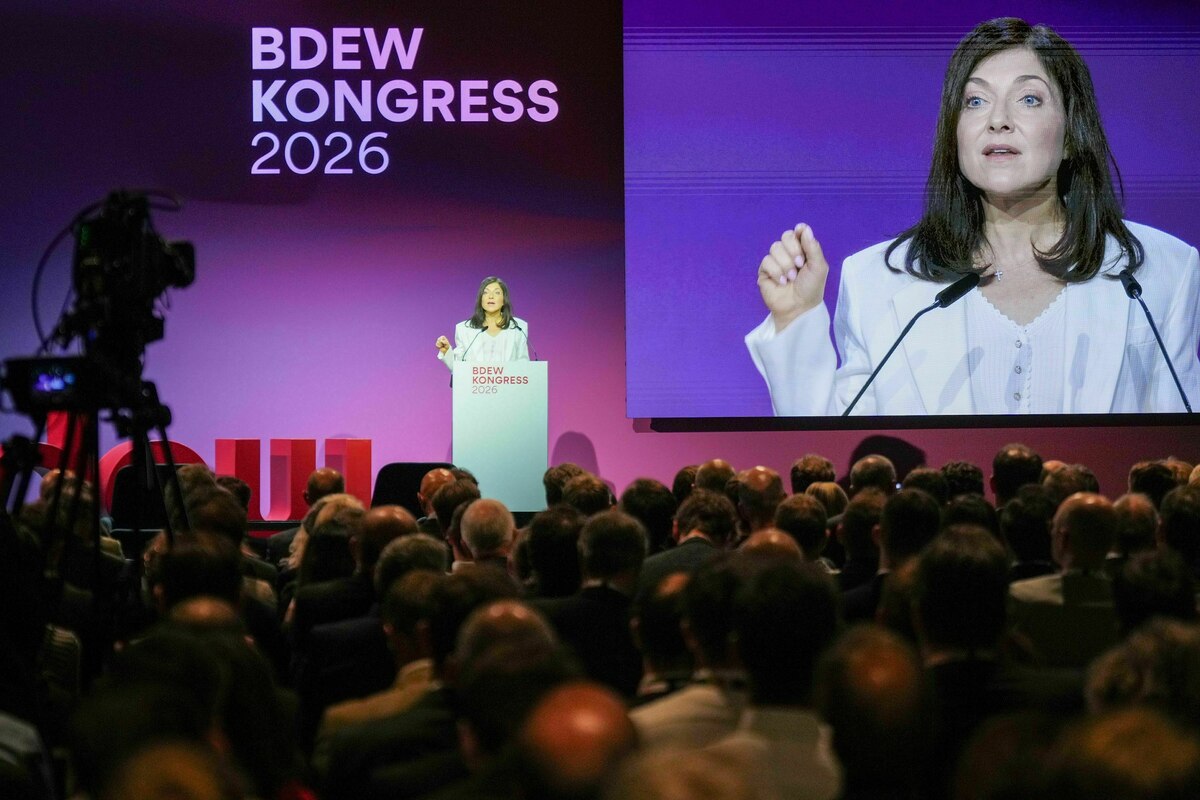
Germany’s energy minister Katherina Reiche has sought to reassure the country’s energy industry that the government is holding course on the energy transition, despite the changes to grid access rules and support payments for renewable power installations currently under consideration in her ministry. Speaking at the annual conference of the Federation of Energy and Water Industries (BDEW), Reiche defended her first year in office, during which she faced criticism over the slow pace of urgent reforms and uncertainty about the future speed of renewable energy expansion. “We stick to the expansion paths” for wind and solar energy and to the target of having 80 percent renewable energy in electricity consumption by 2030, Reiche told the Berlin audience. The government would honour its legally binding climate commitments, the minister said, adding that Germany’s energy transition “already has developed impressively and will continue to do so.” However, Reiche said whether climate action and economic competitiveness can be reconciled “has yet to be answered – and we have to answer it.” High energy prices would be one reason companies are reconsidering investments in Germany, the minster said, adding that changes to energy transition regulation are needed to curb costs. Continuing to build renewables in regions where curtailing is likely due to insufficient grid capacity while still guaranteeing operators full remuneration could not continue in its current form, she argued, and signalled her willingness to adapt her current proposal, which would scrap compensation payments to operators of new facilities in these areas. Germany had entered “the second round” of its energy transition, in which available space and grid capacity for new installations are becoming scarcer. Regulators need to send the signal that renewables “cannot be built without risk.” The forthcoming grid package and the reform of Germany’s Renewable Energy Act (EEG) are meant to address grid access and guaranteed support for new renewable power installations. Industry group BDEW in a statement criticised that key energy legislation remains outstanding after one year under chancellor Friedrich Merz, including auctions for new gas-fired power plants needed as backup for renewables and the Building Modernisation Act, which will regulate the decarbonisation of Germany’s heating sector. “Given the urgency of all these projects, we call for a unified and jointly negotiated energy package in 2026,” said BDEW head Kerstin Andreae. This should ensure that the laws are adopted as quickly as possible. “Investments are only made in places where you have reliable rules,” Andreae added.
Germany remains committed to energy transition, minister tells industry
Germany’s energy minister Katherina Reiche has sought to reassure the country’s energy industry that the government is holding course on the energy transition, despite the changes to grid access rules and support payments for renewable power installations currently under consideration in her ministry. Speaking at the annual conference of the Federation of Energy and Water Industries (BDEW), Reiche defended her first year in office, during which she faced criticism over the slow pace of urgent reforms and uncertainty about the future speed of renewable energy expansion. “We stick to the expansion paths” for wind and solar energy and to the target of having 80 percent renewable energy in electricity consumption by 2030, Reiche told the Berlin audience. The government would honour its legally binding climate commitments, the minister said, adding that Germany’s energy transition “already has developed impressively and will continue to do so.” However, Reiche said whether climate action and economic competitiveness can be reconciled “has yet to be answered – and we have to answer it.” High energy prices would be one reason companies are reconsidering investments in Germany, the minster said, adding that changes to energy transition regulation are needed to curb costs. Continuing to build renewables in regions where curtailing is likely due to insufficient grid capacity while still guaranteeing operators full remuneration could not continue in its current form, she argued, and signalled her willingness to adapt her current proposal, which would scrap compensation payments to operators of new facilities in these areas. Germany had entered “the second round” of its energy transition, in which available space and grid capacity for new installations are becoming scarcer. Regulators need to send the signal that renewables “cannot be built without risk.” The forthcoming grid package and the reform of Germany’s Renewable Energy Act (EEG) are meant to address grid access and guaranteed support for new renewable power installations. Industry group BDEW in a statement criticised that key energy legislation remains outstanding after one year under chancellor Friedrich Merz, including auctions for new gas-fired power plants needed as backup for renewables and the Building Modernisation Act, which will regulate the decarbonisation of Germany’s heating sector. “Given the urgency of all these projects, we call for a unified and jointly negotiated energy package in 2026,” said BDEW head Kerstin Andreae. This should ensure that the laws are adopted as quickly as possible. “Investments are only made in places where you have reliable rules,” Andreae added.
Germany maintains 80% renewable target by 2030 with subsidies reform, but high energy costs and regulatory uncertainty are deterring company investments. Tech managers in Germany must adjust cloud/edge budgeting as transition timelines stretch due to legislative delays and competitive energy pricing.