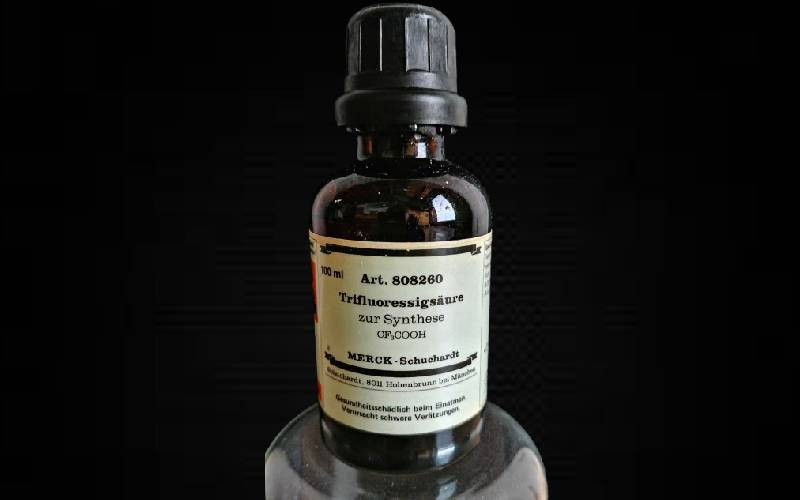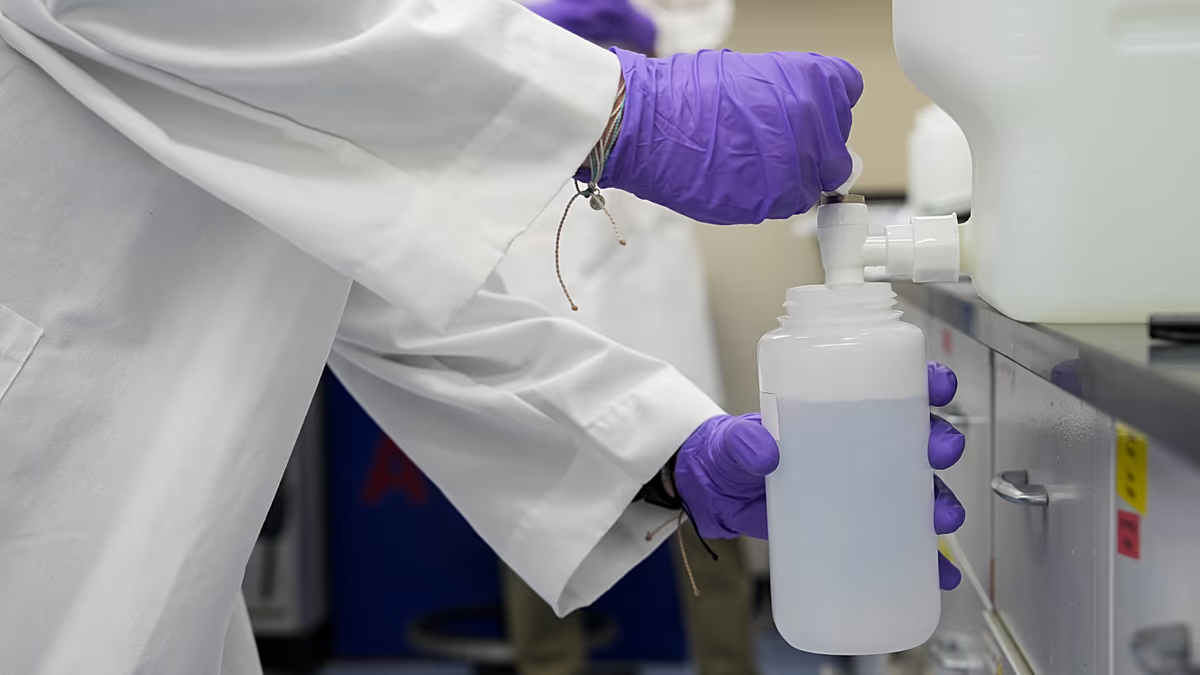
The chemicals created to save the planet may have quietly created a new problem. Decades ago, the world phased out chlorofluorocarbons (CFCs), the refrigerants and aerosols that were tearing a hole in the ozone layer. The replacements were cheered as a triumph of science and environmental policy. But researchers are now learning that those very substitutes have been quietly creating a “forever chemical” that’s raining down across the entire planet from city rooftops to the Arctic ice sheet.According to a new study published in Geophysical Research Letters by researchers at Lancaster University, between 2000 and 2022, CFC replacement chemicals and some inhalation anesthetics deposited the equivalent of about 335,500 tons of trifluoroacetic acid, or TFA, onto the Earth’s surface. That’s a third of a million tons of a hard-to-remove, stubborn chemical, and the problem is still growing.What even is TFA?TFA is part of the PFAS family, or per- and polyfluoroalkyl substances, a group of synthetic chemicals known as "forever chemicals." The name is no dramatic license. A study published in Environmental Science & Technology shows that TFA is a persistent and mobile substance that is increasing in concentration in rain, soils, human serum, plants, plant-based foods and drinking water. Most chemicals break down. This doesn't. Once it enters the environment, it builds up, and there is no practical way today to get rid of it at scale.The Lancaster team used sophisticated atmospheric modeling to follow the breakdown of HCFCs, HFCs and anesthetic gases in the atmosphere and how they eventually form TFA, which is then deposited back onto the Earth through rain or direct atmospheric settling. They tested their models against real-world data, including rainwater samples and Arctic ice cores.It's already in your rainwater and your bloodThe most troubling part of TFA is the extent to which it has already spread. A peer-reviewed study published in Environmental Science & Technology Letters monitored TFA deposition throughout Toronto over multiple years and found that every sample collected (both wet and dry deposition) contained TFA. Notably, the TFA levels showed a significant decrease in 2020 during COVID-19 lockdowns, indicating that industrial and transportation activities are major drivers of continued emissions.Every rainstorm now carries trace amounts of TFA, a forever chemical that standard water treatment cannot remove. Image Credits: ChatGPTIt doesn't stop at rainwater. Researchers at the Rollins School of Public Health at Emory University found TFA to be the most prevalent perfluoroalkyl acid in human blood serum samples, with a detection frequency of 74% and a median concentration of 6.0 nanograms per milliliter. TFA has been found in human urine as well. More recently, the German Federal Office for Chemicals has recommended classifying TFA as potentially toxic to human reproduction, a classification that, if adopted, would significantly increase global regulatory scrutiny. Scientists say that the current environmental levels are still below the levels considered to be harmful, but the concern is that those levels are rising and there is no way to reverse that accumulation.The Arctic is feeling the brunt of itOne of the more striking findings from the Lancaster study relates to the Arctic, an area far from factories, highways and air-conditioning units. Researchers found that nearly all the TFA there could be linked to CFC replacement chemicals. These gases have very long atmospheric lifetimes and can travel huge distances before they eventually break down and deposit TFA in some of the most remote areas of the world.It’s a perfect illustration of how pollution works on a planetary scale. The emissions happen in Atlanta, Frankfurt or Seoul and the chemical is finally frozen in Greenland ice cores.The problem isn't going away; it's just getting startedThe Lancaster study estimates that the peak annual production of TFA from these sources may occur between the years 2025 and 2100. Even with the phase-down of HFCs under the Kigali Amendment to the Montreal Protocol, TFA will continue to be emitted for decades due to their long atmospheric lifetime.And a newer class of refrigerants, HFOs, marketed as climate-friendly alternatives, is bringing new uncertainty. HFO-1234yf, now in about 95% of new cars sold in the United States, is a known TFA-forming compound. The refrigerant breaks down rapidly in the atmosphere, which was the purported environmental benefit, but one of the breakdown products is TFA. The study, published in Environmental Science & Technology, found TFA levels in the environment are currently orders of magnitude higher than other PFAS compounds, and because it is extremely persistent, those concentrations are increasing irreversibly.The Arctic has no factories, no highways, no refrigerants, yet TFA is accumulating in its ice, carried there entirely by atmospheric transport. Image Credits: ChatGPTWhy this matters for Americans right nowThe story comes at a particularly fraught moment for chemical regulation in the U.S. According to research cited by The Conversation, the US Geological Survey estimates PFAS are now present in at least 45% of the tap water in the US, and 98% of the American public has been found to have PFAS in their blood. With high confidence, a panel of health experts said exposure to PFAS is linked to thyroid disease, high cholesterol, liver damage, and kidney and testicular cancer.TFA is the exception to the rule in this regulatory debate. It’s a PFAS, but a shorter chain than the compounds that have gotten the most scrutiny. What chronic exposure at increasing environmental levels actually means for human health is still catching up with regulators.A fix that created a new problemThe chemicals that caused the TFA problem were themselves solutions, and that really makes this story hard. The Montreal Protocol is usually considered one of the most successful environmental treaties ever adopted, and it did succeed. The ozone layer is healing. But the replacements introduced to take the place of CFCs carried a hidden price tag that we didn’t fully understand at the time.“Our study shows that CFC replacements are likely to be the dominant atmospheric source of TFA,” said Lucy Hart, PhD researcher at Lancaster University and lead author of the study. “This really highlights the broader risks that need to be considered by regulation when substituting harmful chemicals.”The science is clear: replacement chemicals need to be assessed for what they turn into, not just what they are. That ozone layer lesson cost a fortune. The TFA lesson doesn’t have to be.
In 1987, the world swapped ozone-destroying CFCs for safer refrigerants; nearly 40 years later, scientists found the switch had been quietly raining a forever chemical across the planet
New study reveals the alarming impact of CFC replacements on the environment, producing a persistent 'forever chemical' called trifluoroacetic acid (TFA) that contaminates water and human blood.
TL;DRAI
CFC replacements since 1987 created 335,500 tons of TFA—now in 74% of human blood, irreversibly accumulating with no removal method. For tech leaders, it signals governance failure: quick-fixes without foresight create irreversible debt—mirroring legacy systems.
1,044 words~5 min read