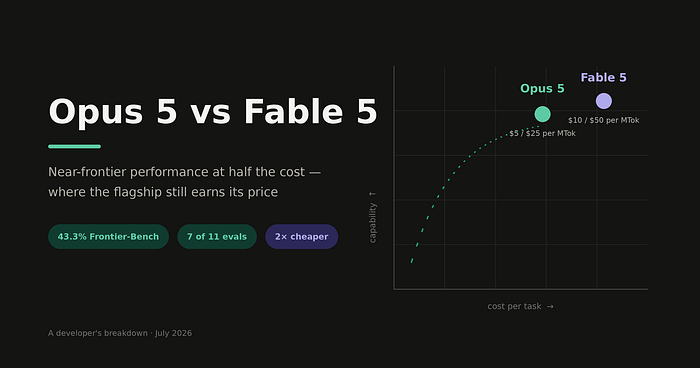
Anthropic's Fable 5 could rewrite how IT works, but the price tag and performance quirks raise hard questions. This and more in today’s ETtech Top 5.Also in the letter:■ Honasa's FY31 roadmap■ ETtech Done Deals■ Xbox braces for job cutsFable 5: Anthropic's latest AI model could transform IT, but at a cost Dario Amodei, CEO, AnthropicAnthropic's latest model, Fable 5, promises to transform IT operations with powerful agency coding and the ability to autonomously handle complex workflows, experts told ET.Driving the news: Experts say Fable 5 is strong enough to take on meaningful chunks of software engineering work and could significantly alter how enterprises build and maintain systems.Srikanth Velamakanni, CEO at AI services firm Fractal Analytics and chairperson of Nasscom, called it one of the most powerful software engineering models yet, and warned that it must be deployed responsibly.Also Read: Claude Fable 5 & Mythos 5: Key highlights from Anthropic’s latest launchThe catch: Anthropic has priced Fable 30% below OpenAI’s GPT 5.5 Pro, but early users say it is currently slower and far more token-hungry. Researchers note that Fable is clearly an enterprise-grade tool, not a model you fire up for everyday, lightweight tasks.India and IT impact: Fable 5’s capabilities could threaten parts of India’s $310 billion IT services industry by automating routine modernisation, maintenance, and other repetitive work that still employs large teams.Also Read: Anthropic’s Fable 5 draws mixed reactions from early usersAnthropic CEO again warns of jobs reckoning; company pledges $200 million to study AI impact Anthropic CEO Dario Amodei has again warned that AI adoption could hit the labour market faster and harder than many executives expect, even as companies frame it as a pure productivity tool.Verbatim: "You automate 90% of the job. Great. People are ten times more productive in the other 10% because they're ten times more leveraged," Amodei said. "But eventually it gets close to 100%. Now the sequel to that is, well, then you have to find something else for them to do.”Also Read:TCS and Anthropic launch global premier partnership to drive enterprise AI scalingOpendoor fires all Indian employees, shuts India operations Kaz Nejatian, CEO, OpendoorUS-based real estate technology company Opendoor is exiting India and laying off all India-based teams as part of a wider restructuring.What's happening? CEO Kaz Nejatian said the company is relocating India-based roles to the US to bring teams closer to customers. The company had nearly 250 employees in India when it launched its ‘Opendoor 2.0’ strategy a few months ago.Tell me more:Opendoor has already shifted some roles to the US over the past few months.It is now moving the remaining operational positions as part of the transition.A small group will stay on temporarily to support critical workstreams.Why the move: Nejatian stressed that the move reflects a change in Opendoor’s operating model, not employee performance. He said the Indian teams made valuable contributions.He added that Opendoor once leaned heavily on its India teams to run manual processes. System consolidation and AI-native customer-facing teams in the US have reduced the need for a large offshore operations.Also Read: Salesforce layoffs: Employees from Agentforce AI, Mulesoft IT teams handed pink slipsHonasa shares jump 6% on Rs 5,500 crore revenue target by FY31 Varun Alagh and Ghazal Alagh, founders, Honasa ConsumerHonasa Consumer, the parent of Mamaearth, saw its shares climb as much as 6% to an intraday high of Rs 438 after it laid out an aggressive growth plan to reach Rs 5,500 crore in revenue by FY31.The stock eventually closed Thursday at Rs 417.8 on the BSE, up 0.9%.Source: Google FinanceDriving the news:The FY31 goal implies about 18% annual revenue growth between FY26 and FY31.Mamaearth alone is expected to generate more than Rs 2,000 crore in revenue by FY31.The Derma Co is projected to contribute nearly Rs 1,500 crore.Honasa plans to build at least two additional brands, each with annual revenue of Rs 500 crore.It aims to expand its distribution network from around 1.2 lakh to 3 lakh outlets by FY31.Q4 snapshot:Net profit: Up 177% to Rs 69 crore from Rs 25 crore.Revenue from operations: Up 23% to Rs 657 crore from Rs 533 crore.Coram AI raises $35 million co-led by Ansa Capital, Battery Ventures Peter Ondruska and Ashesh Jain, founders, Coram AIPhysical security startup Coram AI has raised $35 million in a funding round co-led by Ansa Capital and Battery Ventures.Round details:Existing and new investors, including UP Partners, 8VC and Mosaic Ventures, also joined the round.The fresh funding takes Coram AI's total capital raised to $66 million.The company will use the proceeds to accelerate product development, expand customer-facing teams and scale its engineering operations in Bengaluru.About the company: Founded by Ashesh Jain and Peter Ondruska, Coram AI offers a platform that combines surveillance cameras, access systems, visitor management and emergency response tools into a single AI-powered interface.Manam Chocolate raises $9 million funding from Omnivore, Turner Morrison Chaitanya Muppala, founder, Manam ChocolatePremium chocolate maker Manam Chocolate has secured $9 million in a funding round led by Omnivore, with participation from the Turner Morrison consortium.Fund use: Manam Chocolate will use the funds to expand from three stores to 18 over the next two years, launch new products and enter additional markets.Microsoft's Xbox plans for major layoffs next month: Report Asha Sharma, CEO, Microsoft XboxMicrosoft's Xbox division is preparing a major round of layoffs in July, alongside deep cuts to marketing and other budgets, Bloomberg reported on Thursday.Details:This would be the first big restructuring under Xbox CEO Asha Sharma, who took charge in February.The exact scale of the layoff is not yet clear.It is expected shortly after the close of Microsoft's fiscal year on June 30, according to the report.Why now: Microsoft’s gaming business faces rising pressure as its big bets on subscriptions and cloud gaming have not fully offset weaker console sales and a thin pipeline of blockbuster titles.Sharma reportedly told employees that Xbox’s accountability margin had fallen to 3%, even as the company spent more than $20 billion on content, platform investments and hardware subsidies over the past five years.Also Read: AI to bring more jobs; Indian engineers must focus on collaboration: Microsoft's Rajiv Kumar
Fable 5's cost challenge; Opendoor's India exit
Anthropic's Fable 5 could rewrite how IT works, but the price tag and performance quirks raise hard questions. This and more in todays ETtech Top 5.
TL;DRAI
Fable 5 undercuts GPT 4o Pro by 30% but trades cost for latency and token efficiency, raising ROI concerns for enterprise automation. Opendoor exits India, shifting 250 employees to the US as AI-native systems reduce reliance on large offshore teams.
1,013 words~5 min read