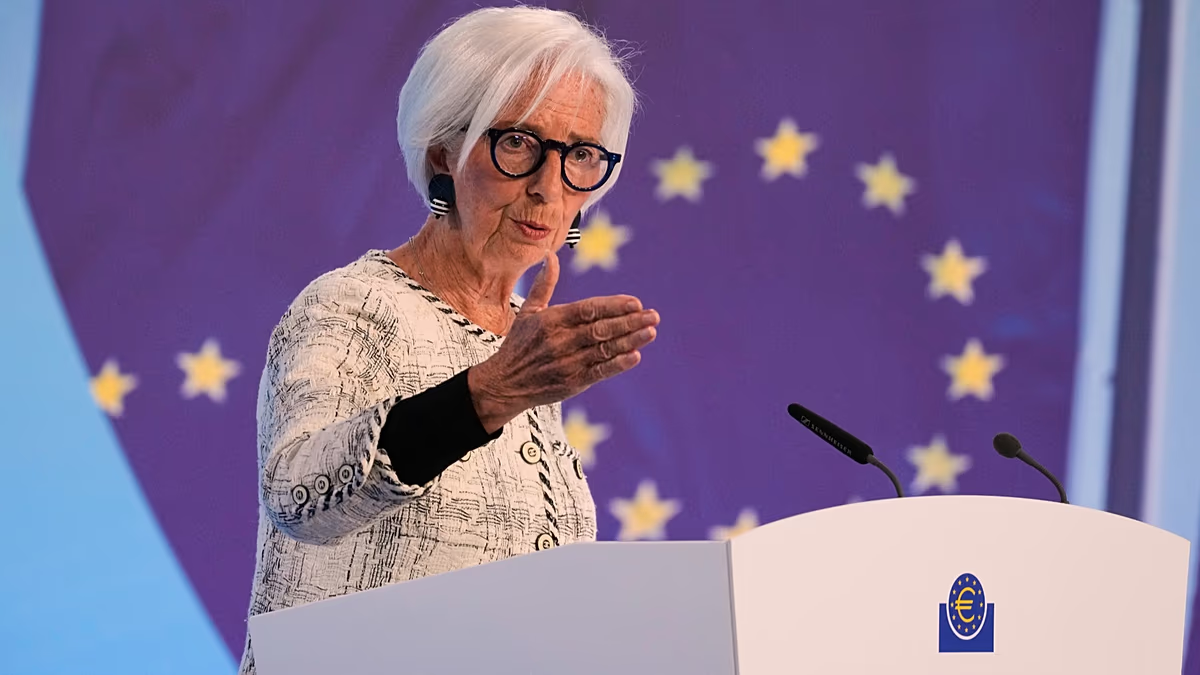
PRESS RELEASE11 June 2026 The Governing Council is committed to setting monetary policy to ensure that inflation stabilises at its 2% target in the medium term. In line with this commitment, it today decided to raise the three key ECB interest rates by 25 basis points. The war in the Middle East is generating inflation pressures, and the decision to raise rates is robust across a range of scenarios mapping out how the shock might evolve and affect the medium-term outlook for the euro area. In the baseline of the new Eurosystem staff projections, headline inflation is expected to average 3.0% in 2026, 2.3% in 2027 and 2.0% in 2028. For inflation excluding energy and food, the baseline foresees an average of 2.5% in 2026 and 2027 and 2.2% in 2028. Compared with March, staff have revised up their baseline projection for inflation in 2026 and 2027 owing to a higher path for energy prices, which, to some extent, is expected to feed into food, goods and services inflation. The baseline sees economic growth at an average of 0.8% in 2026, 1.2% in 2027 and 1.5% in 2028. This is a downward revision for 2026 and 2027, reflecting a more pronounced impact of the war on commodity markets, real incomes and confidence. The outlook remains uncertain, with upside risks for inflation and downside risks for economic growth. The full implications of the war for medium-term inflation and growth will depend on the intensity and duration of the energy price shock, as well as the scale of its indirect and second-round effects. This uncertainty is also reflected in the broad range of outcomes for inflation and growth in the updated illustrative scenarios put together by Eurosystem staff. These will be published with the staff projections on the ECB’s website.With today’s decision, the Governing Council remains well positioned to navigate the uncertainty caused by the war. It will closely monitor the situation and follow a data-dependent and meeting-by-meeting approach to determining the appropriate monetary policy stance. In particular, the Governing Council’s interest rate decisions will be based on its assessment of the inflation outlook and the risks surrounding it, in light of the incoming economic and financial data, as well as the dynamics of underlying inflation and the strength of monetary policy transmission. The Governing Council is not pre-committing to a particular rate path.Key ECB interest ratesThe Governing Council decided to raise the three key ECB interest rates by 25 basis points. Accordingly, the interest rates on the deposit facility, the main refinancing operations and the marginal lending facility will be increased to 2.25%, 2.40% and 2.65% respectively, with effect from 17 June 2026.Asset purchase programme (APP) and pandemic emergency purchase programme (PEPP)The APP and PEPP portfolios are declining at a measured and predictable pace, as the Eurosystem no longer reinvests the principal payments from maturing securities.***The Governing Council stands ready to adjust all of its instruments within its mandate to ensure that inflation stabilises at its 2% target in the medium term and to preserve the smooth functioning of monetary policy transmission. Moreover, the Transmission Protection Instrument is available to counter unwarranted, disorderly market dynamics that pose a serious threat to the transmission of monetary policy across all euro area countries, thus allowing the Governing Council to more effectively deliver on its price stability mandate.The President of the ECB will comment on the considerations underlying these decisions at a press conference starting at 14:45 CET today.
Monetary policy decisions
The European Central Bank (ECB) is the central bank of the European Union countries which have adopted the euro. Our main task is to maintain price stability in the euro area and so preserve the purchasing power of the single currency.
TL;DRAI
ECB raised rates 25 bps to 2.40% citing Middle East-driven inflation, forecasting 3.0% headline inflation through 2026. Higher borrowing costs will compress IT capex, AI infrastructure investment, and startup funding runways across euro area enterprises.
578 words~3 min read