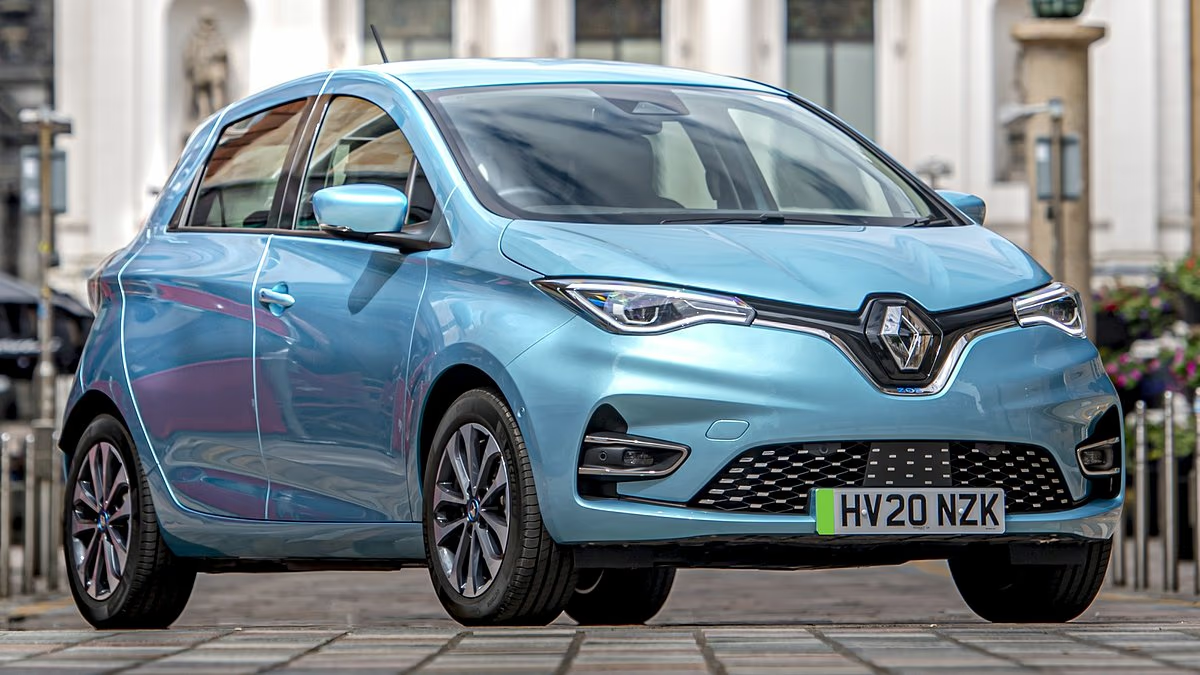
Drivers considering buying a second-hand electric vehicle to avoid surging fuel prices and to save money are being warned of a costly hidden danger.Used-car market experts say EVs are now more likely to have been 'clocked' than traditional petrol and diesel models.Vehicle history platform CarVertical claims that 3 per cent of EVs it checked between January 2024 and March 2026 showed evidence of mileage tampering. That puts EVs ahead of diesels (2.8 per cent), petrols (2.5 per cent) and hybrids (2 per cent).Prevalent in the 1980s and 1990s, clocking has made a comeback in recent years, driven largely by the popularity of new car finance and lease agreements.With drivers facing charges of between 3p and 50p per mile for exceeding mileage limits in Personal Contract Purchase (PCP) deals - used by four in five new car buyers - and leases, more motorists are turning online to source technology that manipulates vehicle odometers.And the problem could escalate from 2028, when Chancellor Rachel Reeves introduces pay‑per‑mile charges for electric cars. There has been an increase in the availability of mileage blockers in recent years driven by the popularity of car finance and customers attempting to avoid mileage-based penaltiesMileage fraud can make an electric vehicle appear newer, less worn and better value than it really is. Buyers seeking a relatively low‑mileage EV at a lower price risk overpaying by thousands of pounds for a vehicle that may require more maintenance than expected.In EVs specifically, higher real mileage can mean greater battery wear from repeated charging cycles than advertised.While EVs are the most likely to have been clocked, diesel cars still tend to have the most miles removed. The average second‑hand diesel with tampered mileage has around 35,000 miles wiped off, according to CarVertical. Petrol cars average around 28,000 miles, hybrids 25,000 miles, and EVs 15,000 miles, the report claims.Some EV brands appear to carry a higher risk. Kia had the highest share of EVs with mileage discrepancies (13.6 per cent), followed by Nissan (12.4 per cent), Renault (4 per cent), Audi (2.7 per cent) and Volkswagen (1.8 per cent).In the hybrid market, Kia again tops the list (11 per cent), ahead of Volvo (4.8 per cent), Mercedes‑Benz (2.8 per cent), Lexus (2.3 per cent) and Toyota (1.8 per cent).Matas Buzelis from CarVertical says: 'Used EVs can seem an obvious way to protect against unpredictable fuel costs, but buyers should be careful not to swap one financial headache for another.'A clocked car can appear a bargain on the surface while hiding a much harder life underneath. 'That matters in any vehicle, but especially with electric cars, where higher true mileage can mean more wear, questions over battery health and a greater risk of overpaying.' Mileage blockers are cheap plug-in devices that pause mileage displayed on a car's clocks while it's being driven. And they are advertised by sellers as 'undetectable'Cheap 'mileage blockers' driving the rise in clocking - and they're technically legalThe growth in mileage fraud is partly driven by a surge in providers offering hi‑tech clocking devices marketed as 'undetectable'.Cheap 'mileage blockers' - also sold as 'mileage freezers' - are devices that can make it extremely difficult to identify if a car has been clocked, allowing drivers to conceal the true mileage from finance and lease providers.Rather than winding mileage back, they pause it while the car is being driven, making usage appear far lower than it is. They affect not just the odometer but also peripheral systems, preventing mileage from being recorded across the vehicle's electronic modules, including the ECU.These devices are so sophisticated that even dealers can struggle to detect tampering, meaning the true scale of affected used cars is unclear.UK sellers exploit legal loopholes by claiming the products are 'for off‑road or research use only', while also advertising them as 'totally untraceable' and '99 per cent undetectable' - raising concerns that fraudsters are using them to inflate resale values.A simple online search returns dozens of UK-based providers offering devices described as '100 per cent untraceable and safe'.Despite such claims, buyers face significant risks, as components may be far more worn than the recorded mileage suggests. Prices for these devices range from £200 to £900, with model-specific fittings.Vehicle data firm HPI says the practice is particularly concerning because cars can still come with a full service history showing false - but seemingly legitimate - mileages.It also avoids obvious discrepancies in MOT records, as mileage is paused rather than reduced, giving the impression the car has simply been unused for long periods.Widely available in the US, these devices are now increasingly sold in the UK, with some companies offering installation by 'fully qualified technicians'. The availability of mileage blockers threatens to scupper Chancellor Rachel Reeves' plans to tax electric and plug-in hybrid car owners for every mile they drive from April 2028EV clocking could surge under proposed 'eVED'According to the latest calculations, the average EV driver is currently saving £980 a year compared with petrol car owners when charging and fuelling costs are compared.Auto Trader and charge‑point mapping service Zapmap says drivers are seeing the biggest gap in fuelling costs since they began recording the data three years ago.The cost of EV charging – based on a typical 80/20 split of home and public charging – with the cost of filling up with petrol at a fuel station last month, with the latter becoming increasingly expensive.But while annual savings of almost £1,000 might tempt motorists to choose a second-hand EV, drivers could be making themselves more vulnerable to buying a clocked car. And the Government's plan to introduce pay‑per‑mile taxation for electric and hybrid vehicles could trigger rocketing EV mileage tampering in Britain.In her Autumn Budget last November, Rachel Reeves announced a 'fairer' system that would see EV owners charged 3p per mile from April 2028, with plug‑in hybrids paying 1.5p.Motorists would self‑declare expected annual mileage and pay accordingly. The policy aims to offset declining fuel duty revenues as more drivers switch to electric vehicles.However, low‑cost mileage blocking devices threaten to undermine the system, allowing drivers to suppress recorded mileage.Under the proposal, MOT tests would verify mileage annually and determine whether motorists owe additional payments or are due credits. But vehicles fitted with blockers could display artificially low figures to evade the charges.For customers who buy from the second-hand market, it could make purchasing a used EV far more treacherous than before. Steve Gooding, director of the RAC Foundation, said the scheme could create a strong temptation for 'unscrupulous drivers to clock their battery‑powered cars'. Legal loophole for clocking devices Under UK law, altering a car's mileage is not illegal. However, selling a vehicle without disclosing known discrepancies is.Traders can be prosecuted for mileage fraud under consumer protection laws, but only if it can be proven they acted for financial gain.The government last examined the issue in 2016, as part of a consultation on roadworthiness testing, which also raised concerns about mileage adjustment devices.Then transport minister John Hayes acknowledged concerns that manipulation itself is not illegal, only the subsequent sale.However, the Department for Transport later issued a non‑committal response, stating it would 'consider further what measures, if any, are needed', drawing criticism from consumer groups and industry bodies.Jon Clay, identification director at HPI, said: 'Mileage fraud remains a grey area in law. The issue is that selling a vehicle with incorrect mileage is only an offence if the discrepancy is not declared—and proving that can be very difficult.'A reputable dealer could unknowingly sell a clocked car and face liability, while there is often no direct route to prosecute the person who altered the mileage in the first place.'
Used EVs 'more likely to be clocked' than petrol and diesel cars
Prevalent in the 1980s and 1990s, clocking has made a comeback in recent years, driven largely by the popularity of new car finance and lease agreements.
1,266 words~6 min read