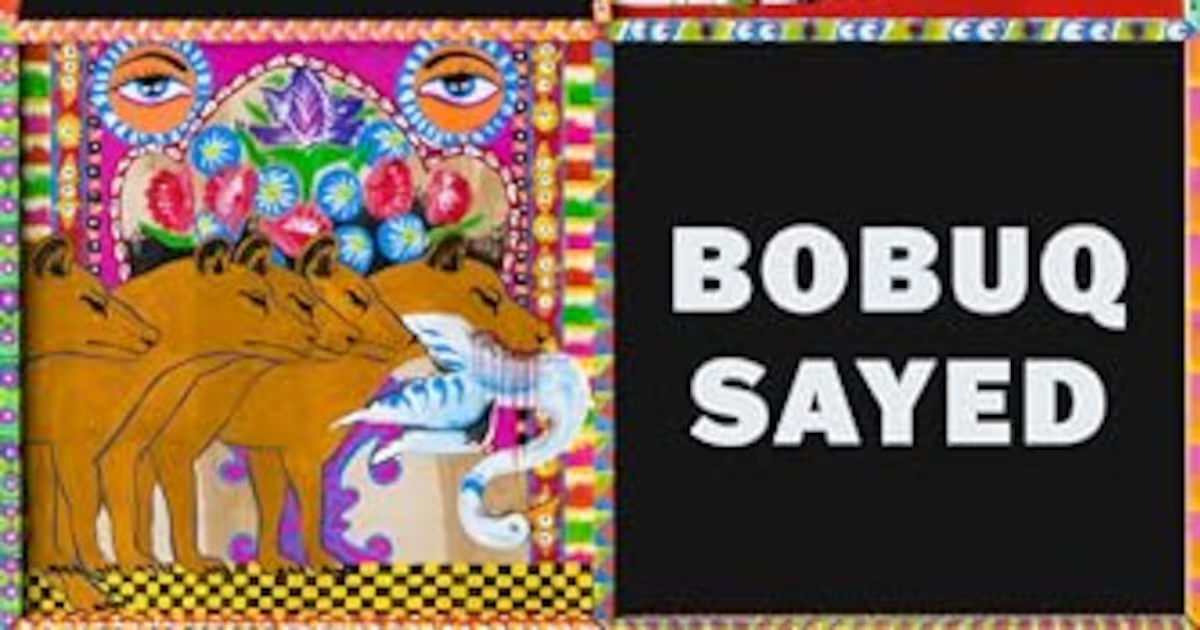
Homebound by Portia ElanPortia Elan is a former teacher and public librarian based in San Francisco. Homebound is her genre-bending debut novel that tells the stories of four women interconnected across centuries.The book opens in 1983 with Becks, a grieving teenager in suburban Cincinnati who inherits her uncle’s floppy disks that contain an unfinished computer game she tries to complete, unaware that her actions will echo across centuries.In 2078, Dr Tamar Portman creates the Ayes, sentient humanoids designed to heal damaged ecosystems. Her vision is planetary, but her investors’ ambitions are sinister. As Tamar writes emails she will never send, the Ayes listen and learn, and remember. Centuries later, Yesiko captains the salvage ship Babylon through the wreckage of a drowned world. Her crewmate and keeper of stories Root is kept alive by nana-medicine, but the treatment is starting to fail. Lt California Solo is the lone pilot inside a text-based computer game sent into deep space to save stranded starships.The novel uses science fiction to ask human questions. What do we inherit from other people? How do stories travel beyond the person who made them? What does connection mean when technology, climate damage and time keep shifting the ground?The Guardian writes, “In their own ways, all Elan’s characters are seeking a salve for loneliness: ‘the possibility of another like us, somewhere in the vast darkness of the universe’. The author tends to oblige. The quiet promise of her novel is that your people are out there, even if they aren’t technically human.”No God but Us by Bobuq SayedBobuq Sayed is a writer and artist born in Perth to Afghan refugee parents. No God but Us is their debut novel.Delbar and Mansur are two gay Afghan men whose lives cross in Istanbul. Delbar is a chaotic 20-something who dreams of becoming a drag queen. After being outed in Washington, DC, he leaves the immigrant suburbs behind and seeks refuge with his aunt in Istanbul. There, he falls in with a community of dissidents, sex workers, activists, poets and others living on the margins.Mansur is more guarded. He has left his family and his first love behind in Iran and wants a quiet life until his refugee status is secure. He plans to keep his head down, work, send money home and stay loyal to Leif. Then Delbar arrives and the careful life Mansur has built starts to fracture.When riot police descend on the annual Pride march, Delbar and Mansur are pushed into each other’s lives with new urgency as Turkey becomes more authoritarian.Kirkus describes the novel as “a sprawling, tender debut about queer refugees finding each other across continents … Sayed weaves together geopolitics, queer history, Persian poetry, and the textures of daily life in exile, but those expecting Delbar and Mansur to ride off into the sunset together will be disappointed. The novel is too wise for such easy comforts … Their connection is real but provisional, like everything else in exile.”Saturn Returning by Kim NarbyKim Narby is a Seattle writer and former New York City Dyke March organiser. Saturn Returning is her first novel.This contemporary lesbian novel centres on Jordan, Trace and Silvia, whose friendship and desire become tangled over a decade as they keep moving in and out of one another’s lives. Told through shifting viewpoints and timelines, it looks at chosen family as well as the baggage people carry into their closest relationships.Narby is interested in the people we return to against our better judgment and how intimacy can outlast common sense and the best advice from everyone around us.Autostraddle calls it a “very lesbian novel”, which is probably the cleanest shorthand for its appeal. Author Casey Tanner describes it as “a mirror for any woman who has ever loved another woman”.Pretend You’re Dead and I Carry You by Julián Delgado LoperaJulián Delgado Lopera is a Colombian writer and the author of Fiebre Tropical, which won the Ferro-Grumley Award. Pretend You’re Dead and I Carry You is their second novel.Set in 1990s Bogotá, the novel deals with grief, family silence and the city’s underground gay and travesti world (travesti refers to individuals assigned male at birth in Latin America who adopt a feminine gender expression).At its centre is Valentina, a teenage girl mourning her mother. Her father, Ignacio, has sunk into depression and is being pulled back towards a hidden past. Then Tía Mama, a travesti matriarch linked to Bogotá’s nightlife, opens the door to a history the family has tried to keep buried.Website Them writes: “The novel is about what happens when someone rejects their queer destiny — and more importantly, what happens to descendants who are left to grapple with intergenerational suppression. Rather than focusing on individual queer hardships, though, Lopera makes it clear that their characters … are linked together by a unifying force larger than any singular experience.”Pure Men by Mohamed Mbougar Sarr, translated by Lara VergnaudMohamed Mbougar Sarr is a Senegalese novelist from Dakar. He won the 2021 Prix Goncourt for The Most Secret Memory of Men, becoming the first Sub-Saharan African writer to win the prize.Pure Men opens with Ndéné, a French literature teacher in Dakar, watching a viral video of a crowd digging up a man’s corpse and dragging it from a cemetery. The dead man has been labelled “góor-jigéen”, a term used against homosexual men and others who fall outside accepted masculine norms. Ndéné begins looking into the man’s life and is drawn into a side of Dakar kept far from the rigid respectability of his family and university. The deeper he goes, the more exposed he becomes.The novel deals with homophobia, public cruelty and the social appetite for punishment. Its force lies in how quickly public morality turns one man’s private life into a cruel spectacle.Booklist writes “Sarr’s tale presents a blistering critique of homophobia in contemporary Senegal…. Sarr’s prose is philosophical, sardonic, witty but most of all, exquisite … Sarr’s characters exude vitality…. A heart-wrenching examination of what it means to be an authentic man in patriarchal modern Africa.”
Five novels for Pride Month
Homebound; No God but Us; Saturn Returning; Pretend You’re Dead; Pure Men
1,003 words~5 min read