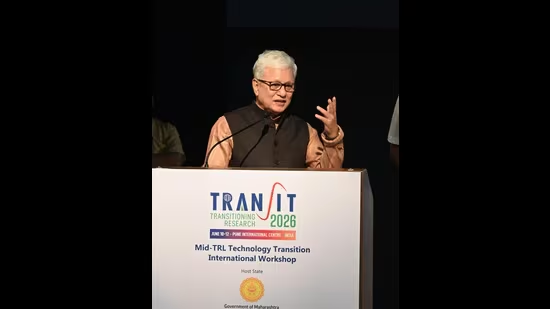
Maharashtra Governor Jishnu Dev Varma on Wednesday said valuable research must move beyond laboratories and academic journals to reach industry, government and society as practical, scalable solutions. He was speaking at the inauguration of TRANSIT 2026, an international innovation acceleration platform at the Pune International Centre.The Governor said initiatives such as TRANSIT 2026 would advance Maharashtra’s ambition of becoming a global hub for advanced manufacturing, aerospace, defence and clean-energy technologies. (HT)Anchored by COEP Technological University and CANEUS International, with the Government of Maharashtra as host state, the three-day workshop focuses on bridging the “Mid-TRL” (Technology Readiness Level) gap that often prevents innovations from reaching the market.The Governor launched the Mid-TRL Innovation Acceleration Handbook, a roadmap for moving technologies from laboratory validation to large-scale deployment.Addressing researchers, industry leaders and policymakers, Varma described COEP Technological University as “not merely an educational institution but a national asset and a symbol of India’s scientific and technological aspirations.”“Valuable research often remains confined to laboratories, academic journals and conference proceedings. It does not always reach industries, government agencies or society in the form of scalable and practical solutions,” the Governor said.He called for stronger collaboration among universities, industries, startups, investors and government institutions to help innovations reach the market.Highlighting India’s startup ecosystem, he noted that the country has more than 1.3 lakh registered startups and thousands of research projects underway, but only a small fraction achieve commercial success.“It is time to think about what we can do for innovation, not merely what innovation can do for us,” he said.The Governor said initiatives such as TRANSIT 2026 would advance Maharashtra’s ambition of becoming a global hub for advanced manufacturing, aerospace, defence and clean-energy technologies.“Our engineers, scientists and entrepreneurs are our greatest strength. Such initiatives convert human capital into economic capital, attract investment, foster startups and generate high-quality employment opportunities,” he said.Linking the event to Atmanirbhar Bharat and Make in India, he said India remains dependent on imports in sectors such as aerospace, defence, semiconductors and advanced materials.Eminent scientist Raghunath Mashelkar linked the workshop’s objectives to his “More from Less for More” philosophy, stressing affordable, scalable and inclusive innovation.Milind Pimprikar, chairman of CANEUS International, outlined plans for a dual-campus Innovation Acceleration and Skilling Institute in Maharashtra, with Navi Mumbai serving as a coordination and industry hub and Khalapur housing laboratories, testing facilities and project-execution infrastructure.Technical sessions on the opening day focused on aerospace and defence, energy, advanced materials, sensors and devices, reliability engineering and cost efficiency.
Research should move beyond academic journals: Guv Varma
Maharashtra Governor Jishnu Dev Varma on Wednesday said valuable research must move beyond laboratories and academic journals to reach industry, government and society as practical, scalable solutions
408 words~2 min read