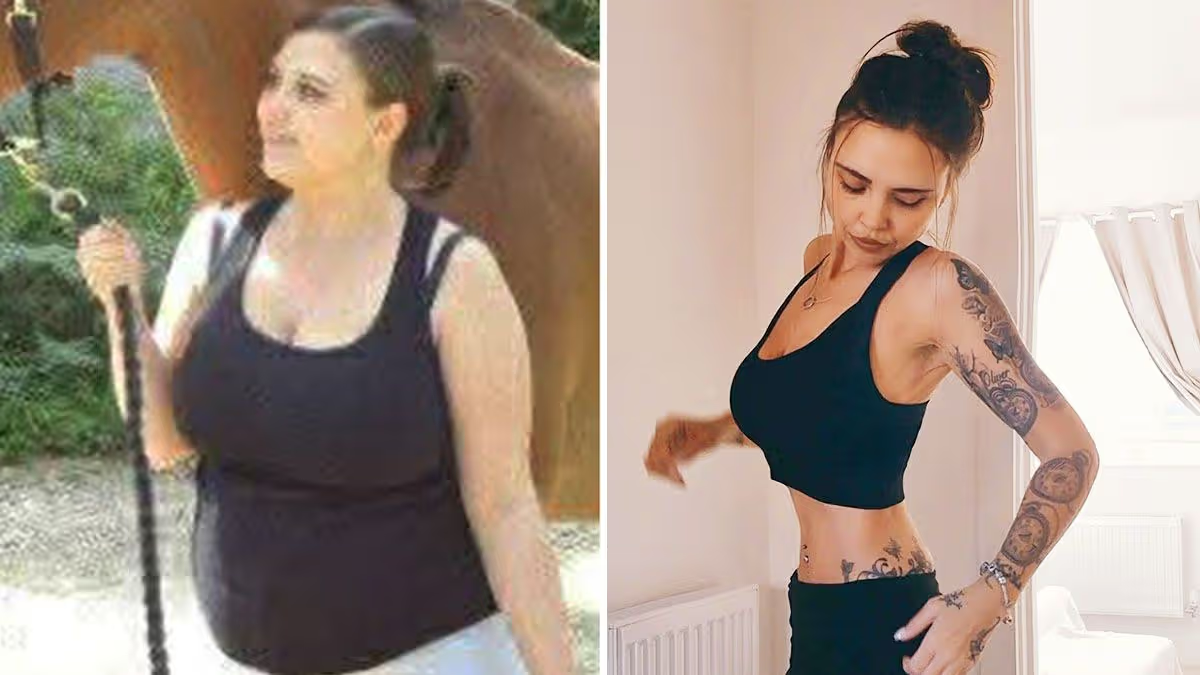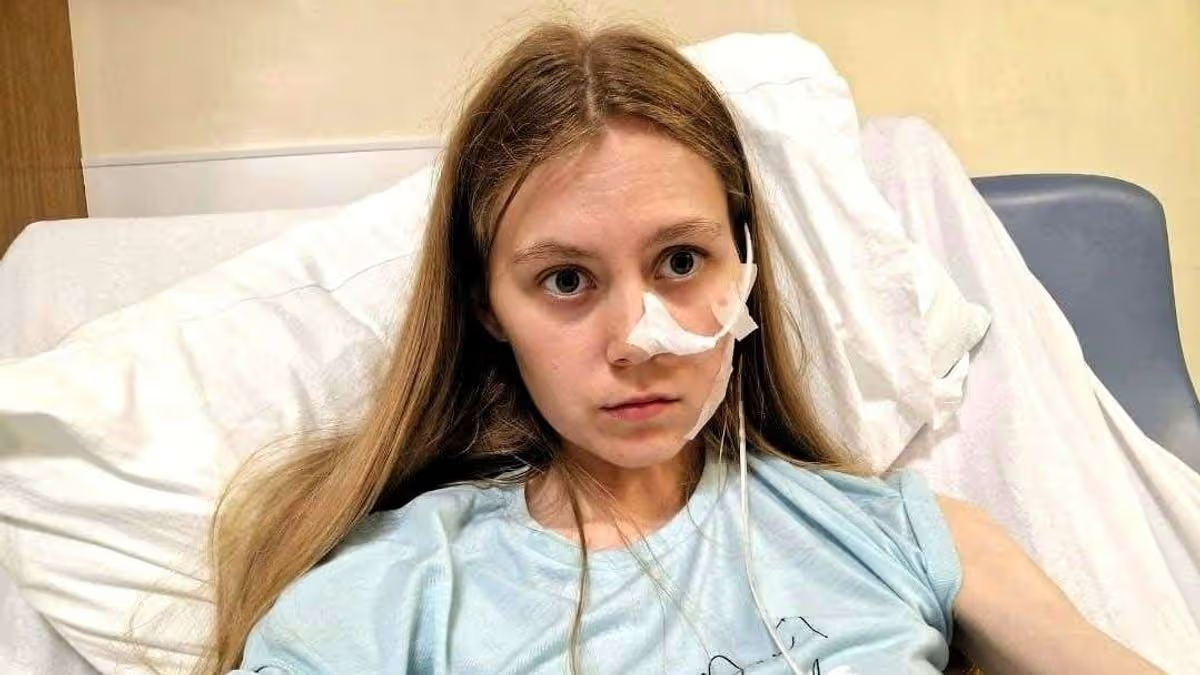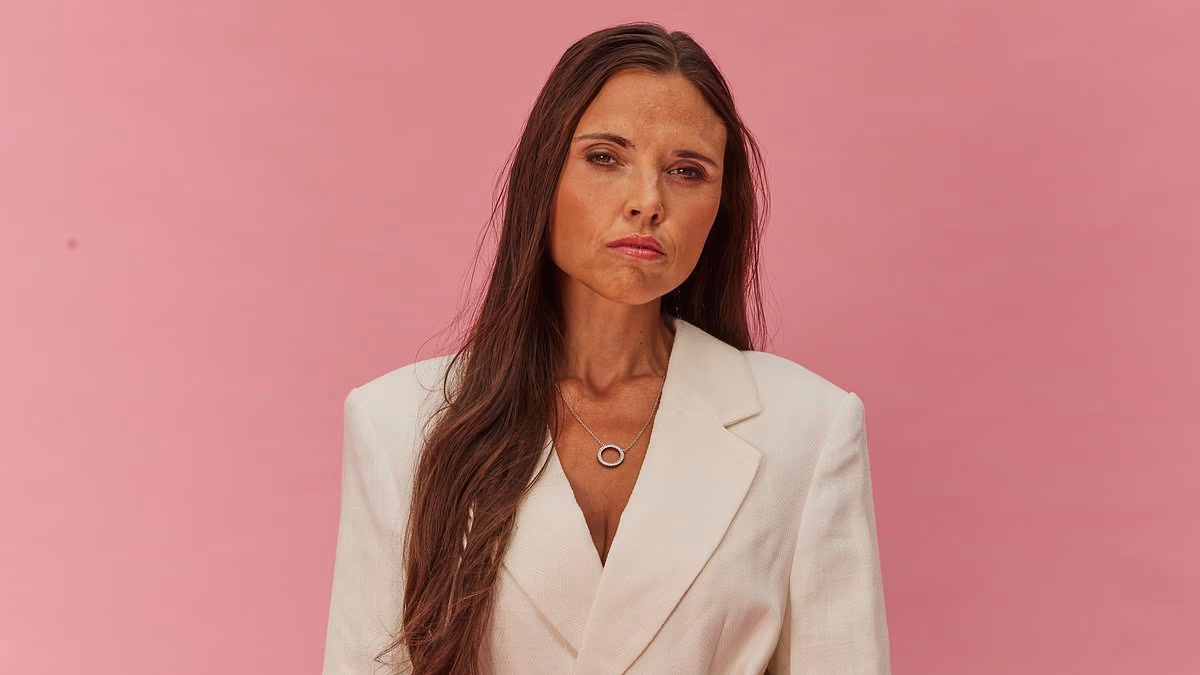
The psychiatrist standing beside Hayleigh Davis’s hospital bed did not sugarcoat her words.‘You have anorexia nervosa and if you don’t start eating, we will have to section you. Otherwise you will die,’ she told the mother of four, who had been blue-lighted to hospital by ambulance, weighing 6st with dangerously low blood pressure and a rampant urinary tract infection (UTI).Just 14 months earlier, Hayleigh, 37, weighed more than 14st and was so worried about being clinically obese that, like 1.6 million others in the UK, she had begun using weight-loss jabs.In little over a year, she had swung from one extreme to the other, having lost 8st – more than half her bodyweight.Hayleigh’s story serves as a stark warning about how easy access to these powerful medications is being abused. Not to mention the pernicious influence of diet-drug culture on those desperate to slim down ever further. ‘The jabs transformed my life, shut off the food noise and made it so easy to lose excess weight I’d been carrying around for ten years mostly due to multiple pregnancies,’ says Hayleigh. ‘For so long I’d been disgusted with my size 18 frame and could hardly bear to look in the mirror.‘But even as a size 4 I didn’t feel skinny, so hearing the doctor’s words were very upsetting and frustrating. I kept trying to tell the staff I didn’t have anorexia, I was just addicted to the jabs.‘They said I had developed an eating disorder while using them, and, if I didn’t get it under control, I risked social services getting involved, and losing my kids.’ Hayleigh Davis now weighs 6st 4lb and has a body mass index (BMI) of 17.2 at 5ft tallEven now, Hayleigh remains in denial about her disordered eating – despite the warnings of family, friends and health experts.She does, however, admit that months after starting the jabs, her shrinking figure started to feel ‘addictive’. She began doubling up on injections and going several days without eating at all. Now banned from using the jabs, but with a body mass index (BMI) of 17.2 at 5ft tall, she is clinically underweight. Yet when she studies her reflection, she still sees ‘chubby thighs, a flabby belly and chunky arms’, an image that bears no resemblance to the reality of her skeletal 6st 4lb frame.‘I’m sharing my story because I want to raise awareness,’ she says. ‘The jabs are great for many people, but they’re far too easily available, without medical guidance. If there had been any sort of check-ups along the way, I’d never have been able to stay on them as long as I did.‘My body is so weakened it’s unable to carry more children, which is not a problem for me but would be a tragedy for a younger, childless woman. My gallbladder and kidney are damaged and my hair is falling out in clumps. All because I abused the jabs.’Even the start of Hayleigh’s story is deeply concerning. In an initial application for a Wegovy prescription, she admitted to having experienced bulimia as a child – and was rejected and told to consult her GP.But Hayleigh, a single mum and mortuary technician from Tidworth, Wiltshire, merely reapplied to the same outlet, omitting this detail – and the prescription was duly filled in November 2024.Over the next three months, she lost almost 2st before plateauing at 12st 6lb, sharing her frustrations with her 300,000 TikTok followers.Then in the next highly dubious twist to this salutary tale, Hayleigh was approached by a weight-loss company last year offering a sponsorship deal – she would be given free Mounjaro for posting promotional content and sharing discount codes.Suppliers often sponsor influencers sharing their weight-loss journey in return for them promoting the company’s online consultation and prescribing services. This is one way of getting around strict UK rules about not advertising prescription-only medication directly to consumers.And, had Hayleigh stuck to using just the pens they supplied and stopped taking it once she’d achieved a healthy BMI, this may have turned out to be a happy partnership. Hayleigh, 37, weighed more than 14st before she started to use weight loss jabsHowever, the outcome was very different. Hayleigh started off on the lowest dose, 2.5mg, and worked her way up to 10mg – the highest is 15mg – over the next four months.‘I loved that the weight was just falling off me, at a rate of about a stone a month,’ says Hayleigh. ‘After a couple of months, however, I started to worry that I might plateau again and decided the solution was to jab twice a week, instead of once.’This goes against guidelines from the makers Eli Lilly and the NHS, which strongly advise against injecting more than once a week. More frequent use causes the medicine to build up in the body, drastically increasing the risk of severe side-effects.Hayleigh’s recklessness was a clear sign of her growing addiction to the effects of the drug.‘The online delivery sites request photographs of you standing on scales, to prove your weight and, knowing I was by then too light to qualify, I asked friends who were heavier and lived far away to send pictures of themselves and order jabs for me.’Doubling up on injections, using up to 17.5mg of Mounjaro a week, Hayleigh lost her appetite entirely. Much of the time she lived on ice cubes. ‘The food noise was totally gone and my weight kept falling,’ she says.Come July, Hayleigh was down to 8st 6lb and a size 10, while claiming to be 11st when requesting new prescriptions.Hayleigh recalls, ‘They got in touch after seeing one of my TikTok videos and said, “The weight you’re telling us you are does not match with what we’re seeing online, so, without a letter from your GP confirming your BMI we can’t issue any more pens.”’Hayleigh roped in a long-distance friend to order Mounjaro, so she could continue doubling up on her fix. By then, she was paying upwards of £240 a month.‘I first realised I’d developed a fear of food when a friend persuaded me to have cheesy chips followed by sticky toffee pudding,’ says Hayleigh.‘After the meal, all I could think was, “I’ve worked so hard to get to this size and now I’ve ruined everything”. Within 45 minutes I’d made myself sick.’Upset at seeing her wasting away, her family and friends begged Hayleigh to eat, pleas she ignored. ‘I can cook for my children – lasagne, cottage pie, pot roasts – but no longer sit at the table with them because even the thought of having to eat that food makes me sick,’ says Hayleigh. ‘It’s sad, but it’s just the way our lives are now.’Hayleigh says, ‘We’re [the doctors and I] at loggerheads because they want me to reach a minimum of 7.5st and that’s not happening'Hayleigh is mum to three daughters, aged 13, eight and three, and a son aged 12, from previous relationships. It was her eldest daughter who first raised the alarm: Out horse riding together in January, she noticed her mother’s hip bones protruding on the saddle. Tearfully, she later asked her dad if her mum was ill.‘He called me and said, “I’ve just had to reassure our daughter that you’re not dying. Please tell me you’re getting help?”’ recalls Hayleigh. ‘So I spoke to her about it and she got upset, saying, “I don’t want to stand next to your coffin, Mummy.” I told her, “You won’t, baby, I promise.”’Having spoken with a striking lack of emotion about her illness until this point, Hayleigh breaks down in tears. ‘She made me a sandwich and I tried to take a bite,’ says Hayleigh, wiping her eyes. ‘I told her I wasn’t hungry and she sobbed, pleading with me to eat it. But I just couldn’t.’Her eldest daughter’s dad contacted Luke, the father of her youngest child, who she’d separated from two years ago. ‘When he saw how unwell I looked, he said, “I’m done, you’re literally killing yourself. I’m calling an ambulance”,’ says Hayleigh. ‘The paramedics took my temperature, which was very high, and my blood pressure and blood sugar, which were low, and said, “You’re very unwell, we’re taking you in.”‘Once I was there, they insisted I had an eating disorder. I said I was unwell because of the UTI, but they said my body was weak because of lack of nutrition, which was the root cause of all my other physical problems.’Hayleigh was given intravenous antibiotics for the UTI, and told her the reasons for her recurrent urinary infections were the impact of dehydration and malnourishment on her immune system.She was kept in for three nights and given an iron infusion and vitamin B12 injections.‘The prospect of being sectioned was terrifying – my kids are my life and I can’t bear the thought of being separated from them – but the biggest emotion I felt was anger because I’d never asked for medical help,’ she says. Even with warnings that anorexia has the highest mortality rate of any psychiatric disorder, Hayleigh continued injecting herself with MounjaroAn appointment was made at an eating disorders clinic for the day after Hayleigh’s release from hospital where a psychiatrist explained that anorexia was ‘completely ruling’ her life.‘I said, “Look, I’ve abused the jabs, I accept that and take full accountability. But I don’t have an eating disorder, it’s just that the jabs mean I’m not hungry,”’ recalls Hayleigh. ‘Then the doctor asked whether, if she put a digestive biscuit in front of me, I’d eat it. I said I would but she called my bluff. I just couldn’t put the biscuit in my mouth.’Hayleigh was told she must co-operate with blood tests and weigh-ins, follow the clinic’s eating plan and attend regular therapy sessions.However, even with warnings that anorexia has the highest mortality rate of any psychiatric disorder, Hayleigh continued injecting herself with Mounjaro.‘When my blood test showed I had Mounjaro in my system the doctor told me if I do it again I will be sectioned,’ she says. Until recently, Hayleigh would also, on the rare occasions she ate anything of substance, resort to purging but says she has stopped that now.She has been diagnosed with an inflamed gallbladder, a painful complaint that is linked to the medication slowing down digestion. She has been warned it may need to be removed. A scan also showed damage to her left kidney – likely the result of rapid weight loss and dehydration.She says: ‘I did everything I could to get my hands on the injections to improve my health and now doctors are telling me I’m in for lifelong complications because of losing so much weight on them.’Hayleigh’s daily diet now consists of half a tin of tuna, a Petit Filous yoghurt and a handful of sesame seeds.Hayleigh has put on 4lb since January and now, at 6st 4lb, finds herself in another battle with doctors. ‘We’re at loggerheads because they want me to reach a minimum of 7.5st and that’s not happening. I’m only short so any gain really shows.‘They’re confident, in time, that I’ll see things differently.’As well as talking therapy to support her with increasing her food intake, Hayleigh is having dialectical behavioural therapy, learning skills including self-soothing, sensory distraction and mindfulness, to help her tolerate distress and regulate emotions which lead her to restrict and purge.‘I realise it’s my own fault for continuing to use weight-loss jabs and not listening to my own body’s warning signs,’ says Hayleigh, who still refuses to believe she has an eating disorder.‘I’ve been body-shamed more for my size now than when I was big. I’ve had some horrendous comments, on TikTok. I’m “a walking poster-girl for anorexia” and I “look like Skeletor”. 'I think I’m in better shape than I’ve been for years. However, the doctors disagree and I know that if these jabs weren’t so readily available I would never have ended up being diagnosed with anorexia.’A spokesman at Eli Lilly said: ‘Patient safety is Lilly’s top priority, and we actively engage in monitoring, evaluating and reporting safety information for all our medicines.‘Lilly does not promote or encourage use of any Lilly medicine outside of its approved indication. Mounjaro should only be used when prescribed and supervised by a licensed healthcare professional, and prescriptions should be fulfilled and supplied by registered pharmacies or providers. 'We encourage patients to consult their doctor or other healthcare professional to discuss any possible side effects they may be experiencing.’If you’re worried about your own or someone else’s health you can contact Beat, the UK’s eating disorder charity, on 0808 801 0677 or at beateatingdisorders.org.uk
I became addicted to weight loss jabs and lost eight stone
The psychiatrist standing beside Hayleigh Davis's hospital bed did not sugarcoat her words: 'You have anorexia nervosa and if you don't start eating, we will have to section you.'
2,100 words~10 min read