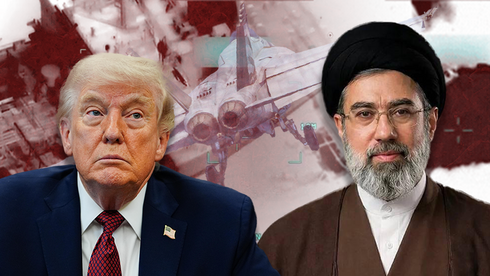
Officials believe Tehran unlikely to fire missiles at Israel in response to another US strike, but say military ready as Trump raises pressure on Iran Related TopicsIsraeli security officials said Jerusalem is on alert and preparing for a possible resumption of fighting if Iran fires missiles at Israel in response to a U.S. strike. But officials currently assess that Iran will avoid targeting Israel so as not to give it justification to attack Iran.3 View gallery US President Donald Trump, Iranian Supreme Leader Mojtaba Khamenei (Photo: AP Photo/Julia Demaree Nikhinson, CENTCOM, US Navy/Handout via REUTERS)The threats from Tehran also intensified Wednesday. Ebrahim Azizi, chairman of the Iranian parliament’s National Security Committee, wrote on X: “We are not afraid of fighting losers. The number of American casualties is much higher than Trump admits, and it will only rise. This time, the war will not be limited to the region.” He ended the post with the phrase, “We’ll see what happens,” a phrase often used by Trump when discussing Iran.An Israeli security official said Trump was “raising the bar” and would likely return to fighting soon unless an agreement is signed. “For now, he is increasing pressure on the Iranians, thinking this will make Mojtaba Khamenei give a positive answer to his proposal,” the official said. “But as it looks now, the Iranians are playing for time, and Trump is losing patience and is frustrated. In any case, we are prepared for renewed fighting.”Although Israel assesses that Iran is unlikely to fire missiles at it, officials are preparing for that possibility, especially because Trump is unpredictable and could order a broad strike.3 View gallery Strait of Hormuz (Photo: REUTERS/Stringer)Israel believes Iran will not sign an agreement with the Americans and will continue to mislead the Trump administration. Jerusalem’s preferred option is a resumption of fighting and the execution of strikes Trump previously halted in Iran. Trump himself has spoken about attacking bridges and power stations, though so far he has also restrained Israel regarding such targets.U.S. officials believe another strike could shock Iran into accepting a deal. Israel, however, believes the Iranians see weakness and think Trump does not want to return to fighting. Even if Tehran agrees to the wording of an agreement, Israeli officials believe it would be a temporary deal granting Iran another 60 days of ceasefire rather than ending the conflict.Details also continue to emerge about tense U.S.-Iran negotiations mediated by Pakistan.According to the French newspaper Le Figaro, one obstacle to an agreement is the way Iran is conducting negotiations, particularly the inability to communicate directly with Mojtaba Khamenei.The report said that when Pakistani army chief Asim Munir arrived in Iran for a two-day visit on May 22, he held a tense meeting with Revolutionary Guards commander Ahmad Vahidi. Before the visit, it had reportedly been agreed that Munir would meet with Mojtaba Khamenei to finalize details of an emerging agreement between Washington and Tehran.3 View gallery Pakistani army chief Asim Munir (Photo: Inter Services Public Relations via AP)But when Munir asked Vahidi when he could meet Khamenei, Vahidi replied that it was impossible because Khamenei was still suffering from injuries. According to Le Figaro, the conversation grew heated, and Munir reminded Vahidi that he had avoided being killed by the United States or Israel only because of Islamabad’s efforts.Regarding recent military incidents between the United States and Iran, including the downing of an Apache helicopter in the Strait of Hormuz, security analysts told The Wall Street Journal that they may indicate a shift in Iran’s defense doctrine. Under the change, the Revolutionary Guards are giving field commanders greater freedom to make operational decisions without approval from headquarters in Tehran.Analysts said Iran aims through the change to reestablish deterrence against the United States and Israel.The Wall Street Journal also reported that hard-liners inside Iran’s leadership are pushing for more aggressive responses, though they also hope to avoid being dragged back into a full-scale military confrontation.Hamidreza Azizi, a visiting fellow at the German Institute for International and Security Affairs, said the situation has become highly fragile. ““The pattern on the Iranian side has been to keep the escalation below a certain threshold,” he said, “and that threshold has been killing American soldiers and personnel during the ceasefire.”Comments
Israel watches US-Iran escalation, prepares for possible flare-up
Officials believe Tehran unlikely to fire missiles at Israel in response to another US strike, but say military ready as Trump raises pressure on Iran
708 words~3 min read